
Deliverables
8 pages of under A4 (204 x 291 mm) portrait, to include: cover (title "FILM MONTHLY") and the strapline "get to know (director's name", plus info on issue no, date, free issue. Worthing Connaught Cinema to be included. Rear cover, biography spread, contents page, film spread
Task 1
The Connaught Theatre ("the client") commissioned each student to produce a film magazine called Film Monthly with the purpose of featuring the famous work of one chosen film director - in my case, Wes Anderson.
Research
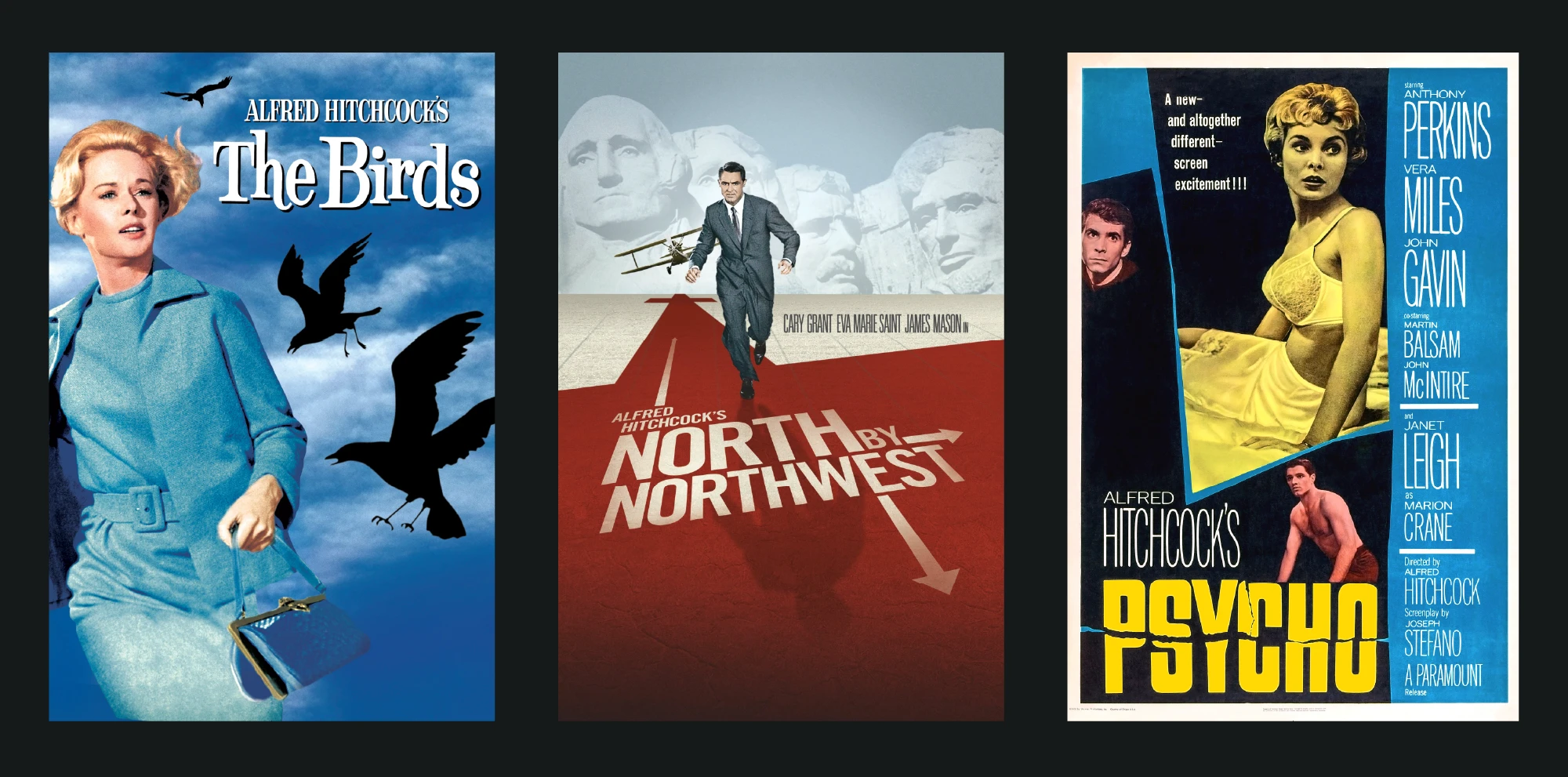
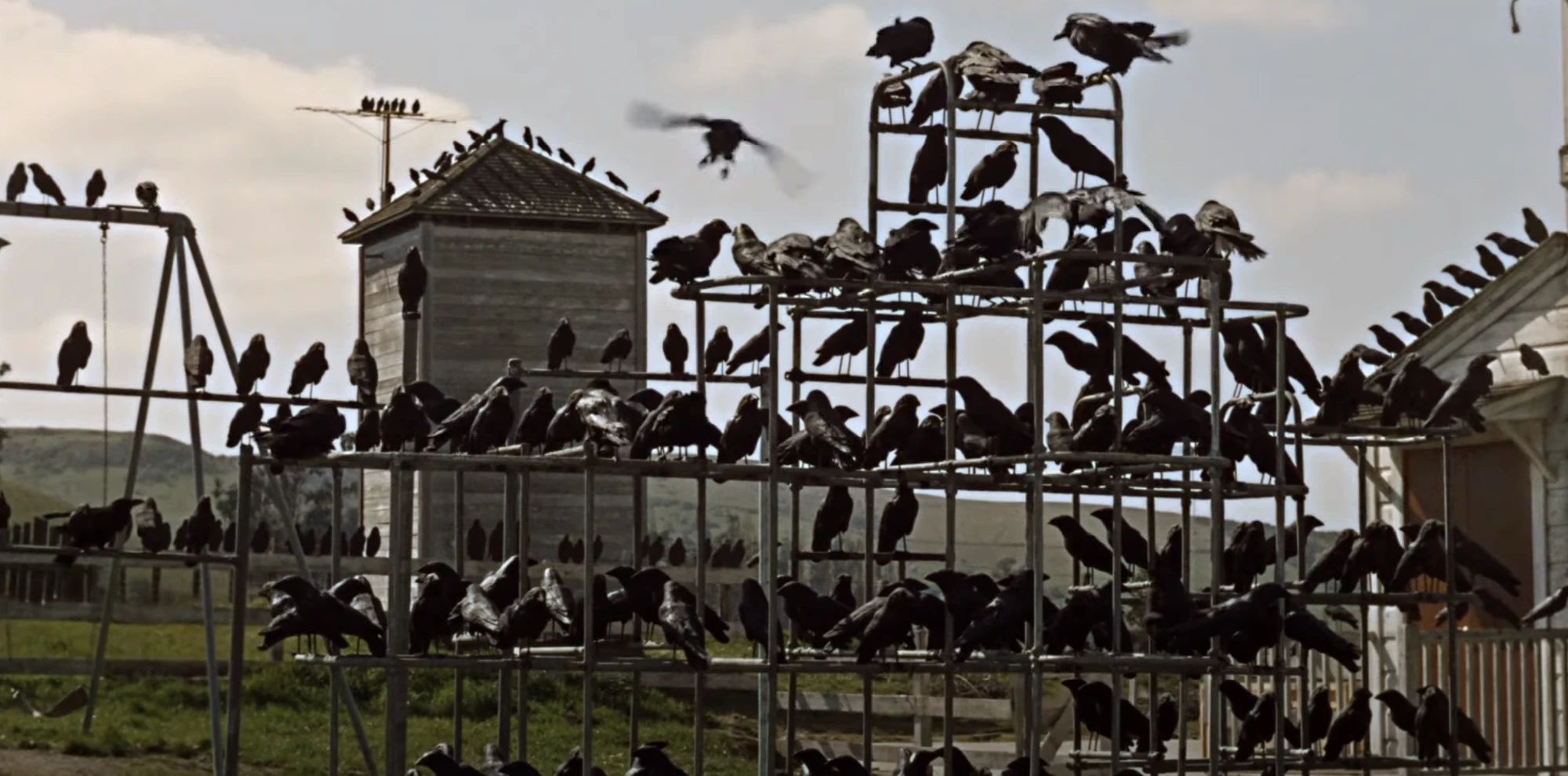
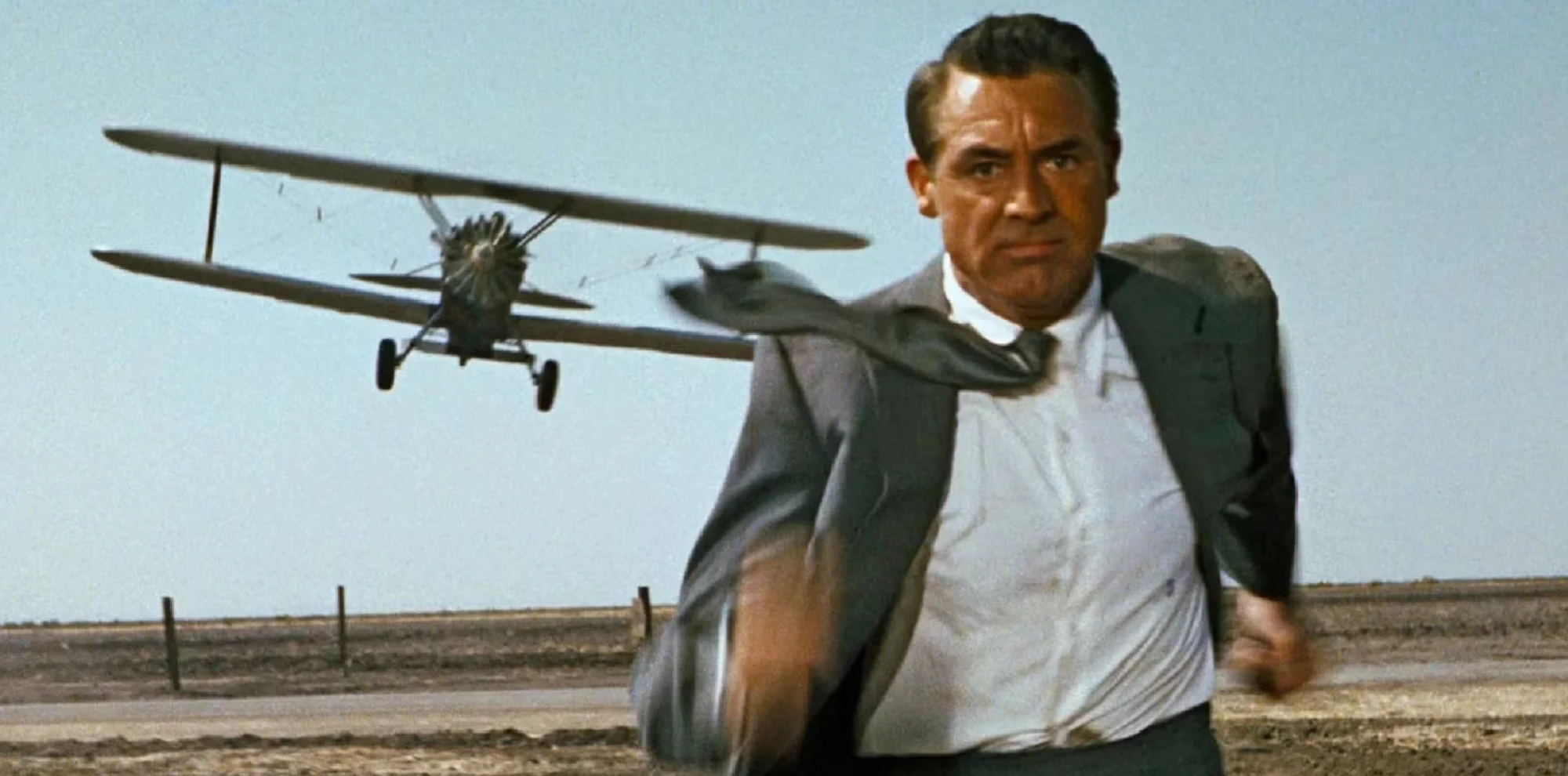
The first choice I had to make was which director should I choose. The list included Fredrico Fellini, Spike Lee, Wes Anderson, Stanley Kubrick, Kathryn Bigelow, Sofia Coppola, and Alfred Hitchcock.
Having only heard of one of these directors, I had to look into each of them to be able to make an informed decision.
Research
Federico Fellini
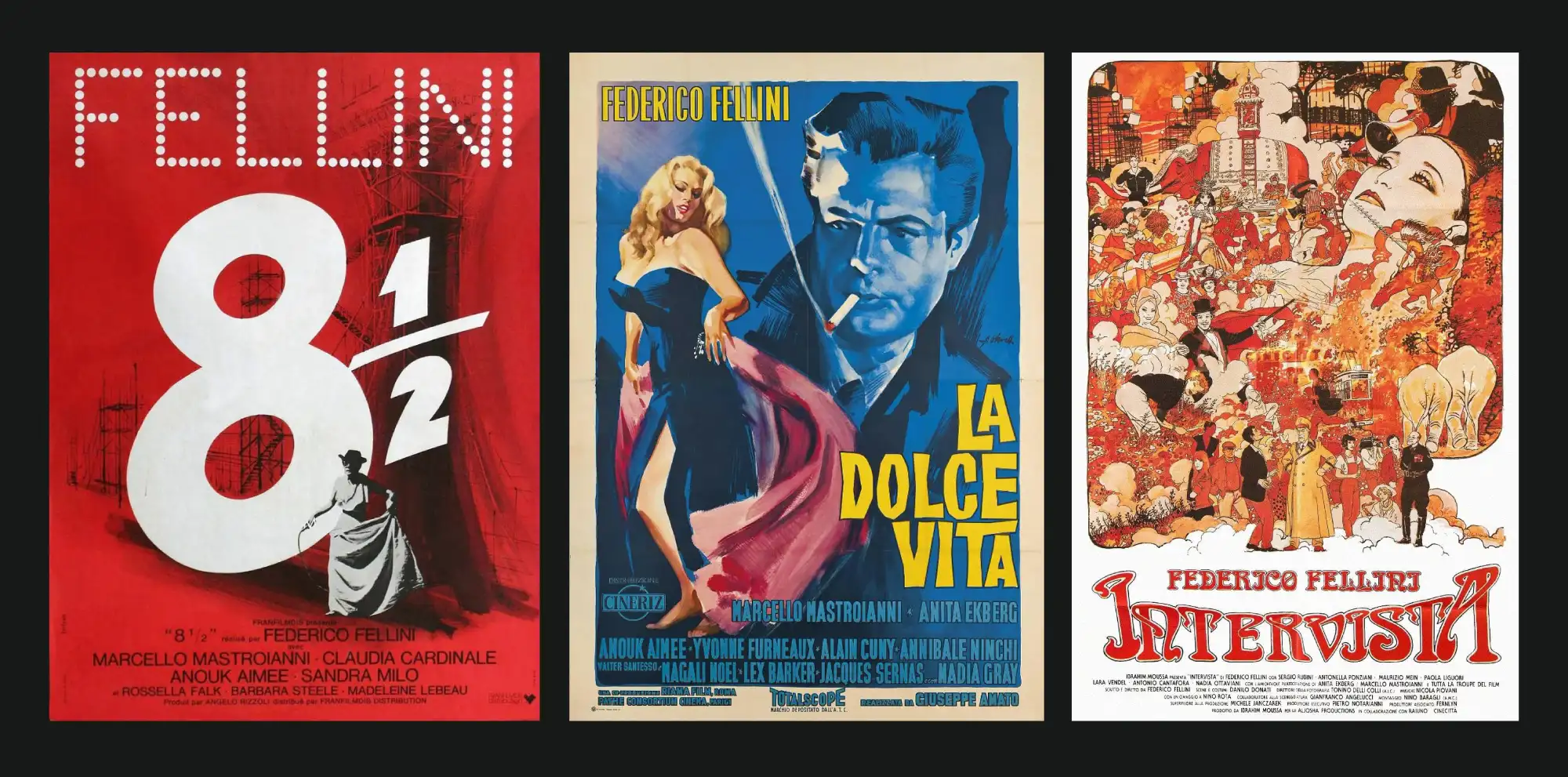
Federico Fellini (1920–1993) was an Italian director and screenwriter widely regarded as one of cinema’s most influential visionaries. Born in Rimini, he demonstrated early aptitude for drawing and storytelling before relocating to Rome, where he contributed to magazines and radio. Fellini began his film career in the 1940s through collaborations with Roberto Rossellini on neorealist classics such as Rome, Open City. He directed his first feature, Variety Lights (1950), followed by The White Sheik and I Vitelloni, which solidified his reputation.
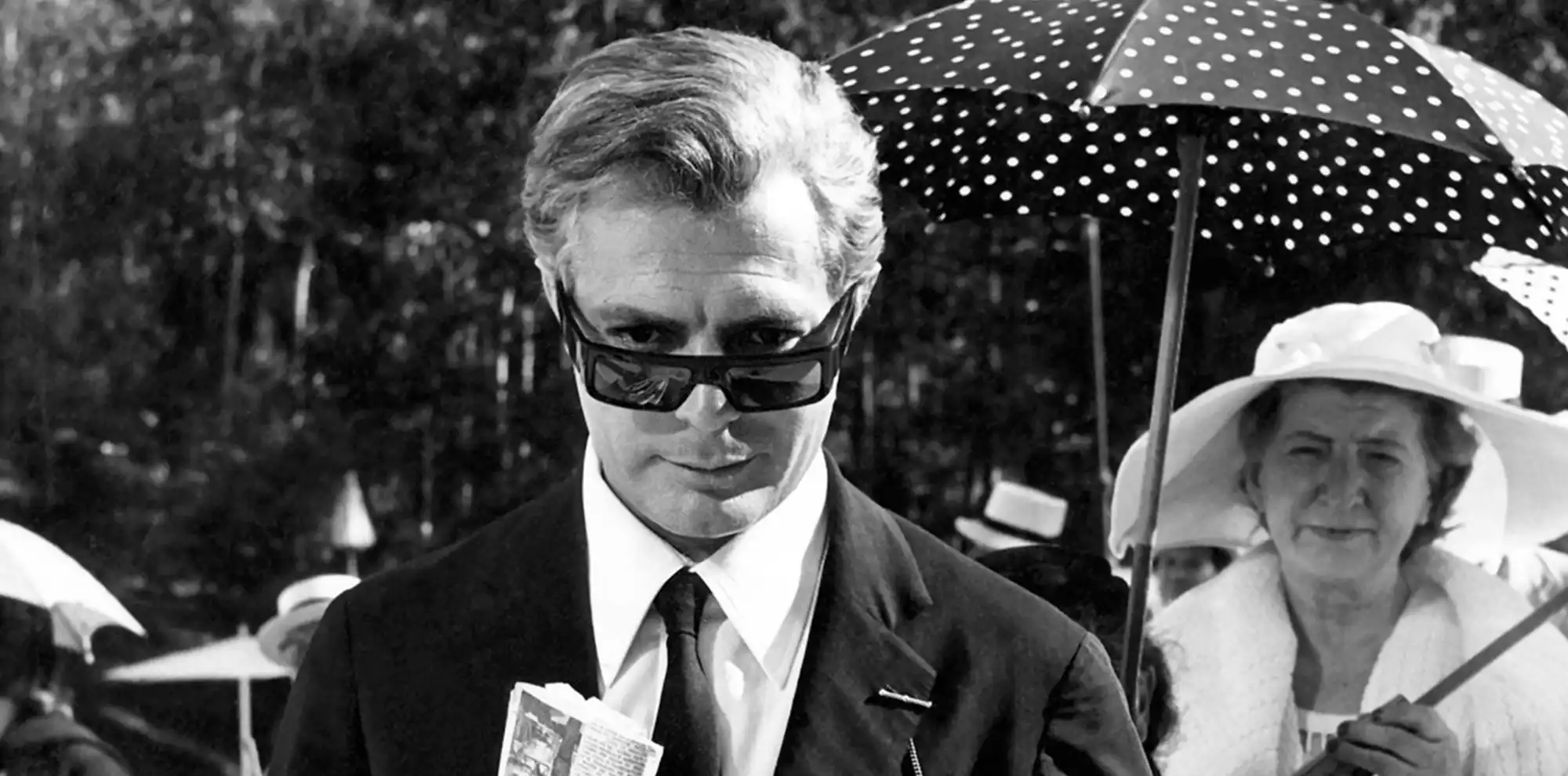
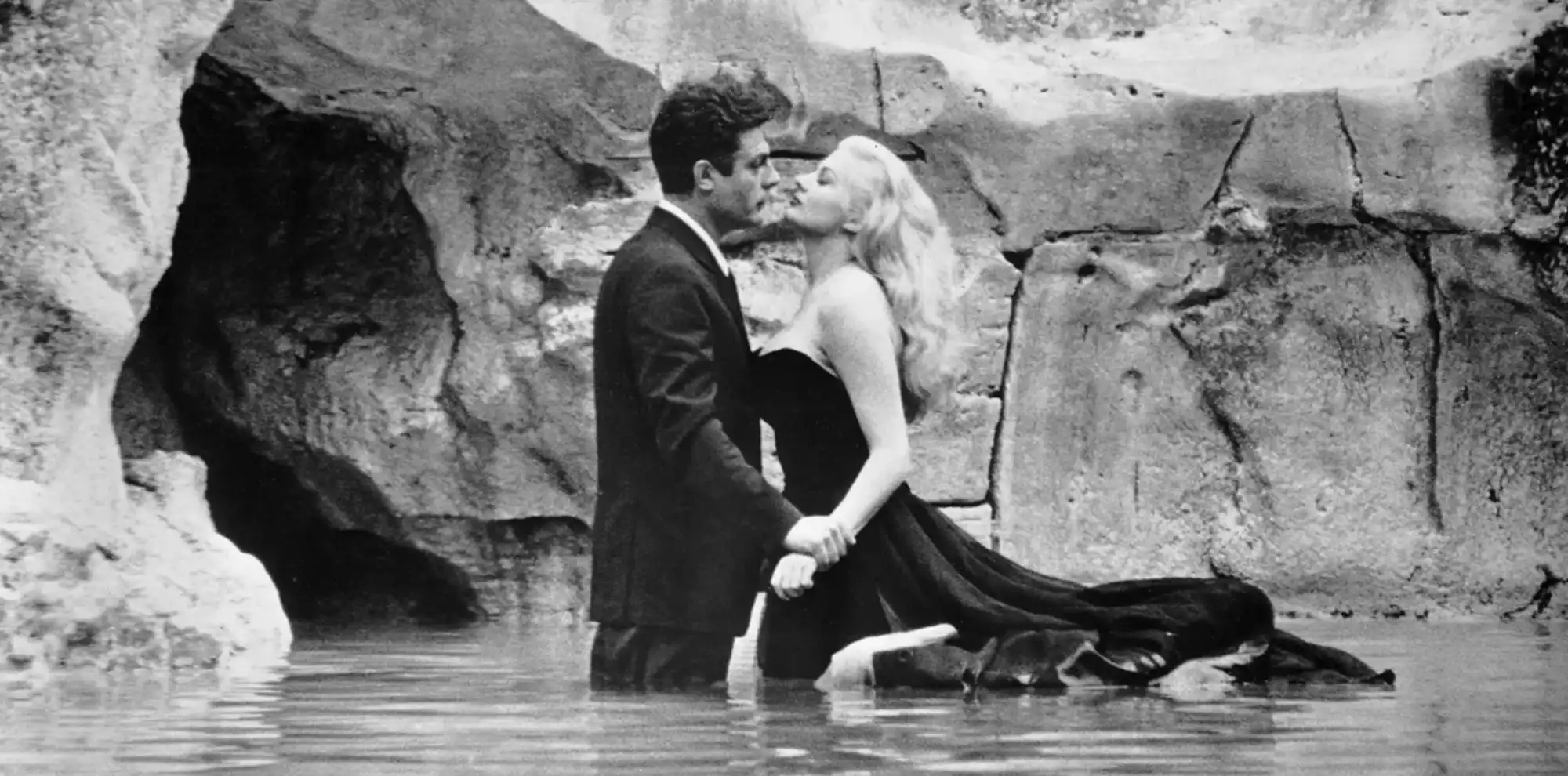
By the mid-1950s, Fellini moved beyond neorealism with films such as La Strada (1954) and Nights of Cabiria (1957), both starring his wife Giulietta Masina. His international breakthrough came with La Dolce Vita (1960), a satirical portrait of modern life that blended realism and spectacle. He reached a creative peak with 8½ (1963), a dreamlike exploration of artistic imagination. Later films—including Juliet of the Spirits (1965), Fellini Satyricon (1969), Roma (1972), and Amarcord (1973)—embraced surrealism, fantasy, and autobiography.
Fellini’s style, shaped by ideas from Jungian psychology, mixed dreams, symbols, and rich, detailed images, which led to the term “Felliniesque.” Though he grew up Catholic, he often criticized the Church, and in politics, he stayed independent and rejected strict control.
Over his career, Fellini won four Academy Awards for Best Foreign Language Film, the Palme d’Or for La Dolce Vita, and multiple lifetime honors. His later works, including Intervista (1987) and The Voice of the Moon (1990), continued his exploration of memory and fantasy. He remains a central figure in world cinema, admired for his unique blend of realism, imagination, and personal vision.
Research
Spike Lee
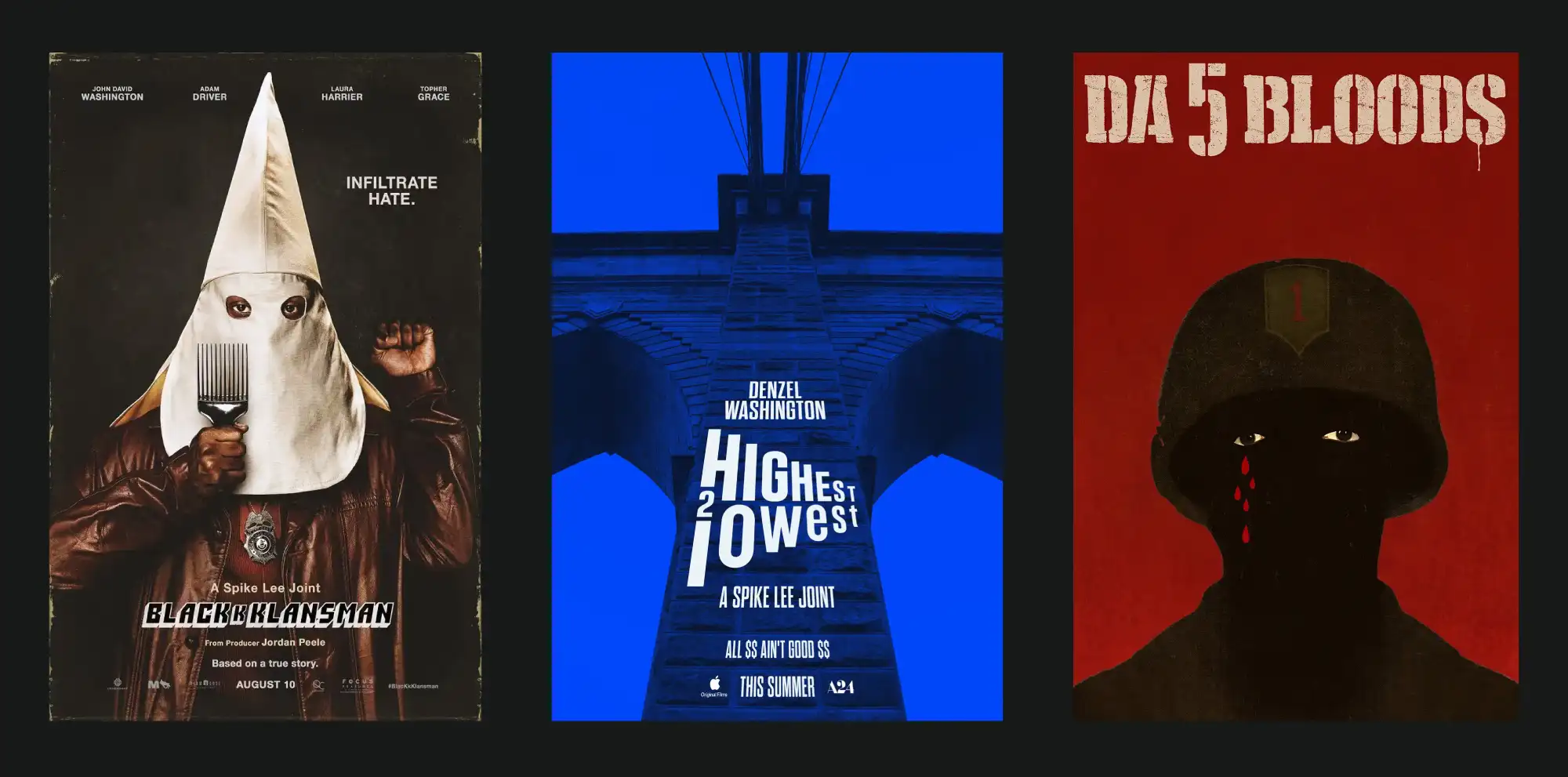
Spike Lee (born 1957) is an American filmmaker known for socially-conscious films that examine race relations, African-American community issues, media’s role, poverty, urban life, and politics.
He grew up in Atlanta, Georgia, and Brooklyn, New York. His mother was a teacher of arts and literature, his father a jazz musician. He studied mass communication at Morehouse College, then got an MFA in film and television from NYU’s Tisch School of the Arts.
Lee launched his career in the 1980s with student films and his first feature She’s Gotta Have It (1986). He gained critical acclaim with Do the Right Thing (1989), which addressed racial tension in Brooklyn. Notable films from the 1990s include Mo’ Better Blues, Jungle Fever, Malcolm X, Crooklyn, Clockers.
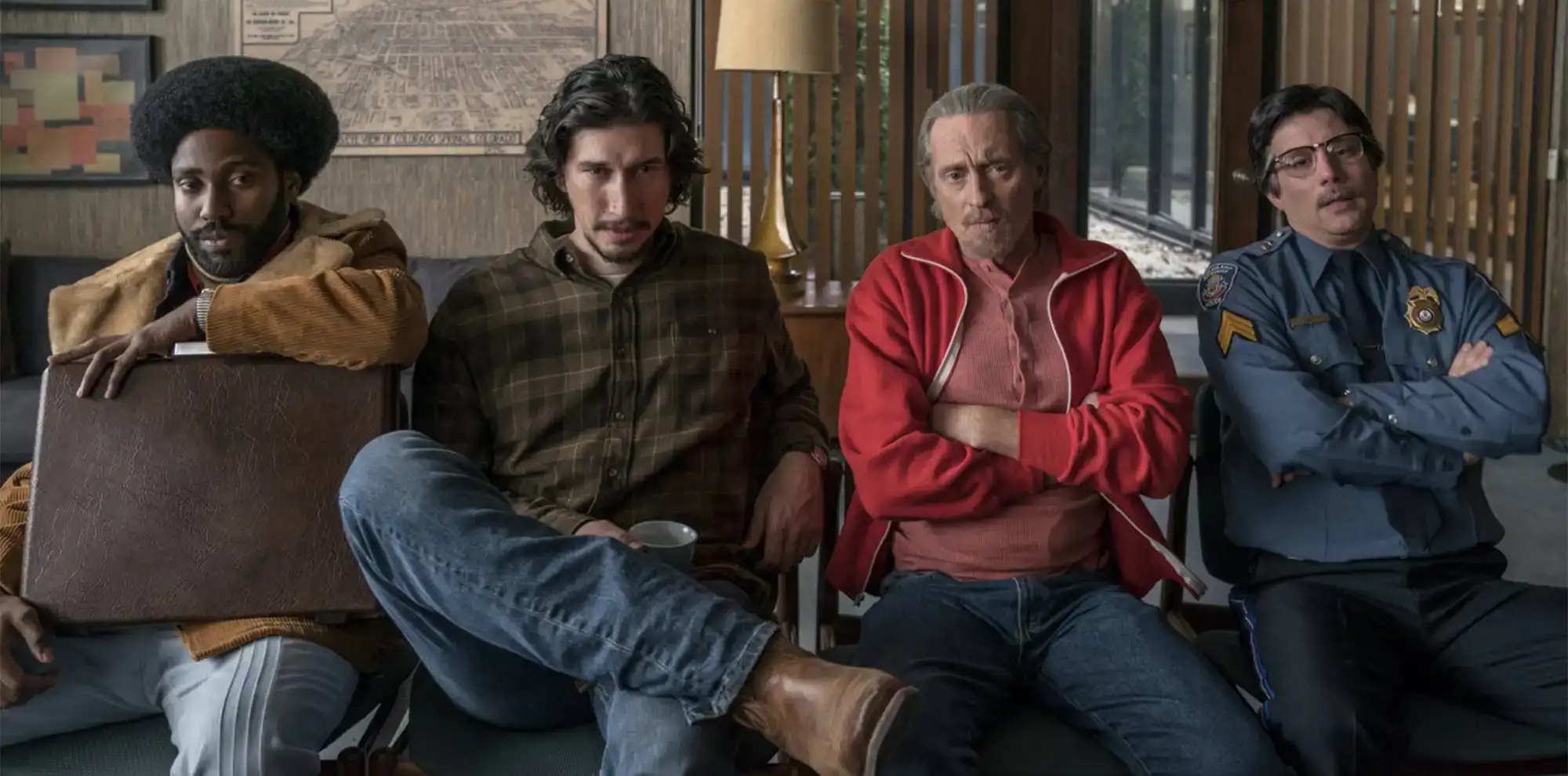
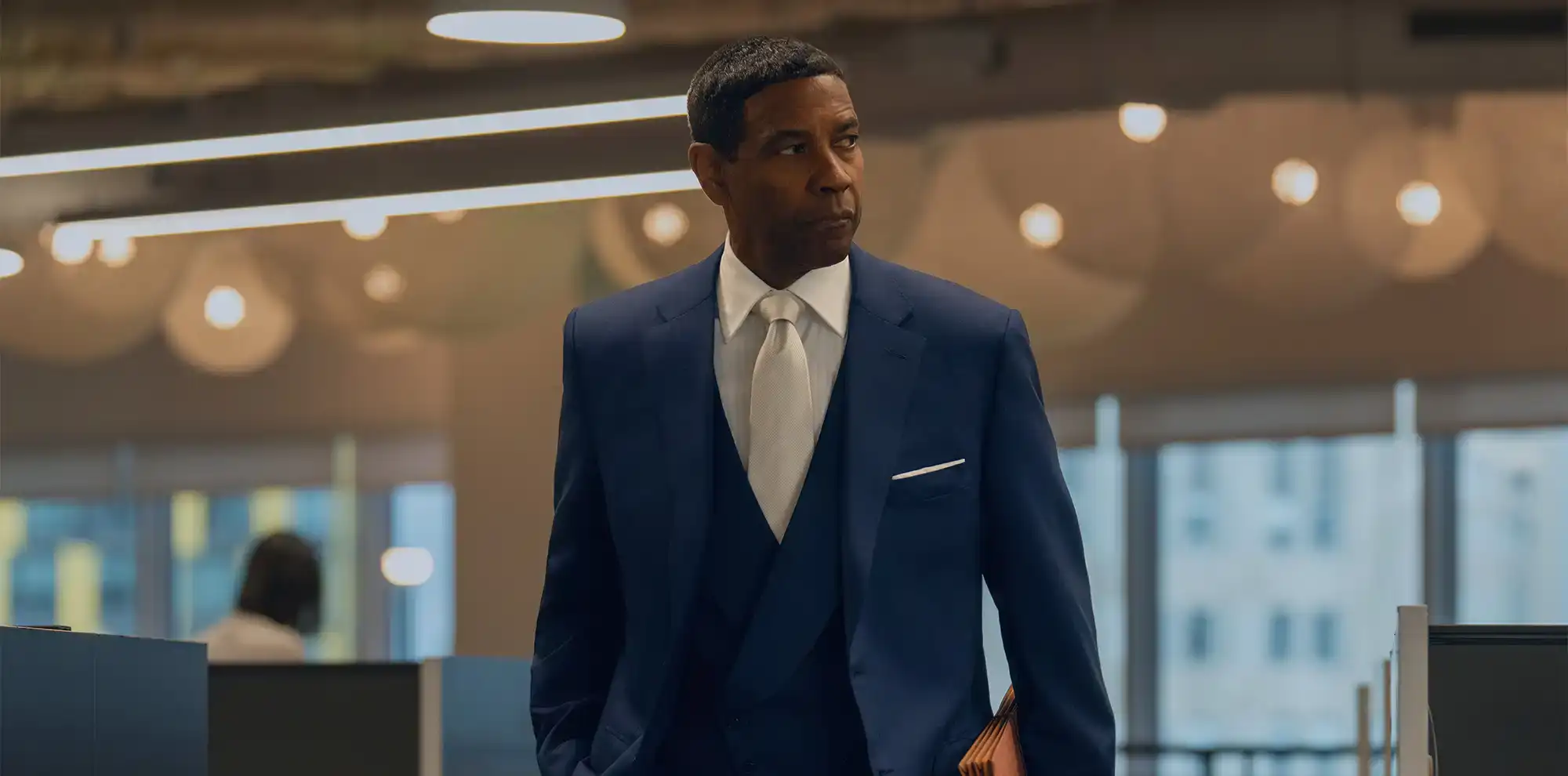
In the 2000s, his work included Bamboozled (2000), 25th Hour (2002), and Inside Man (2006), among others. After a quieter period, he saw renewed acclaim with films like Chi-Raq (2015), BlacKkKlansman (2018) — for which he won the Academy Award for Best Adapted Screenplay — and Da 5 Bloods (2020).
Stylistically, Lee is known for repeated visual motifs (such as dolly shots emphasising movement through space), for his sound and musical choices, and for films that combine political urgency with popular genres. Personal themes often include justice, identity, and the experience of black Americans.
He also teaches at NYU Tisch, runs his production company 40 Acres and a Mule Filmworks, and has received many awards and honors.
Research
Wes Anderson
Wesley Wales Anderson (born 1969) is an American filmmaker celebrated for his distinct visual and narrative style, often centered on themes of grief, family dysfunction, and loss of innocence.
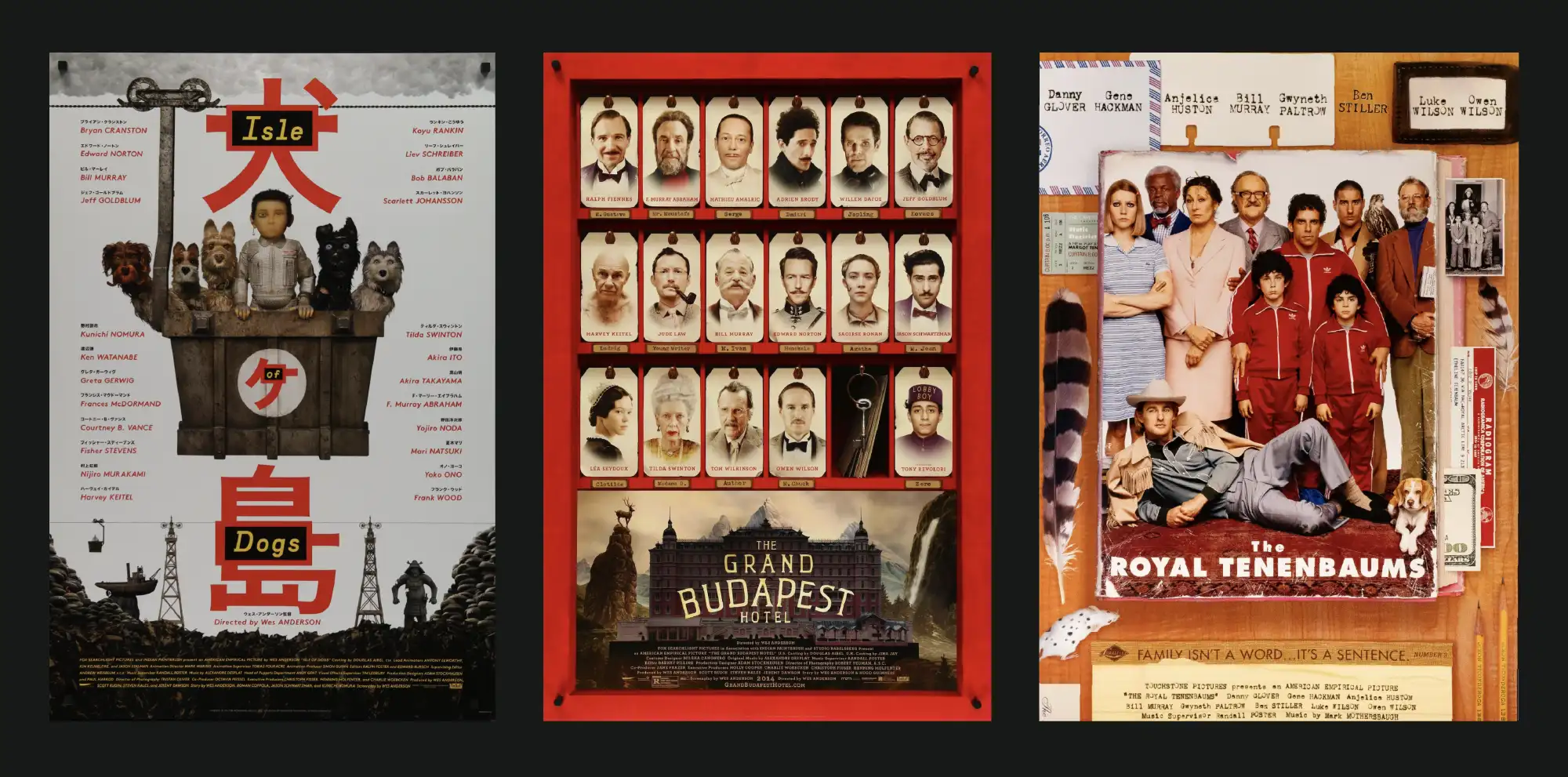
He began with Bottle Rocket (1996) and rose to wider recognition with Rushmore (1998), and later found further success with The Royal Tenenbaums (2001). His subsequent films include The Life Aquatic with Steve Zissou, The Darjeeling Limited, Fantastic Mr. Fox (his first stop-motion effort), Moonrise Kingdom, The Grand Budapest Hotel, Isle of Dogs, The French Dispatch, Asteroid City, and others.
Anderson’s films are known for symmetrical compositions, flat camera moves, snap zooms, limited colour palettes, handmade art direction, and the use of miniatures. He often relies on ensemble casts and recurring collaborators (such as Bill Murray, the Wilson brothers, Jason Schwartzman), with strong musical sensibilities and tightly curated soundtracks.
His work is often labeled “postmodern” for its nostalgic attention to detail, genre blending, and quirky, character-driven storytelling.
Research
Stanley Kubrick
Stanley Kubrick (1928-1999) was an American filmmaker and former photographer, celebrated as one of cinema’s most meticulous and influential auteurs.
Born in New York City, Kubrick began his career as a photographer before moving into short films and then features. His early features include The Killing (1956), which showcased his flair for precise visual storytelling, and Paths of Glory (1957), an acclaimed anti-war drama. After relocating to England in 1961, he made notable films such as Lolita (1962) and Dr. Strangelove (1964).
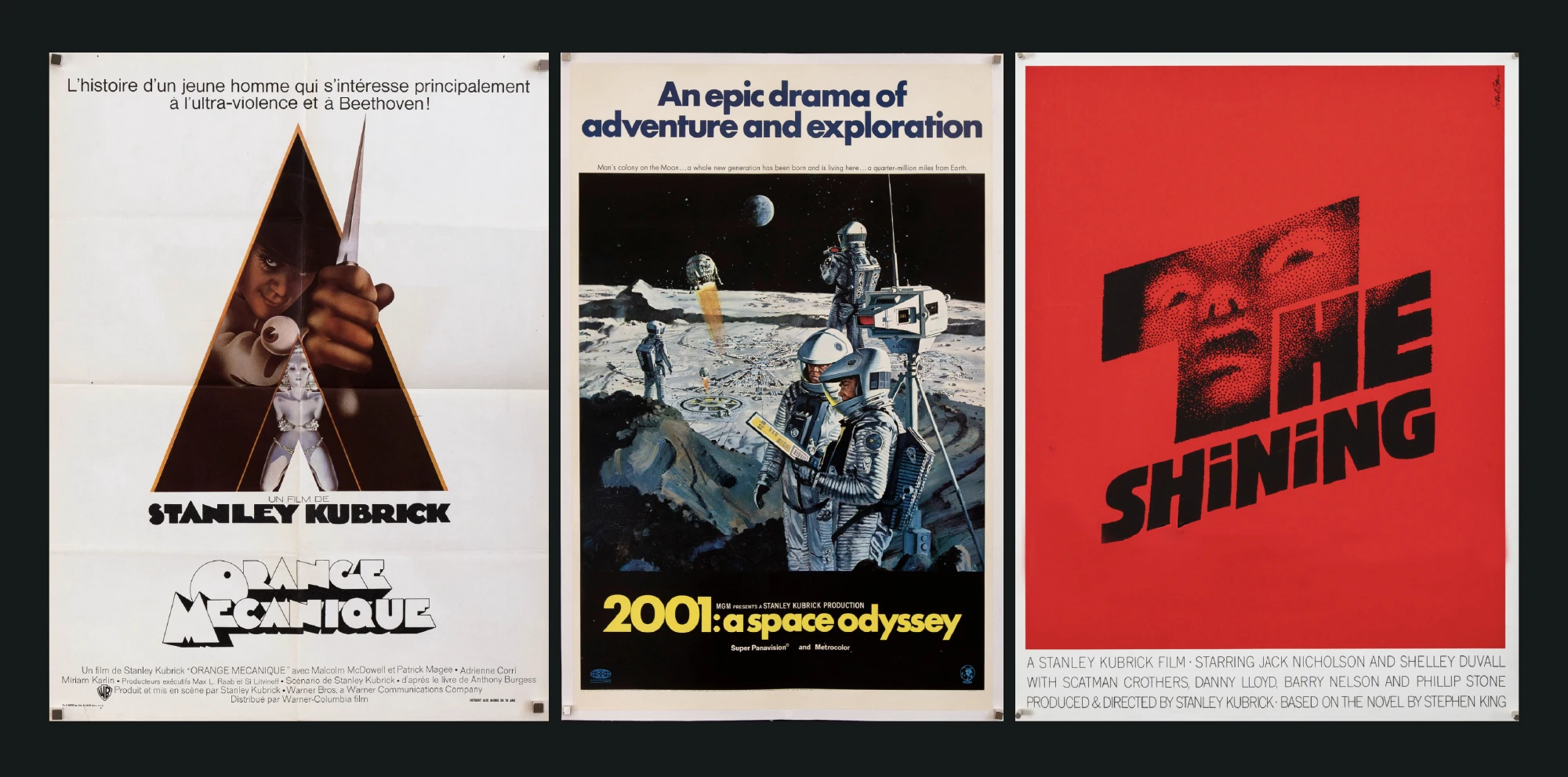
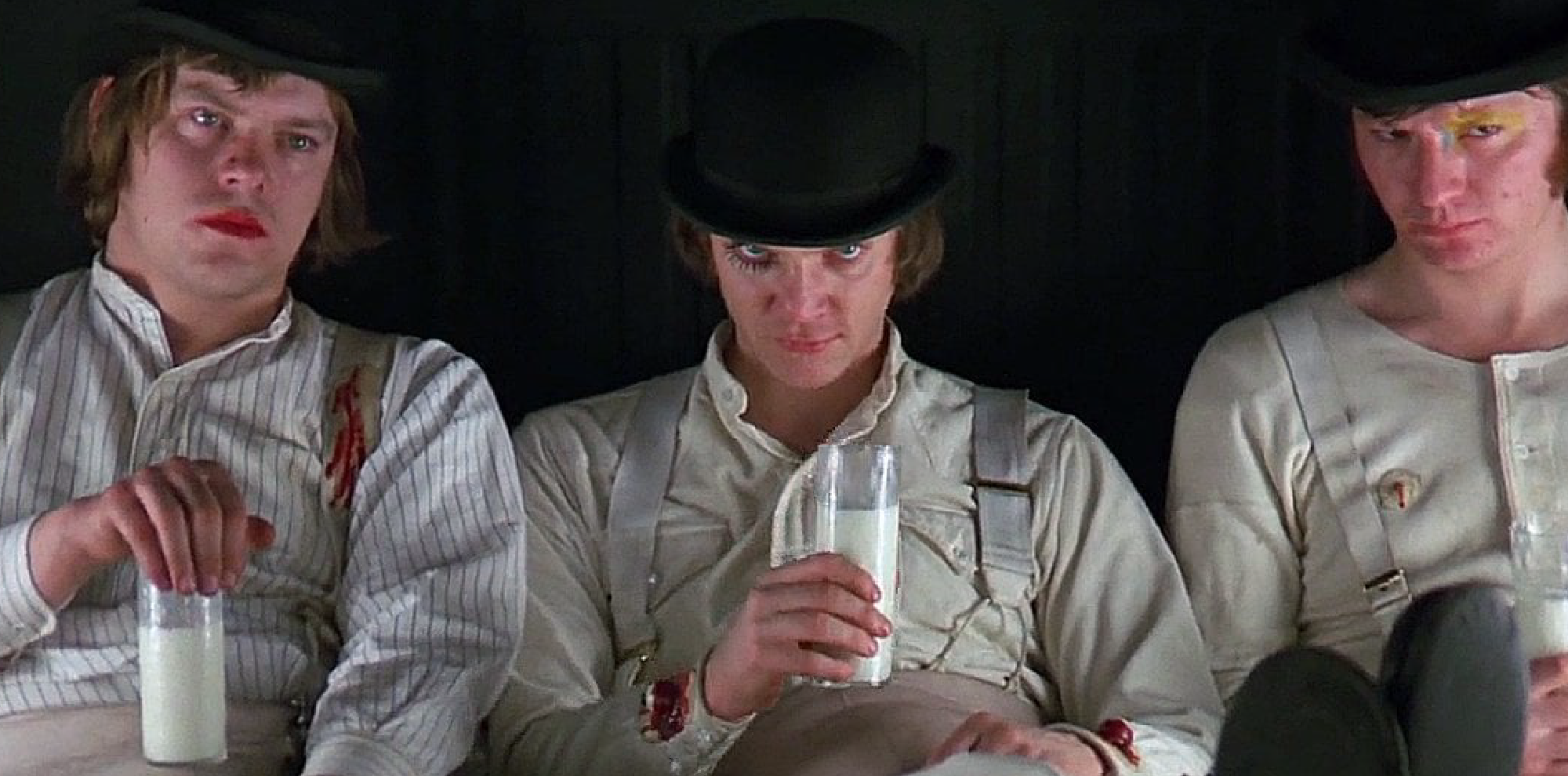
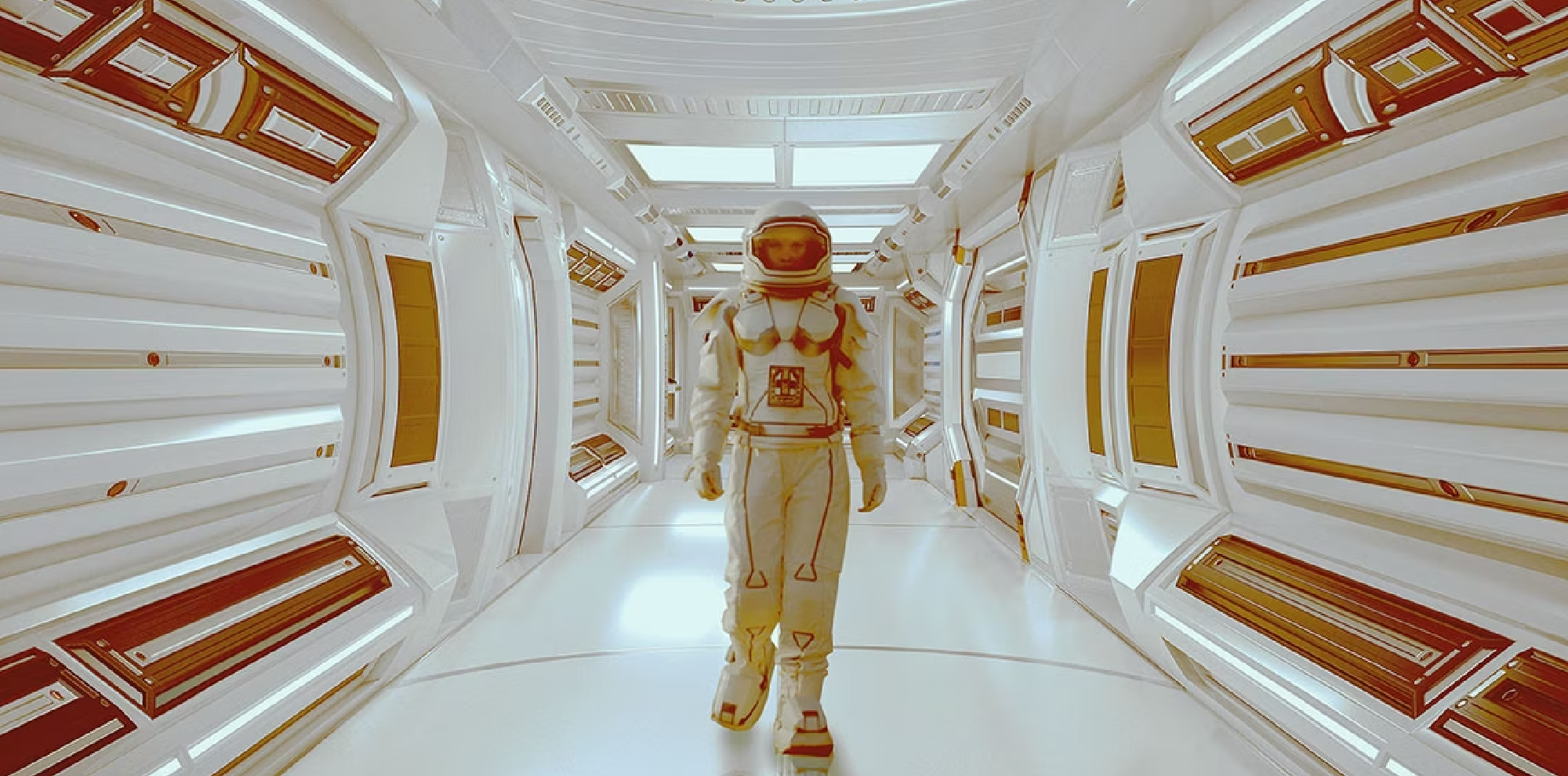
Kubrick’s ambition soon turned toward groundbreaking works in science fiction and psychological drama. He directed 2001: A Space Odyssey (1968), famous for its innovative effects and philosophical scope, earning him his only Academy Award (for visual effects). His later films include the controversial A Clockwork Orange (1971), the visually sumptuous Barry Lyndon (1975), the atmospheric horror The Shining (1980), the war film Full Metal Jacket (1987), and his final film Eyes Wide Shut (1999).
Kubrick was known for his perfectionism: extreme control over every aspect of production, repeated takes, and deep technical research. His themes often engage with human nature, order versus chaos, power, violence, and alienation. Despite mixed initial receptions to some films, many have been critically reappraised and are now considered modern classics.
Research
Kathryn Bigelow
Kathryn Bigelow (born 1951) is an American director, producer, and screenwriter known for intense, politically charged films.
Raised in California, she studied art and film (earning a BFA and an MFA) and began her career co-directing The Loveless (1981). She gained attention with genre films like Near Dark (1987), Blue Steel (1990), Point Break (1991), and Strange Days (1995).
Her major breakthrough came with The Hurt Locker (2008), for which she became the first woman to win the Academy Award for Best Director. She later directed Zero Dark Thirty (2012), which drew acclaim and controversy, and Detroit (2017).
Bigelow’s style often fuses action and violence with political themes, using kinetic filmmaking techniques (mobile/handheld cameras, custom rigs) to heighten realism. She resists labels like “woman filmmaker,” instead emphasizing her interest in pushing genre boundaries and exploring power, conflict, and identity.
Research
Sofia Coppola
Sofia Carmina Coppola (born 1971) is an American filmmaker, screenwriter, and producer known for her delicate, atmospheric storytelling and exploration of isolation, privilege, and youth. The daughter of director Francis Ford Coppola and documentarian Eleanor Coppola, she grew up surrounded by cinema and appeared in several of her father’s films before turning to directing. Her debut feature, The Virgin Suicides (1999), established her as a distinctive voice in American independent film with its dreamlike tone and themes of adolescence and confinement.
Coppola gained international acclaim for Lost in Translation (2003), a quiet, introspective film about loneliness and connection, earning her the Academy Award for Best Original Screenplay and nominations for Best Director and Best Picture. She later directed Marie Antoinette (2006), which reimagined the French queen’s story through modern pop culture sensibilities; Somewhere (2010), a meditation on fame and emptiness; The Bling Ring (2013), a commentary on celebrity obsession; The Beguiled (2017); On the Rocks (2020); and Priscilla (2023).
Her work is marked by minimalist dialogue, atmospheric visuals, and a strong sense of mood and rhythm. Recurring motifs include femininity, detachment, and the tension between freedom and confinement. Coppola became the first American woman to win the Best Director award at the Cannes Film Festival and has earned major honours at Venice and the Oscars. She is widely regarded as one of the most distinctive and influential filmmakers of her generation.
Research
Alfred Hitchcock
Research
My Choice
Wes Anderson
Interview Summary
Planning
Before I began mood boarding, I created a "mind map" of key concepts to ensure my creative direction is accurately influenced. These key concepts are those used by Anderson himself and I have broken them down into key pieces of visual language to help build a strong vernacular of his work that I can replicate in my own.
I'm not a huge fan of mind maps though as they're not very organised, so instead I've compiled my thoughts into beautifully organised categories with lists. Perfect.
Planning
Mind Map
The key concepts within Anderson's work include Symmetry & Composition, Colour & Palette, Design & World Building, Typography & Graphic Motifs, Characters & Blocking, Narrative Devices & Structure, and Tone & Atmosphere.
Let's break these down into a visual language that can help evoke the same emotional response as a true Wes Anderson movie.
Planning
Symmetry & Composition
Concept:
Order, control, and artificiality as narrative devices.
Visual Language:
Rigid central symmetry (camera locked to the axis)
Planar staging – actors framed frontally, often in profile or direct gaze
Straight-on architecture (facades, corridors, doorways)
Whip-pans and track-ins/outs instead of handheld movement
Repetition and mirroring within frames
Often combined with sudden dynamic inserts (e.g., overhead shots, maps, diagrams)
Effect:
Creates a feeling of heightened reality – meticulously constructed, almost storybook-like worlds.
Magazine Design Applications:
Use symmetrical grid systems or centred layouts
Mirror margins and gutter spacing across spreads
Place main imagery or headlines on a central vertical axis
Repeat consistent column widths to create visual rhythm
Align photography and text geometrically for balance
Effect:
Pages feel deliberate, composed, and theatrical — like film stills.
Planning
Colour & Palette
Concept:
Emotional coding through controlled chroma.
Visual Language:
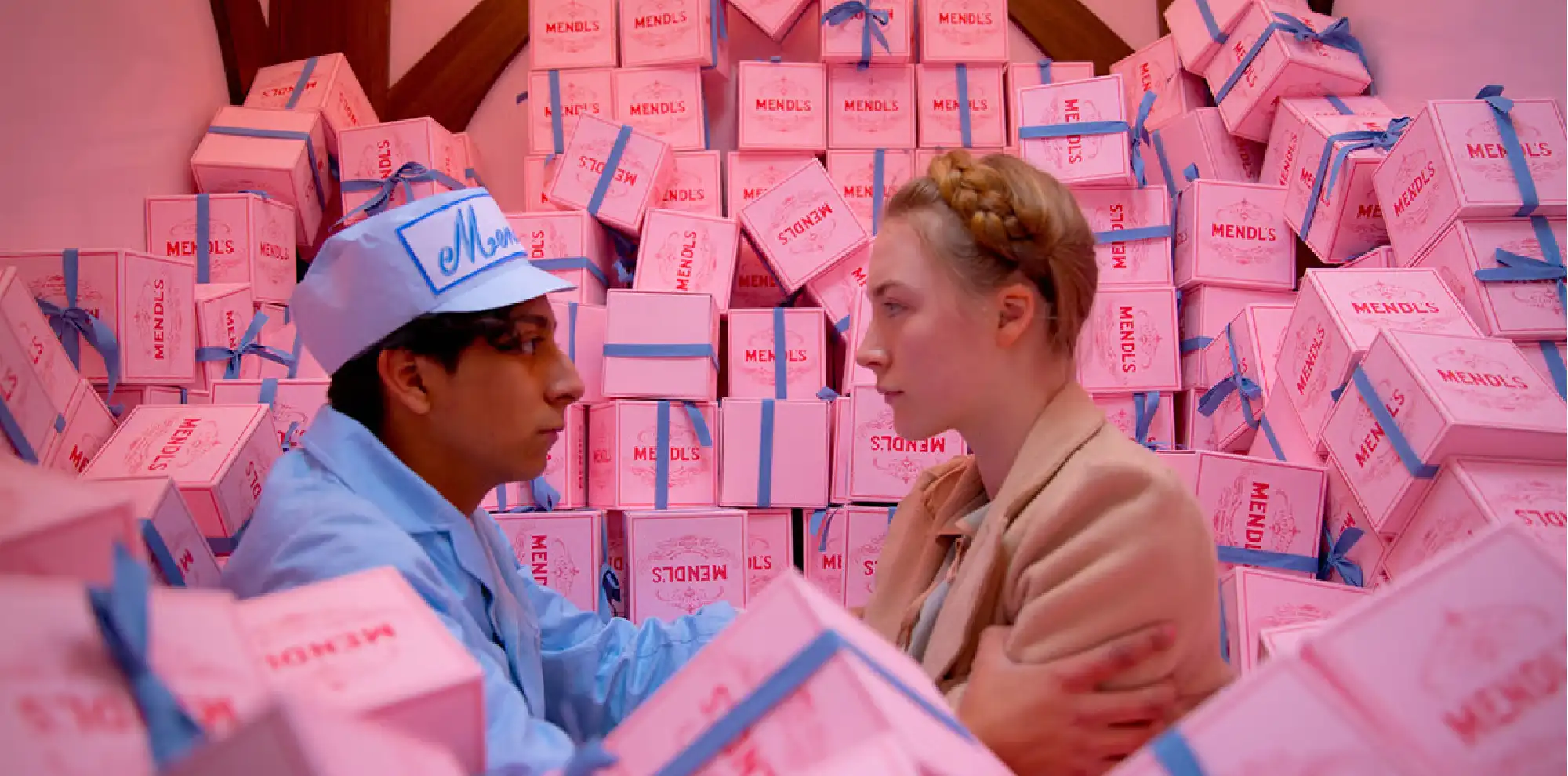
Distinct monochromatic environments per film (for example, pink in The Grand Budapest Hotel or mustard yellow in Moonrise Kingdom)
Pastel tones mixed with faded primaries for a nostalgic yet deliberate atmosphere
strong colour hierarchy with a dominant, secondary, and neutral tone
Uniform colour-matching across sets, costumes, and props
Symbolic palettes where warm tones suggest intimacy and cold tones suggest detachment
Effect:
Builds mood instantly and reinforces themes of nostalgia, melancholy, and control.
Magazine Design Applications:
Build restrained colour palettes for each section or feature
Use pastel tones with rich accent colours for contrast
Apply colour blocking to divide articles or highlight quotes
Match photography, typography, and backgrounds tonally
Experiment with duotones or monochromatic imagery for nostalgia
Effect:
Establishes mood and cohesion across the publication.
Planning
Design & World Building
Concept:
Hyper-designed universes functioning as psychological portraits.
Visual Language:
Miniatures and models (ships, buildings, trains)
Handcrafted props and signage — often typography-led
Retro technology (typewriters, record players, rotary phones)
Period ambiguity — each world feels vintage but timeless
Uniforms and badges giving social order and hierarchy (e.g., scouts, hotel staff)
Effect:
The world mirrors the characters’ emotional structure — nostalgia as control.
Magazine Design Applications:
Treat each feature as a unique visual “set” with its own motif
Use props, illustrations, or patterns to reinforce narrative themes
Incorporate textures like paper grain, fabric, or wood into layouts
Introduce small repeated motifs or icons that create continuity
Use detailed spreads that feel “designed within” the magazine’s world
Effect:
Each article feels immersive and bespoke — like a miniature film world.
Planning
Typography & Graphic Motifs
Concept:
Text as part of cinematic design.
Visual Language:
Futura Bold or Futura-like geometric sans in titles and captions
Centred or all-caps layout in credits and intertitles
In-world text elements (maps, labels, stationery) as storytelling devices
Static framing of written objects — reading is part of viewing
Effect:
Unifies the visual language across film, marketing, and set design — typography as world-building.
Magazine Design Applications:
Use geometric sans-serifs (Futura, Gill Sans, ITC Avant Garde)
Set titles in centered, all-caps compositions
Use bold type on solid colour backgrounds for cover or section openers
Include typewriter-style or monospaced fonts for captions and props
Integrate text directly into imagery (e.g., signs, labels, or diagrams
Effect:
Creates a cohesive, nostalgic typographic voice across the magazine.
Planning
Characters and Blocking
Concept:
Emotional restraint and eccentric order.
Visual Language:
Characters move with deadpan precision; gestures deliberate, minimal
Tableaux vivant staging — actors positioned like figures in a painting
Frontal dialogue delivery, often centre-frame
Costume as identity marker (distinct colour, uniformity, repetition)
Effect:
Amplifies both humor and melancholy through emotional stillness.
Magazine Design Applications:
Stage portrait photography frontally, with direct eye contact
Keep subjects centered or symmetrically framed
Use minimal facial expression and neutral postures
Match clothing colours to the palette of the spread
Allow generous negative space around figures for control and stillness
Effect:
Produces striking, balanced portraits with a quiet, cinematic tone.
Planning
Narrative Devices & Structure
Concept:
Story within a story — layers of artifice.
Visual Language:
Framed narratives (books, plays, documentaries)
Voiceovers that feel literary rather than cinematic
Chapter titles and inserts using typography
Meta-fictional awareness — consciously commenting on its own narrative structure, characters, and storytelling techniques
Effect:
Makes the viewer conscious of storytelling as performance.
Magazine Design Applications:
Divide long articles into “chapters” or “acts” with title dividers
Use running headers styled like film credits or screenplay text
Begin each feature with a cinematic title page or illustrated opener
Include marginalia or small side quotes as “voiceovers"
Design pull quotes and captions like snippets from scripts or narration
Effect:
Reinforces the sense of storytelling and sequential pacing.
Planning
Tone & Atmosphere
Concept:
Melancholy within whimsy.
Visual Language:
Balanced irony and sincerity — humor laced with sadness
Muted emotional delivery contrasts with visual intensity
Music: 1960s–70s British pop, French chansons, classical cues
Rhythmic editing — precise cuts matched to musical beats
Effect:
Emotional detachment becomes emotional depth.
Magazine Design Applications:
Combine clean, geometric layouts with quirky or nostalgic imagery
Use vintage photography aesthetics (film grain, soft lighting)
Pair serious text with playful visuals to maintain contrast
Include delicate typographic details under bold headlines
Use consistent rhythm in visual pacing from spread to spread
Effect:
Creates an emotional balance — whimsical but emotionally grounded.
Planning
Mood Board
Below is an interactive mood-board created using moodboard.com – a fantastic tool I found recently that allows you to create interactive mood-boards with text and images. It's great as you can add GIFs as well as images which helps to further enhance the boards creative influence.
In my mood-board I have included imagery of Anderson's movies to remind me of the creative style that I need to replicate. Alongside this, I've included selected images directly related to the visual components I have listed before that will help to replicate the key concepts used in Anderson's films. For example, there's restricted pastel colour palettes (establishes mood and cohesion across the publication), as well as frontal centrally aligned photography (produces striking, balanced portraits with a quiet, cinematic tone).
This mood-board accurately represents Anderson's themes and the devices used to communicate them making it a useful tool to utilise throughout the design of my magazine.
Cover
Now I have my mood-board, it's time to get on with the designing. My plan for the actual design phase is to sketch a page/spread, create it, then sketch the next, create it, and so on. So with that being said, let's make the cover.
Cover
Thumbnail Sketches
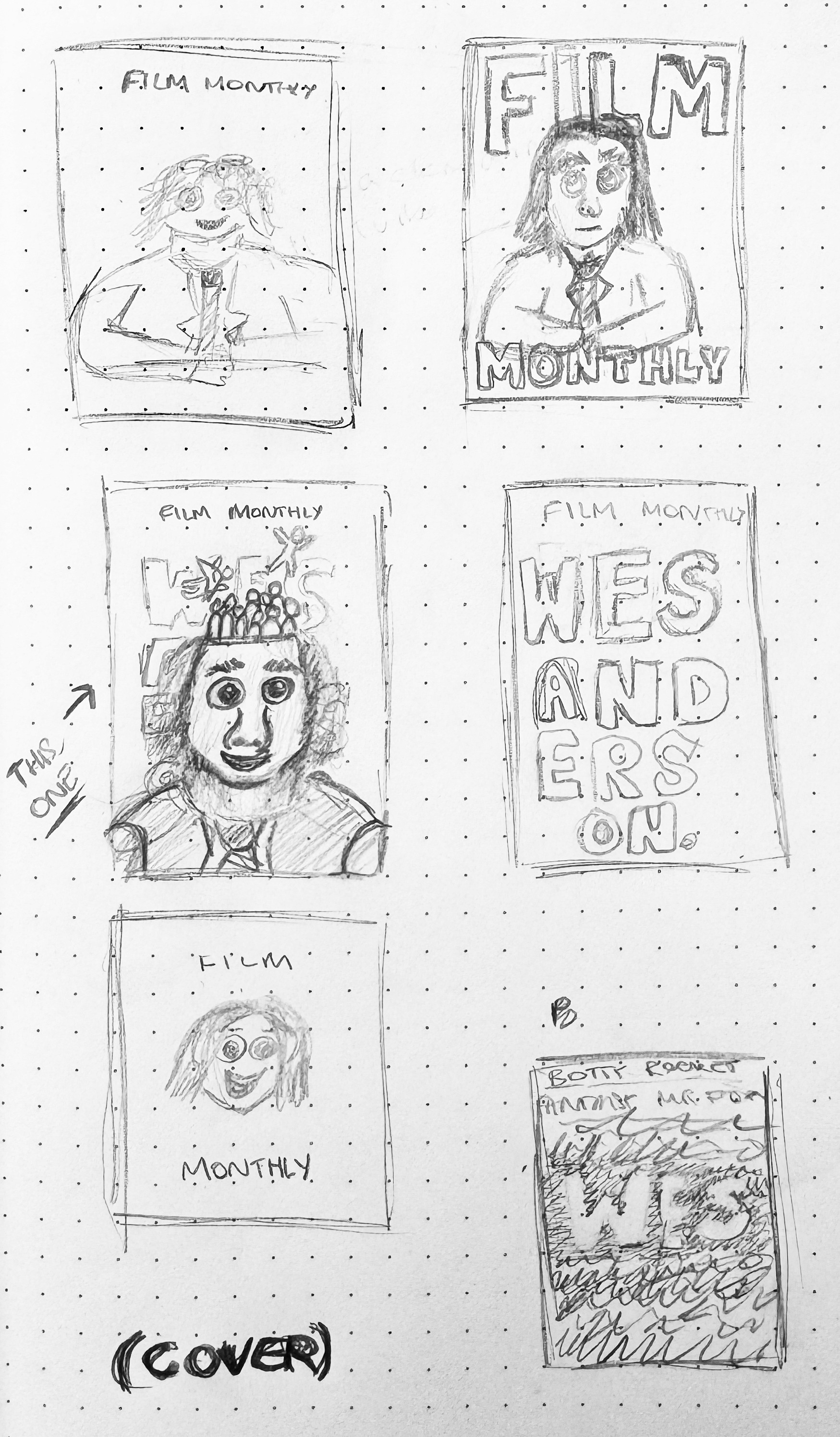
Below are six sketches for my cover page.
The top left idea was to have Anderson filling most of the page with his arms folded resting on the bottom of the page. Typography then had space at the top part of the page, simple.
To take the first sketch a little further, we've got the top left idea. Similar concept, except Anderson's figure can be used to create depth on the flat cover (similar to how Anderson adds depth to his movies whilst using seemingly shallow camera angles). With the magazine title "Film Monthly" split between the top and bottom of the page, Anderson's head and arms can overlap the text to create a striking composition.
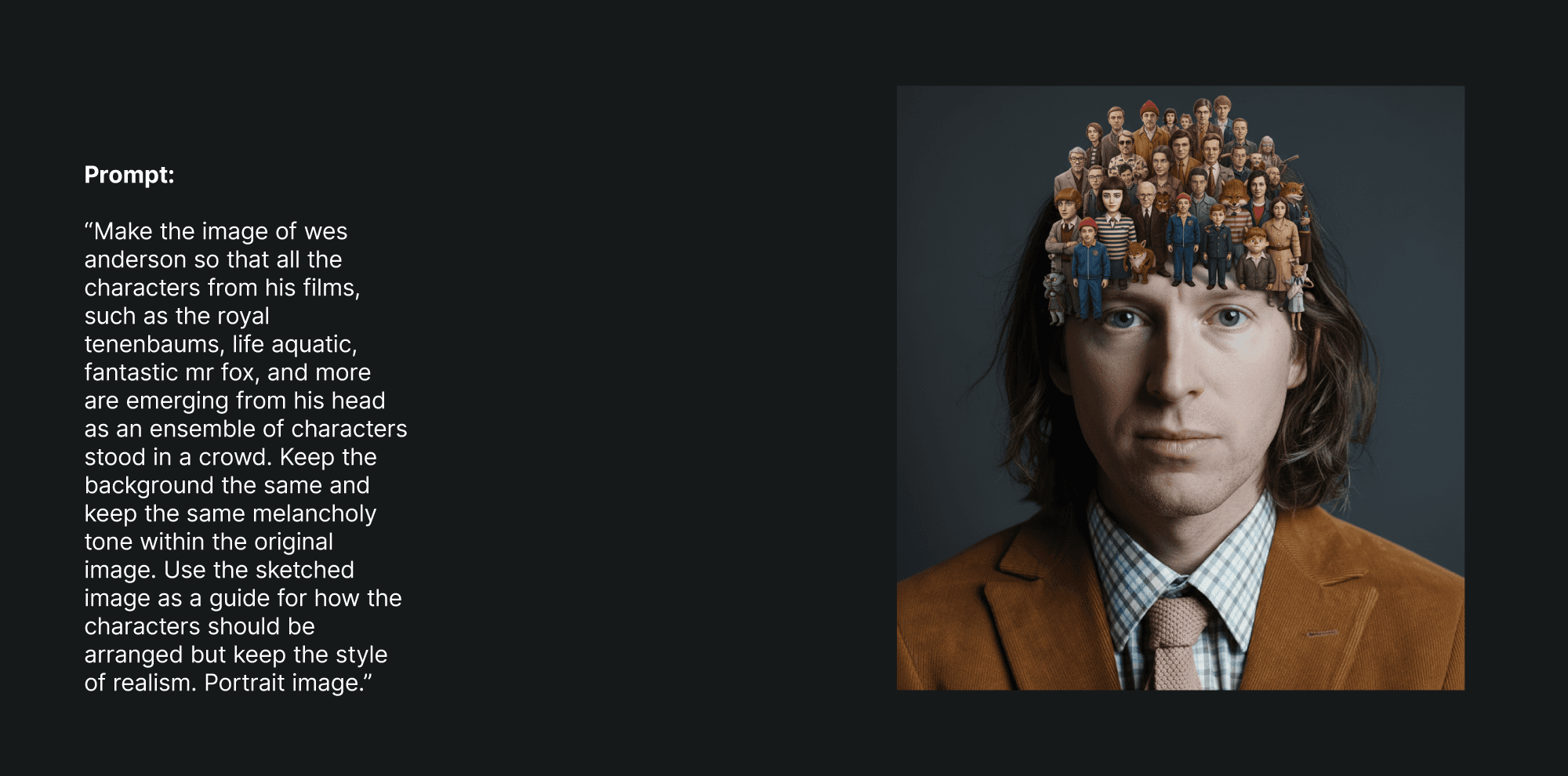
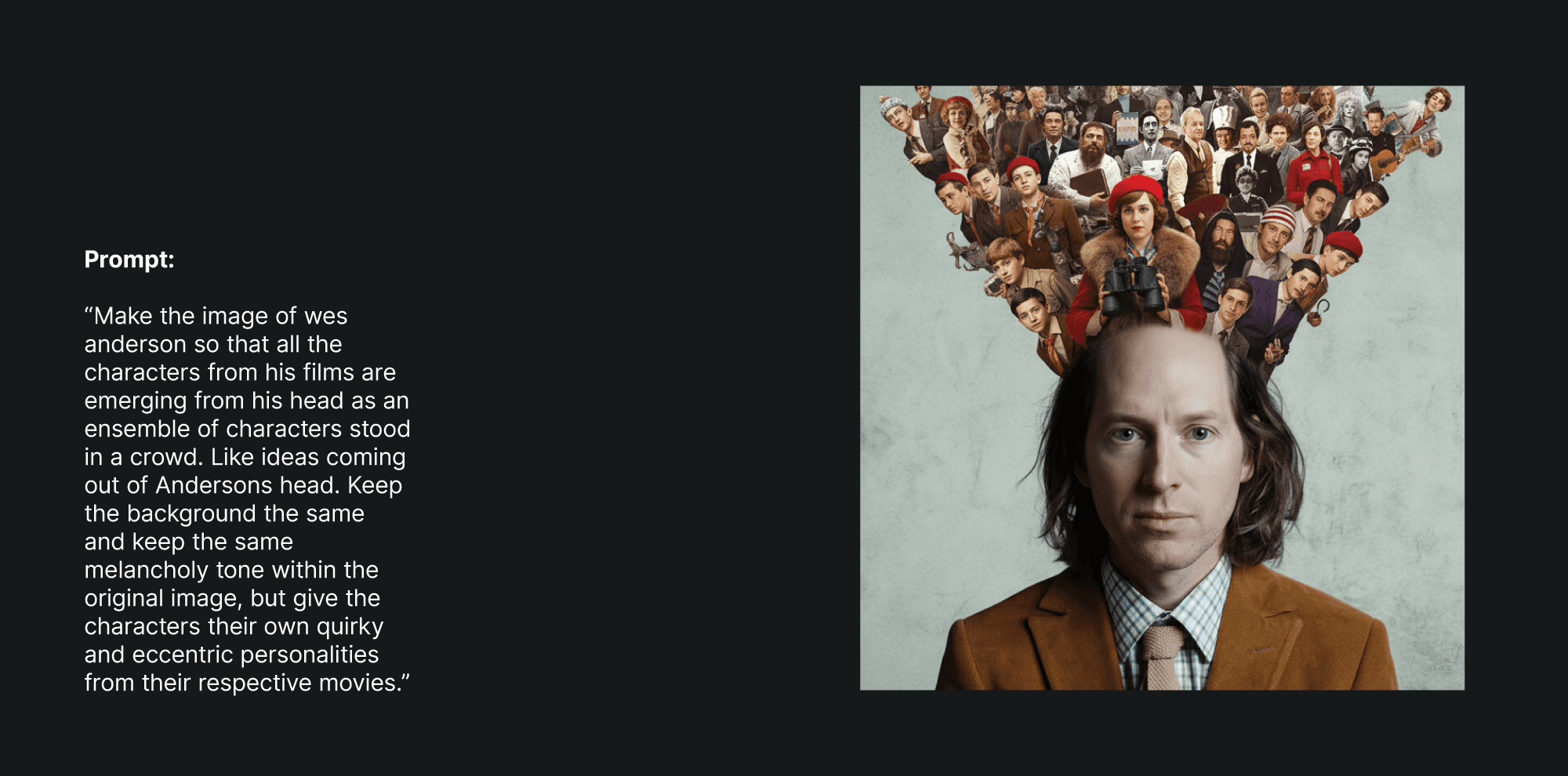
Moving on to middle left. The idea is ambitious to say the least. Wes sits front centre of the page like the other ideas, but the top of his head is replaced with an ensemble of all the characters from his movies (or the most relevant characters at least). I feel like this would make an epic cover, but trying to get every character in an ensemble and edit his head correctly will be a challenge.
Cover
Design Phase
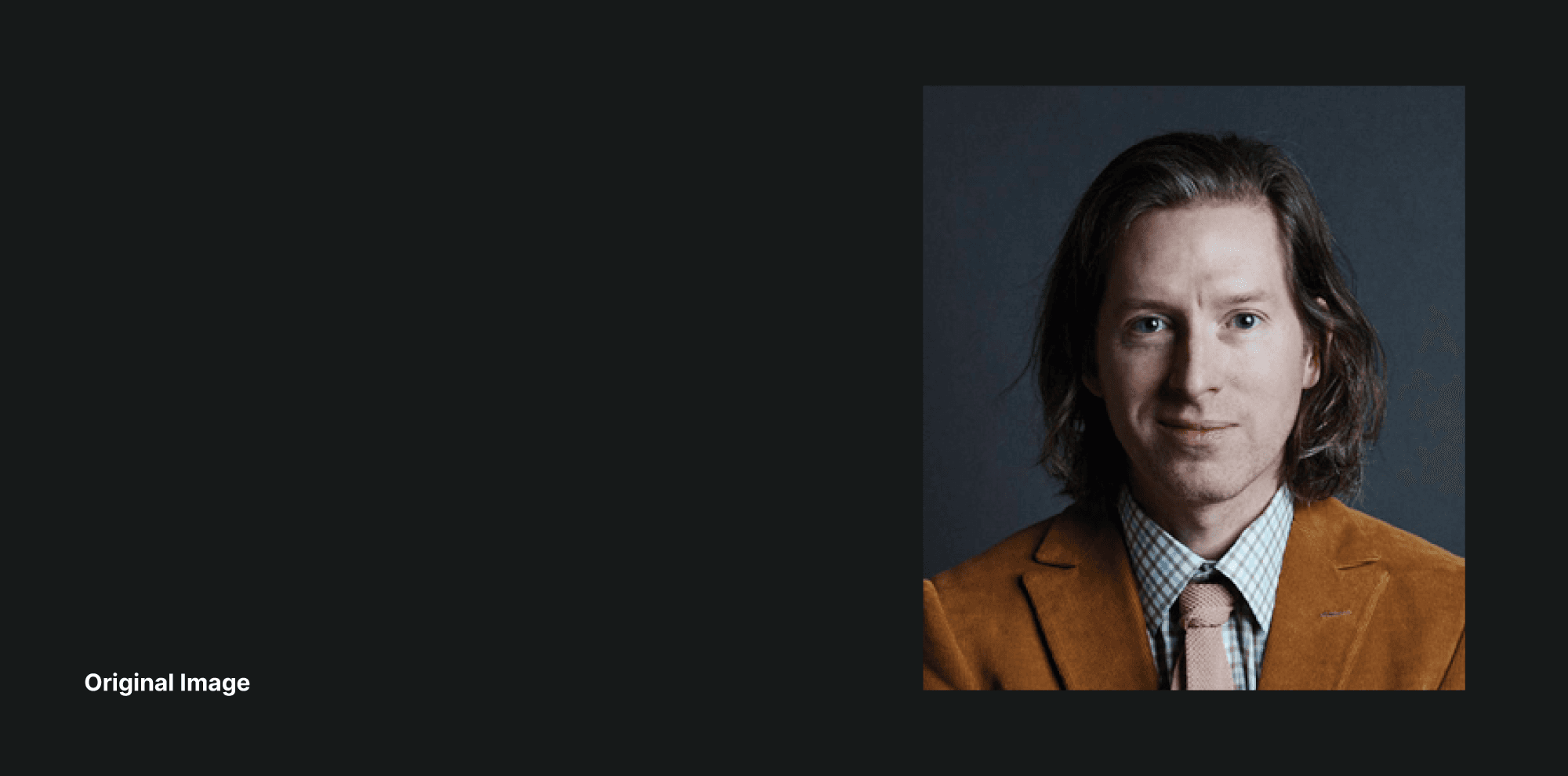
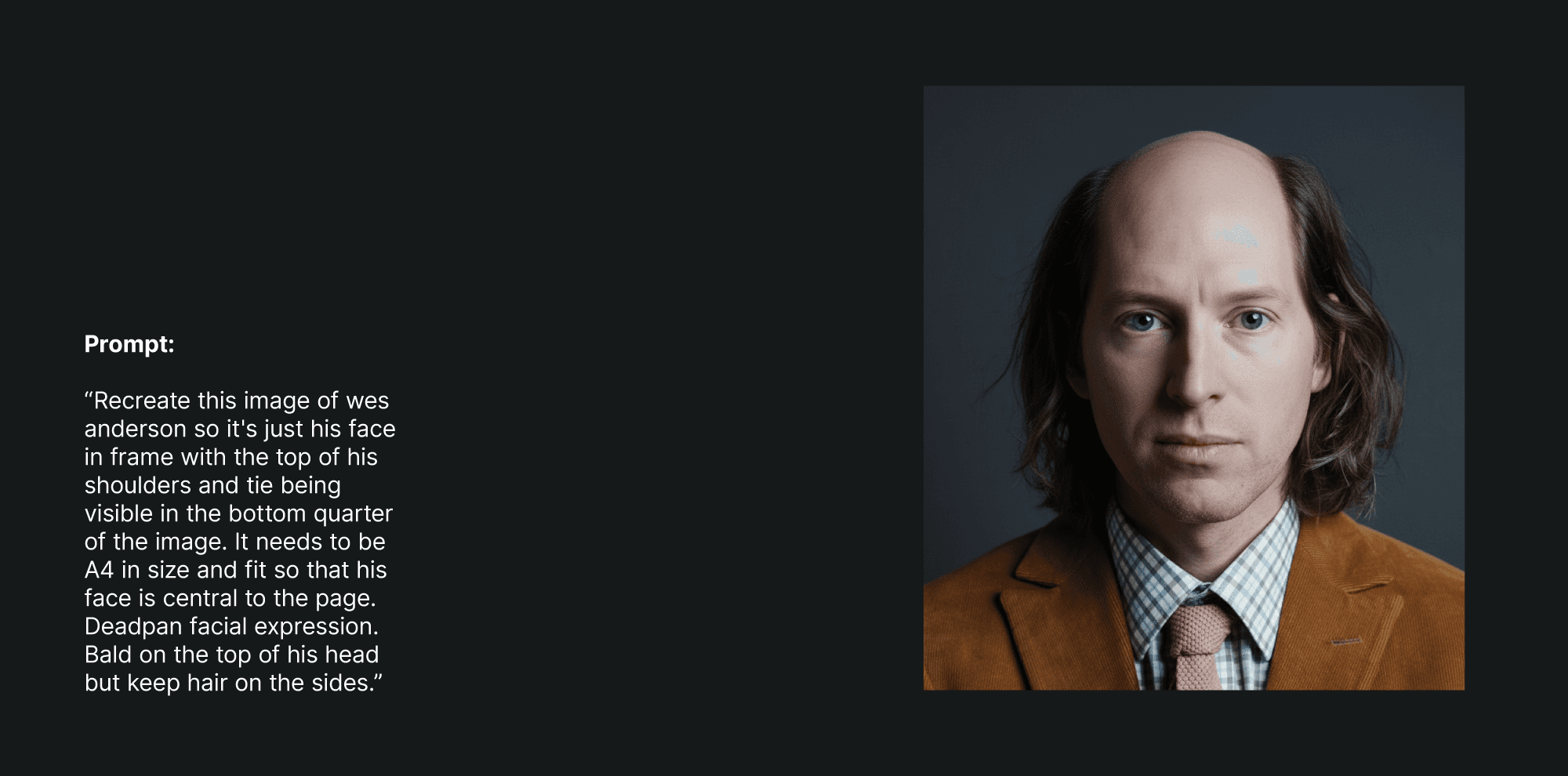
The first part of the design was to find the right image. I had a great starting point (a photograph of Anderson face on) which I then tried to manipulate. I thought with AI being so advanced now, I would give it a try. With the likes of Sora 2, which if you haven't seen - it's nuts, I thought it would be a breeze.
The first edit I made was cropping the image and giving Anderson a perfect deadpan facial expression which went incredibly well. The next step was to add the ensemble of Anderson's movie characters standing together as if they were poking out of his head (as shown in the sketch). This part went terribly. Although AI is pretty impressive now, it couldn't quite grasp the concept as it struggled to identify and recreate all the characters and further struggled to arrange them in the way I wanted it to. Unfortunately this meant I had to go with a different idea.
I chose to play off the sketch on the top right. It's frontal portrait and symmetrical typography makes it perfectly Wes Anderson without being overly complex.
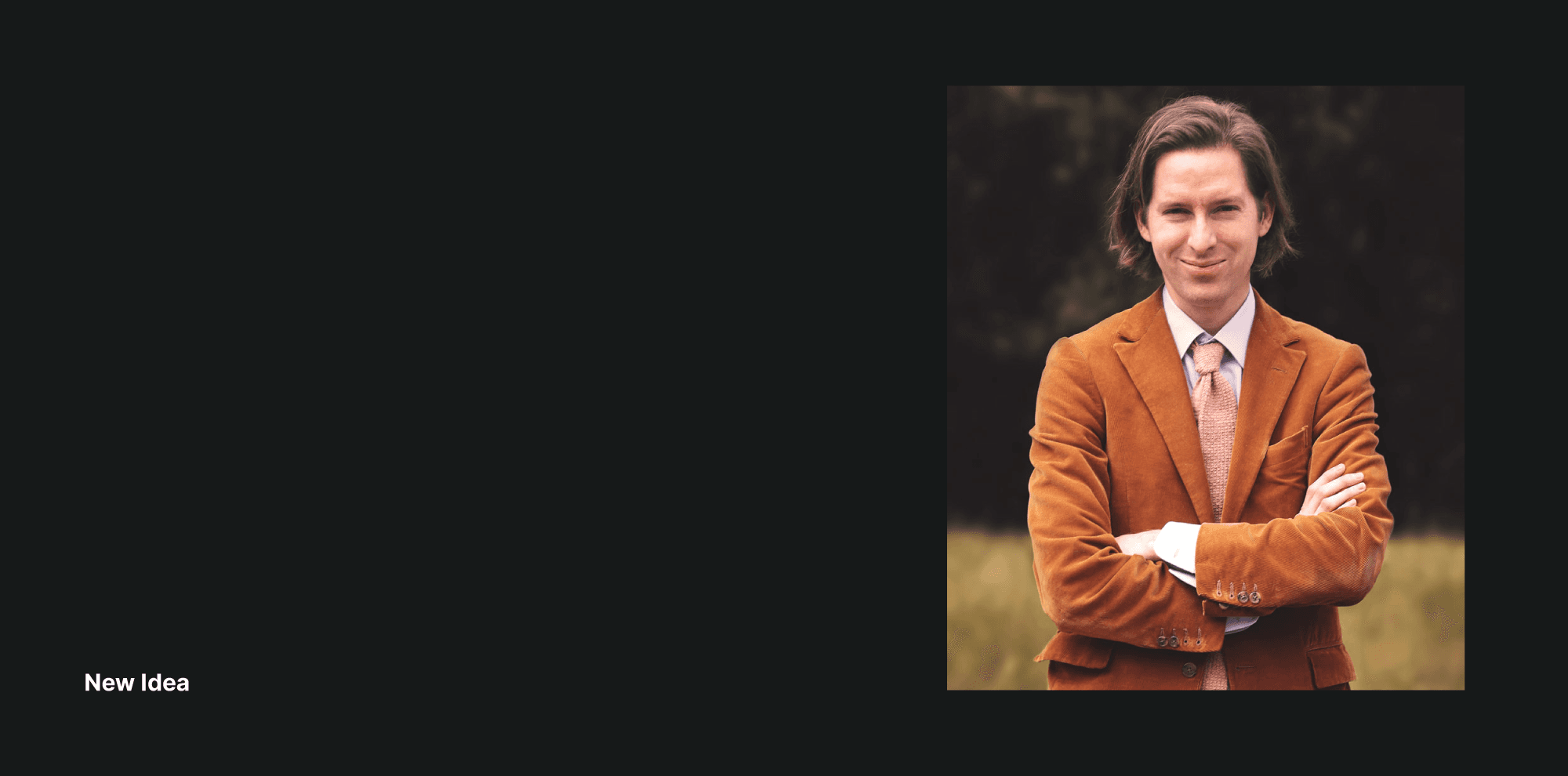
I took an image of Anderson standing with his arms folded and upscaled this using an online image up-scaler as it would have looked pixelated at A4 otherwise. I also added a little more saturation to the image to make it more colourful. To aid the image, I took it into indesign where I added the typography. I used Futura Bold in all caps filled with bright yellow as this common throughout Andersons movies.
Update:
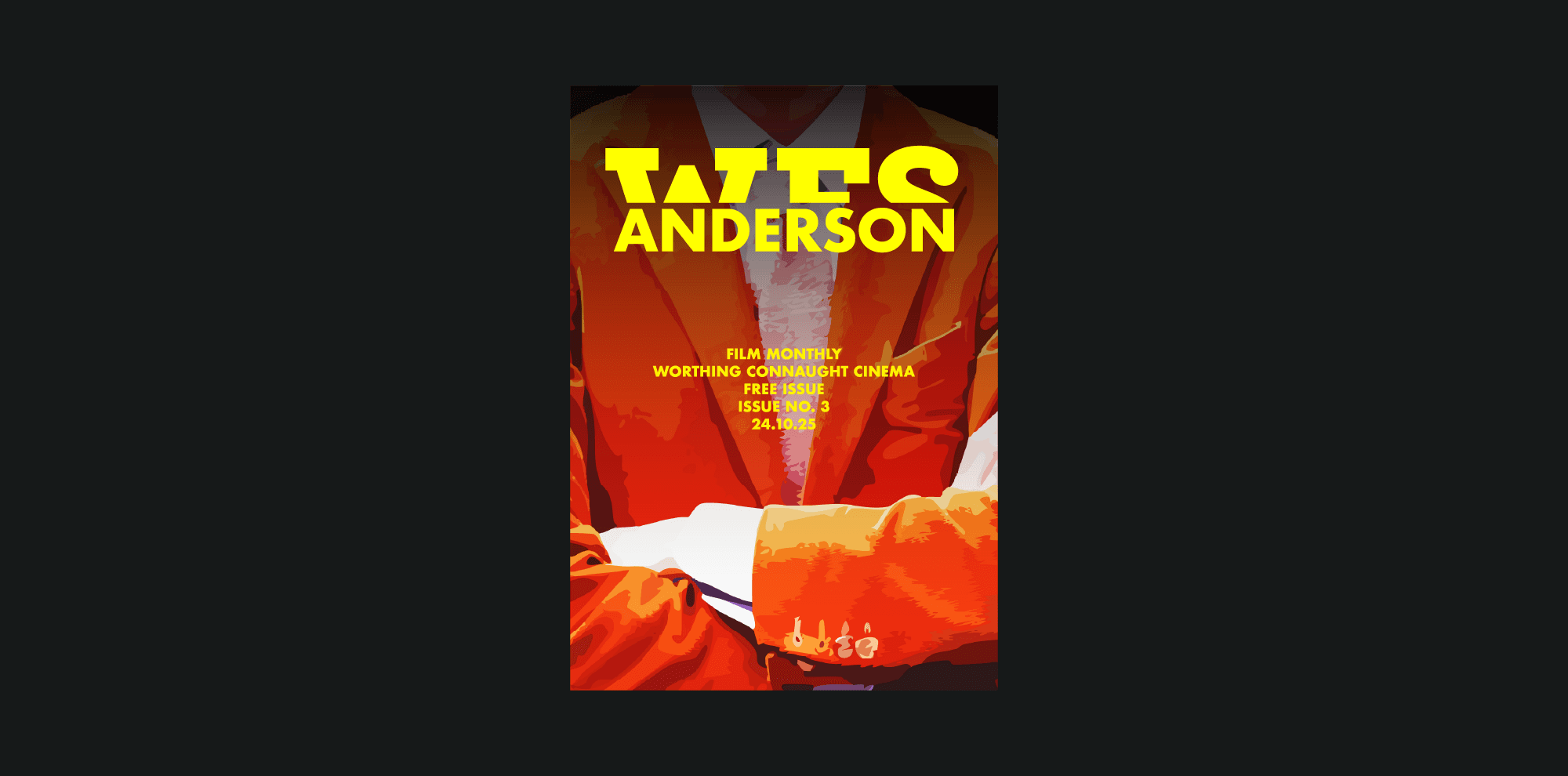
Half way through the rest of the magazine, I felt like things were becoming inconsistent and there was no cohesion between the cover and other pages within the magazine. The cover played it a little too safe. It felt rather boring and didn't help to convey Wes Anderson's style very well at all. They say you shouldn't judge a book by it's cover, but that doesn't mean the cover isn't equally as important as the rest of the content.
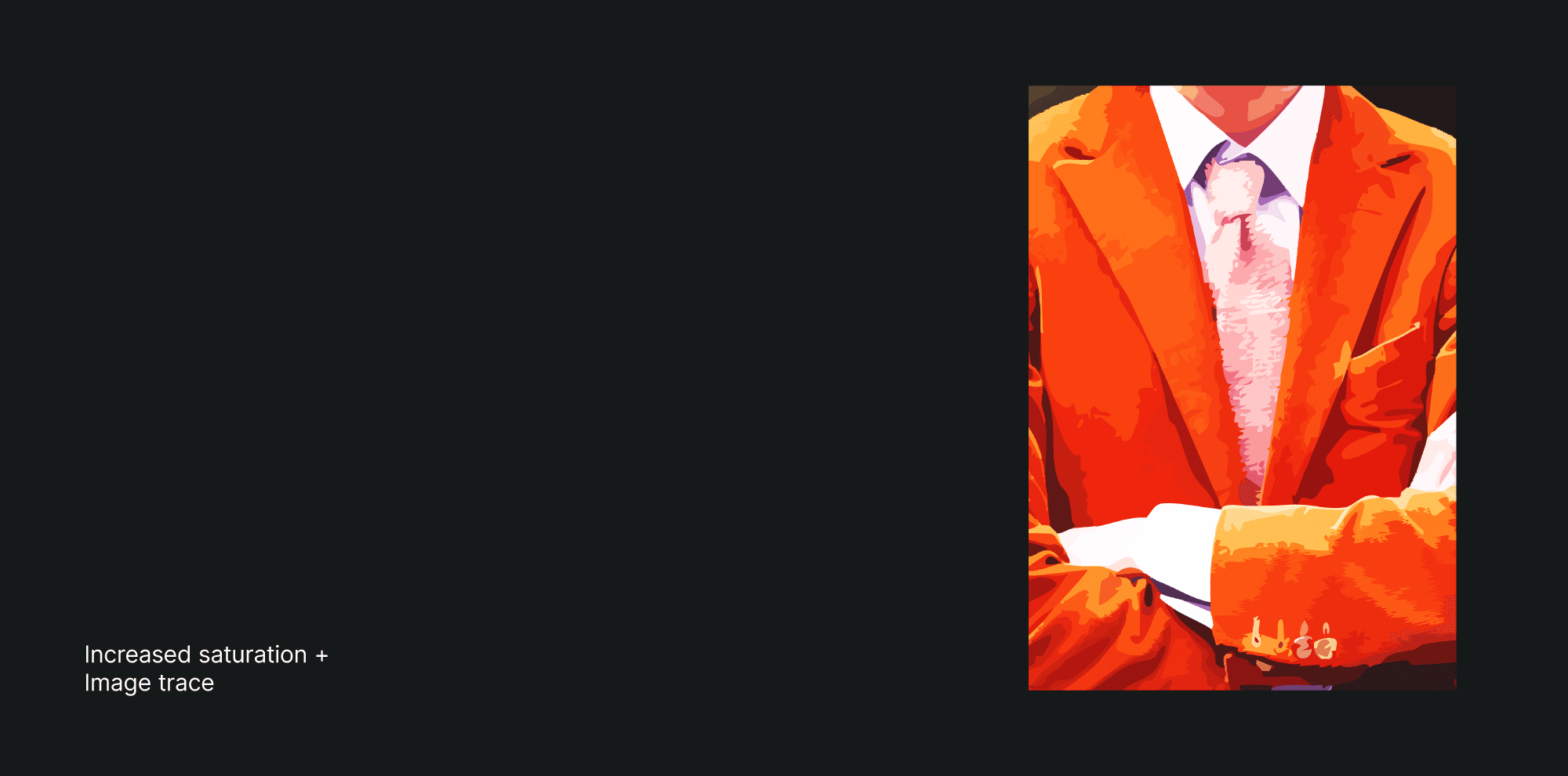
I took the same image I already had but made some changes and cropped in to focus on just his folded arms and the bust of his suit. I thought this would be an interesting focal point as you don't get to see Anderson's face, just his eclectic fashion sense. This also hints at his shy personality despite his daring imagination.
I took advantage of some stylistic choices chosen from other pages (particularly Illustrator's Image Trace tool) to create a version of the image that felt much more reminiscent of Andersons work due to the distinct colours.
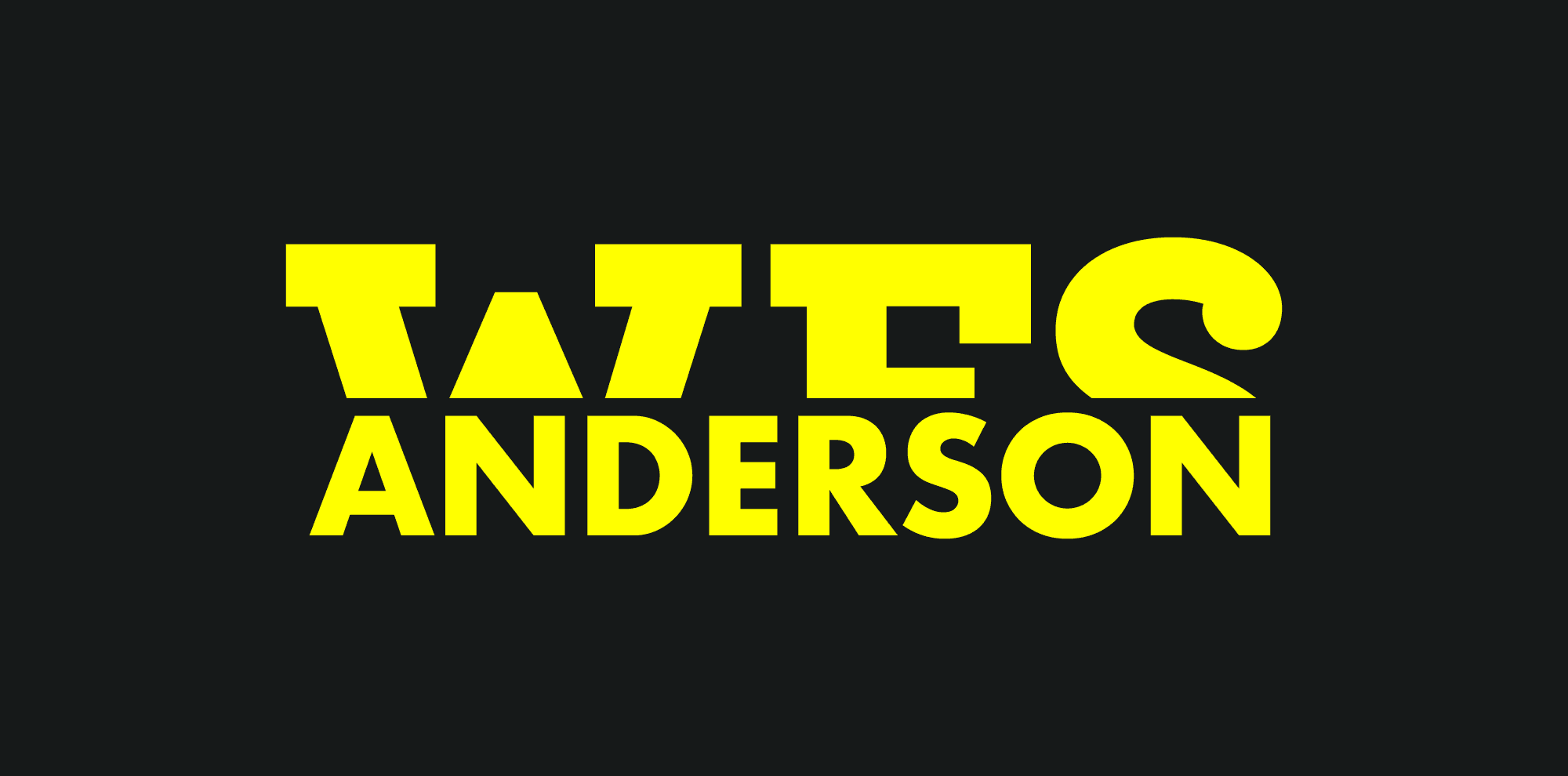
I also created a split-type title using Archer and Futura, two fonts Anderson uses consistently throughout his work.
As a final touch, I designed a little sign for the bottom right of the page that reads "this way please", inviting the reader to open the magazine and read on. Anderson often uses billboards, signs, and other elements within his movies to deliver messages without directly interacting with the audience.
Contents
I was originally stumped with the contents page, as I was with the rest of the magazine, if I'm being honest. I kept thinking of stale, boring ideas that didn't feel very challenging or experimental.
As mentioned before, the creative block at the beginning of the project had put some pressure on. This meant I had way less time to do a fair bit of work. I knew I had a solid idea with the cover page and took this forwards for other pages without making them all the same. Due to the time crunch, I didn't have much time for sketching and ideation on paper put I did some retrospective sketches to explore layouts that could be used if I had time to do so.
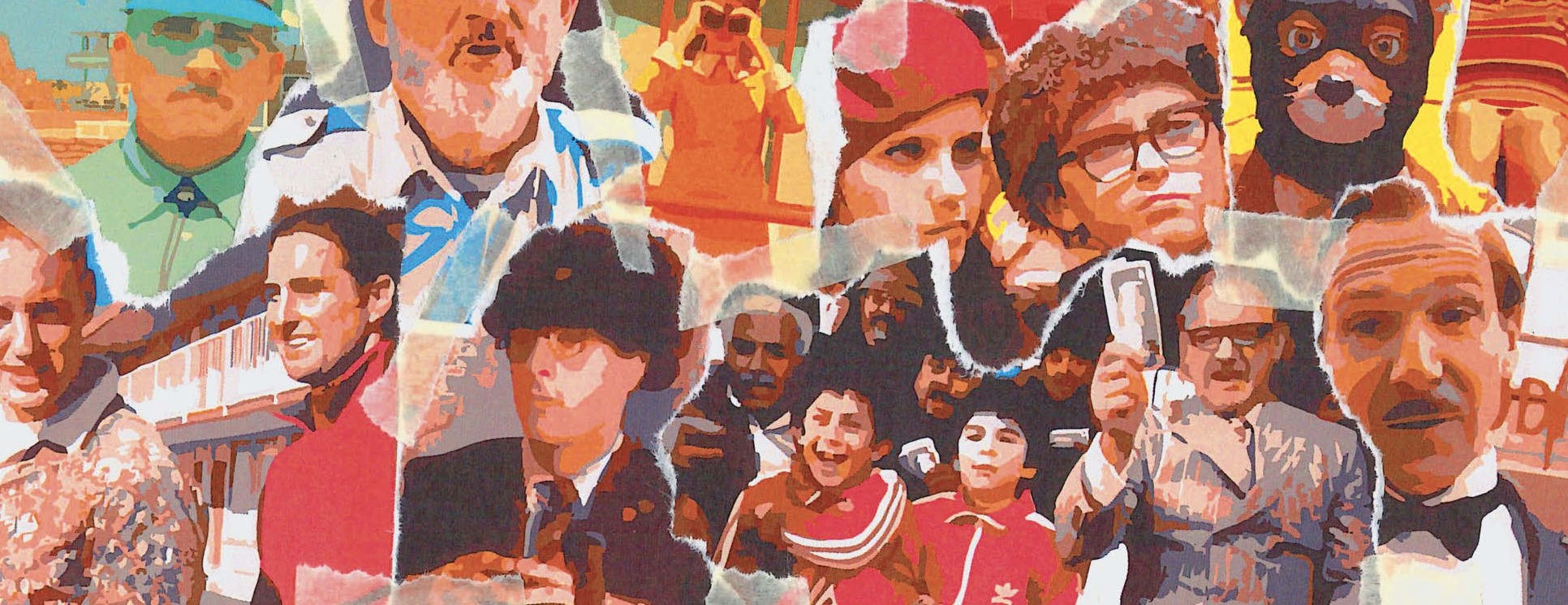
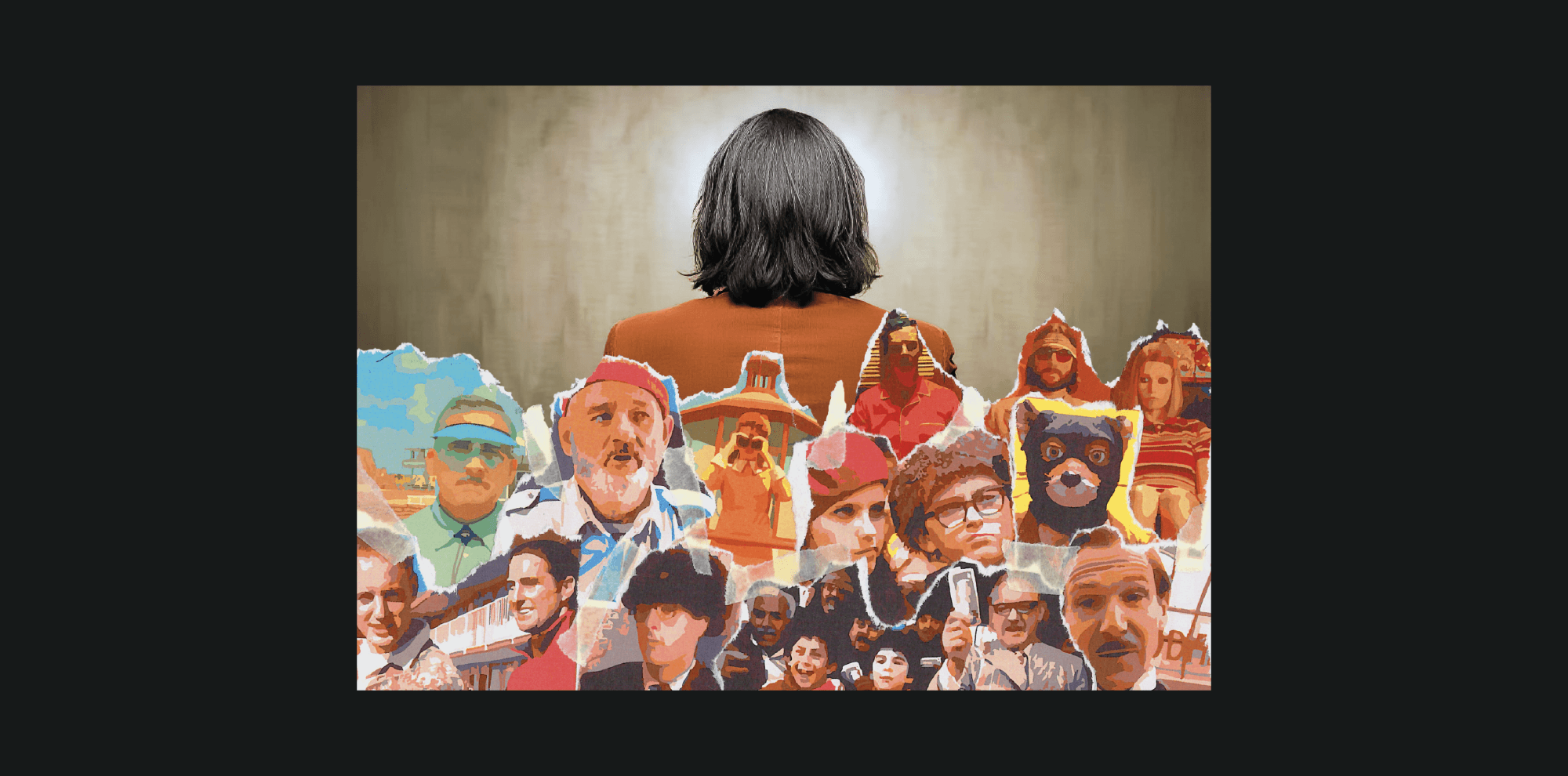
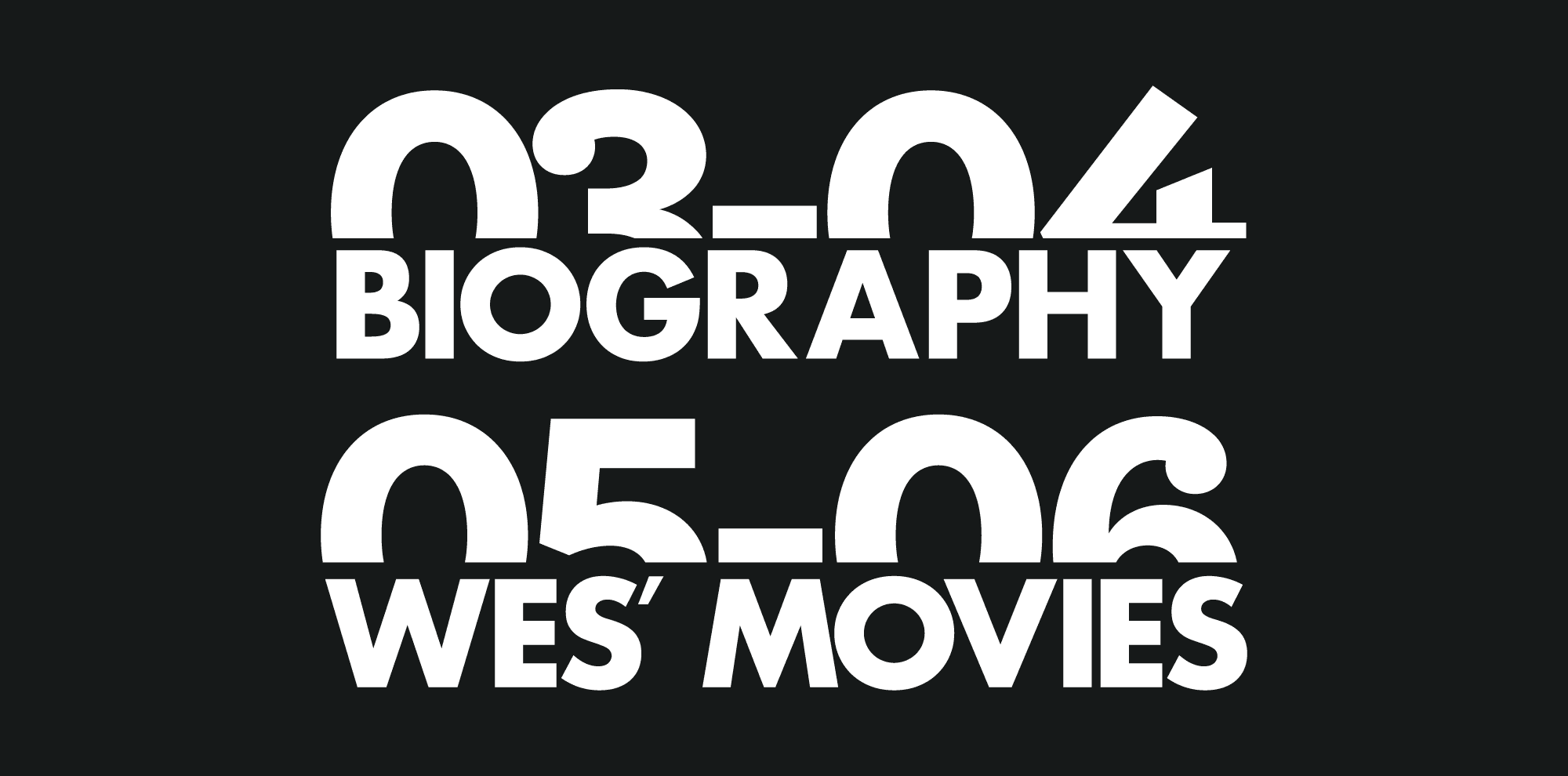
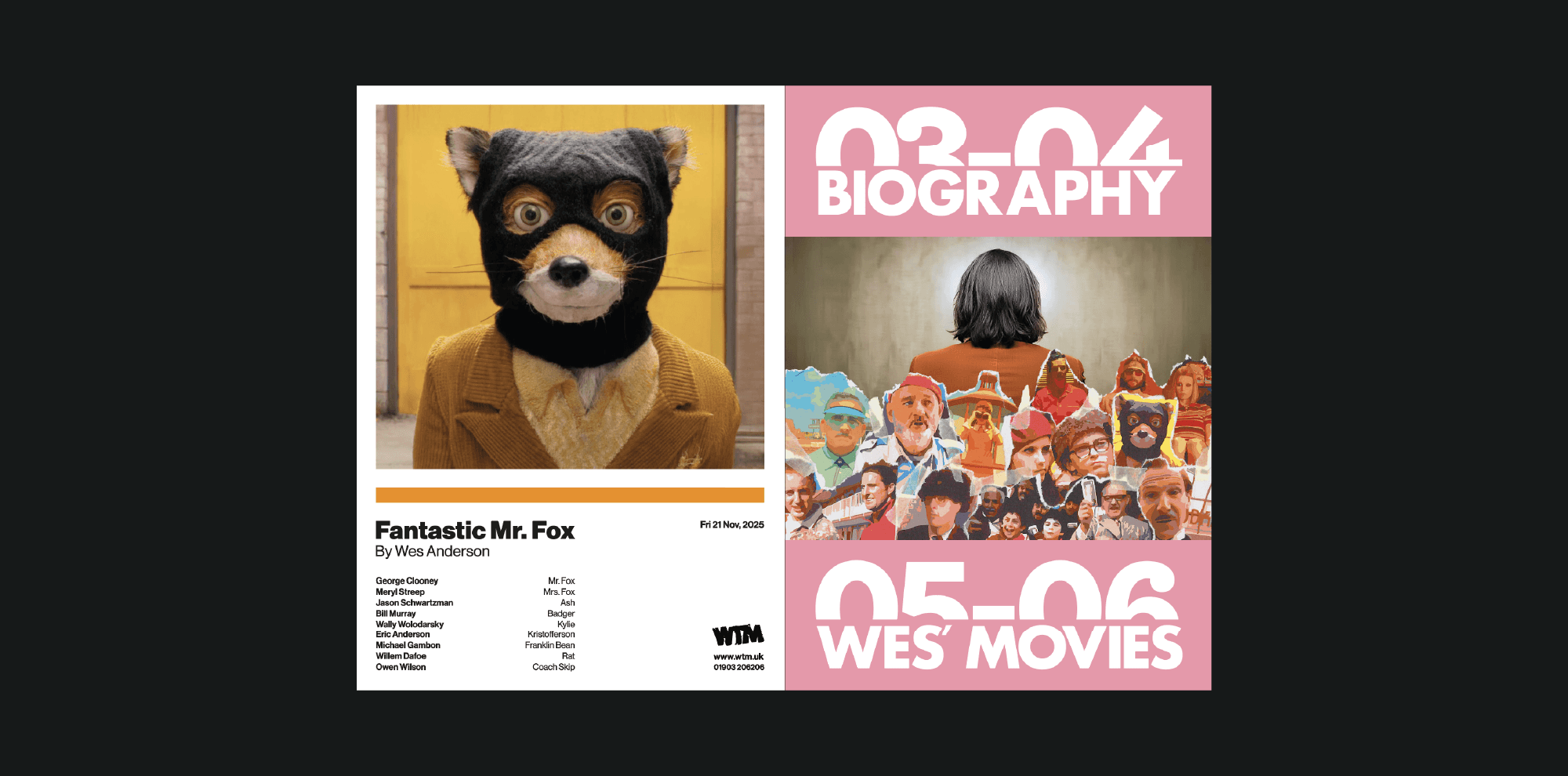
The idea I had was to divide the contents page equally into quarters as the contents consisted of two topics spanned across four pages (Biography: 3,4 and Filmography: 5,6). Quartering the page meant I had space for two pairs of type and image which could be allocated to the content of the magazine.
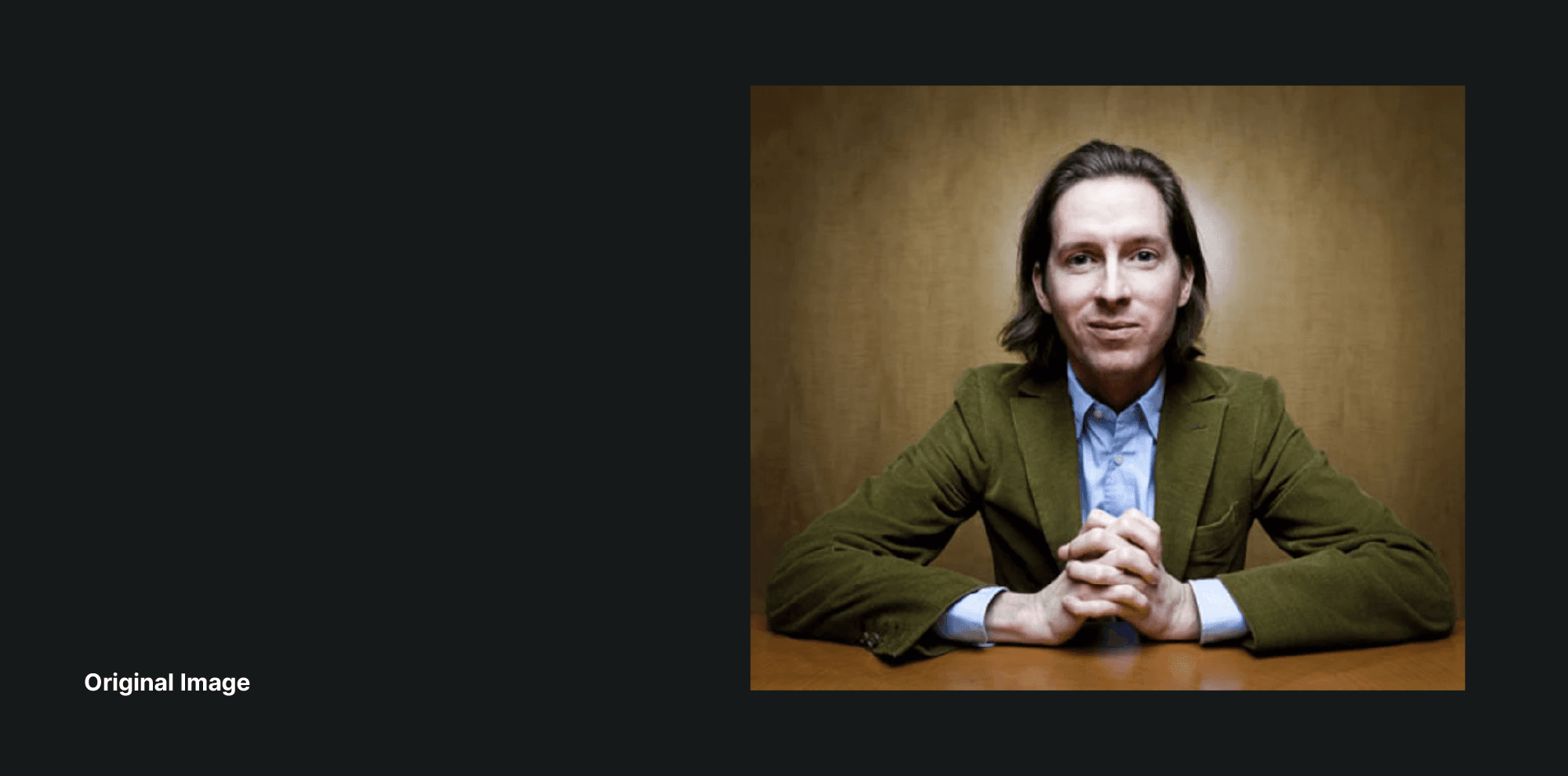
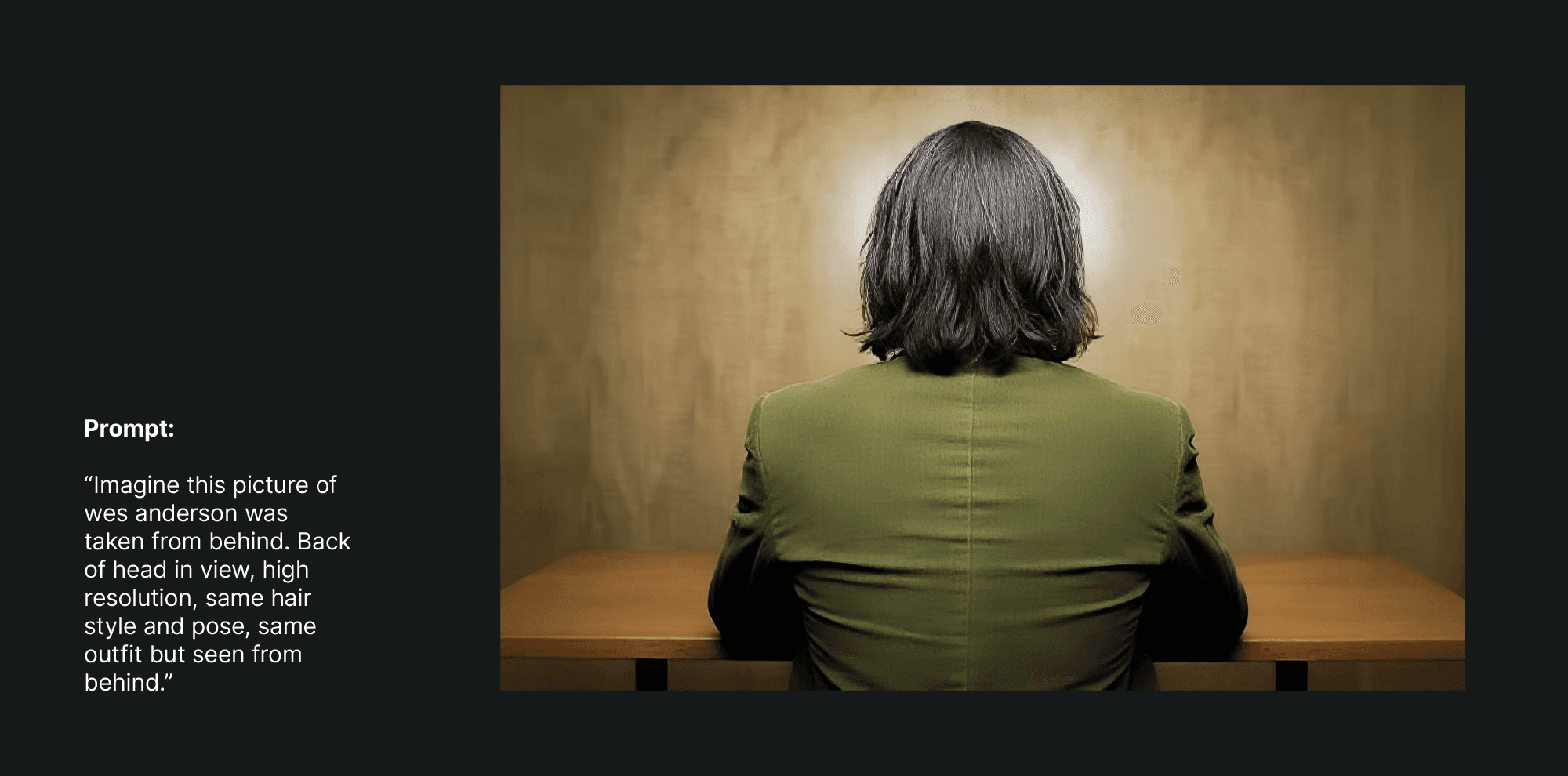
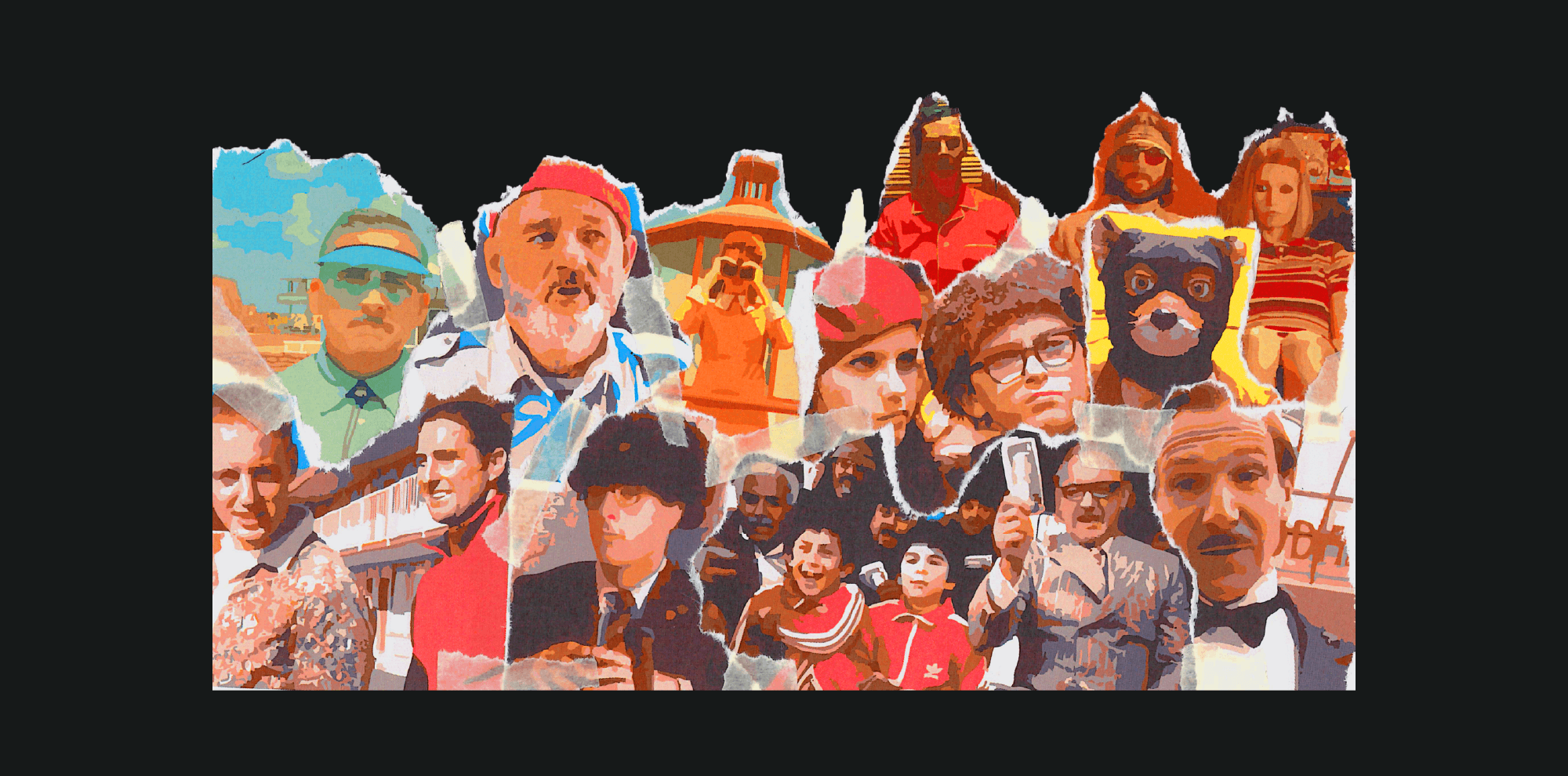
Using the established split-type design, I created filled the top and bottom quarters with the relevant information. Then for the images, which would sit central to the composition, I attempted to find an ensemble of Wes' movie characters and a new image of Wes that didn't directly show his face. I settled on a picture of Wes facing the camera but this broke the rule. I used generative AI to recreate the image as if it was taken from behind and this worked perfectly. After some refinement, I had my image. For the character ensemble, there was no images of all of them together. Only ensembles of particular movies, and not all of them.
I ended up gathering images of characters and printing them all to a similar size. I then tore them out and collaged them together with small pieces of masking tape to give it a hand crafted feel, perfectly fitting the magazine's theme.
After layering these components together, I had a strong composition for my contents page which I'm really happy with.
Biography
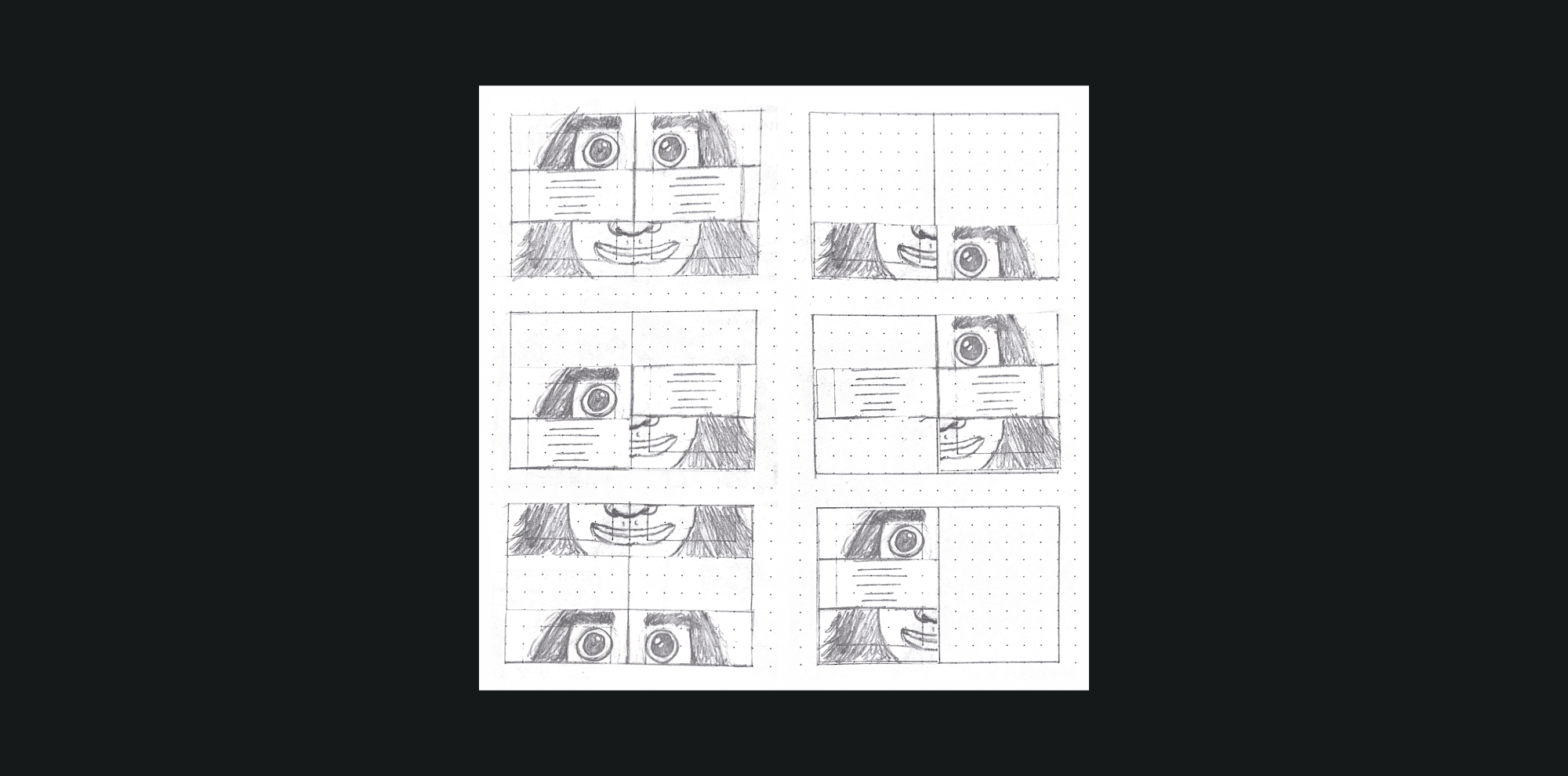
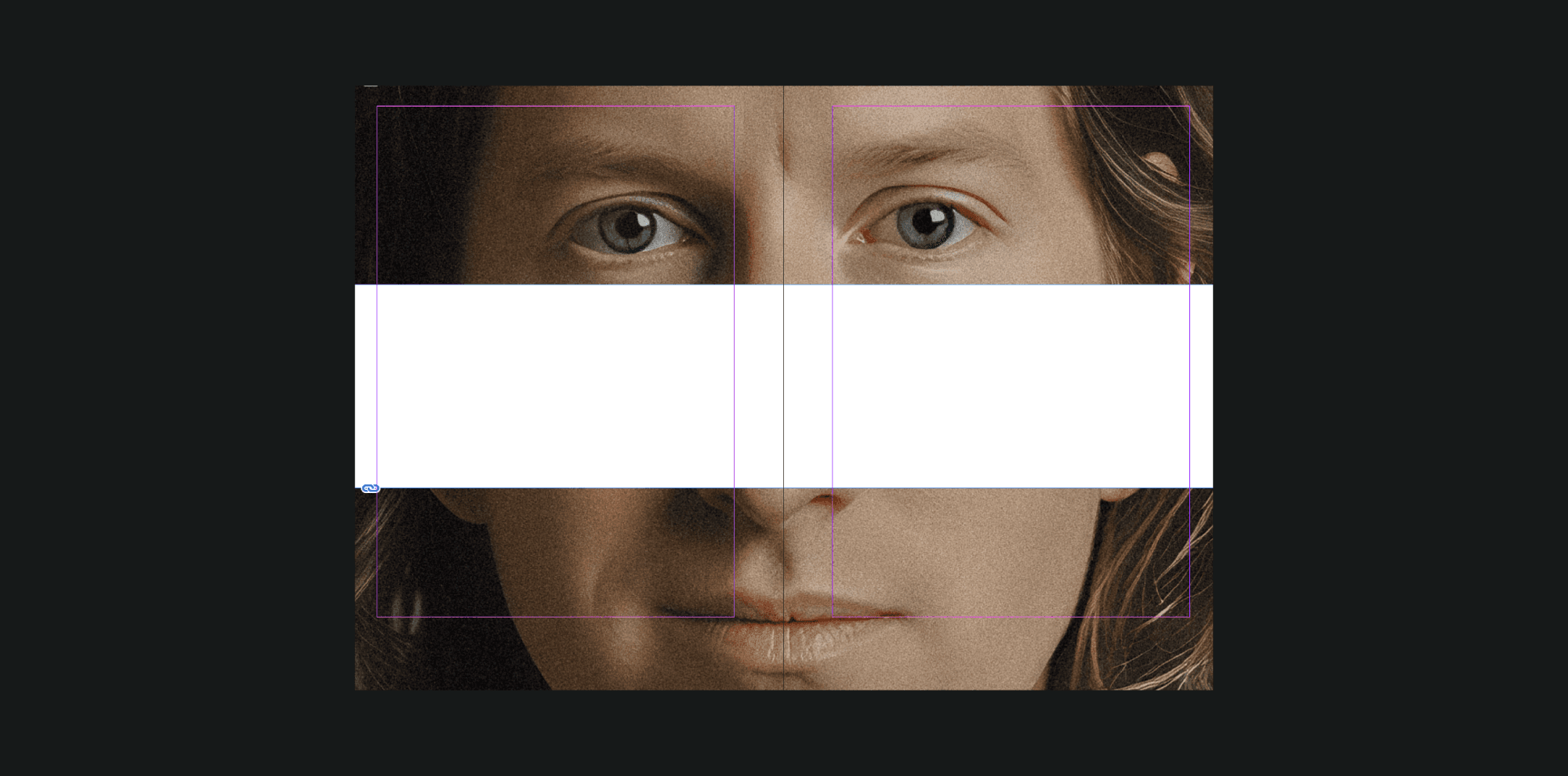
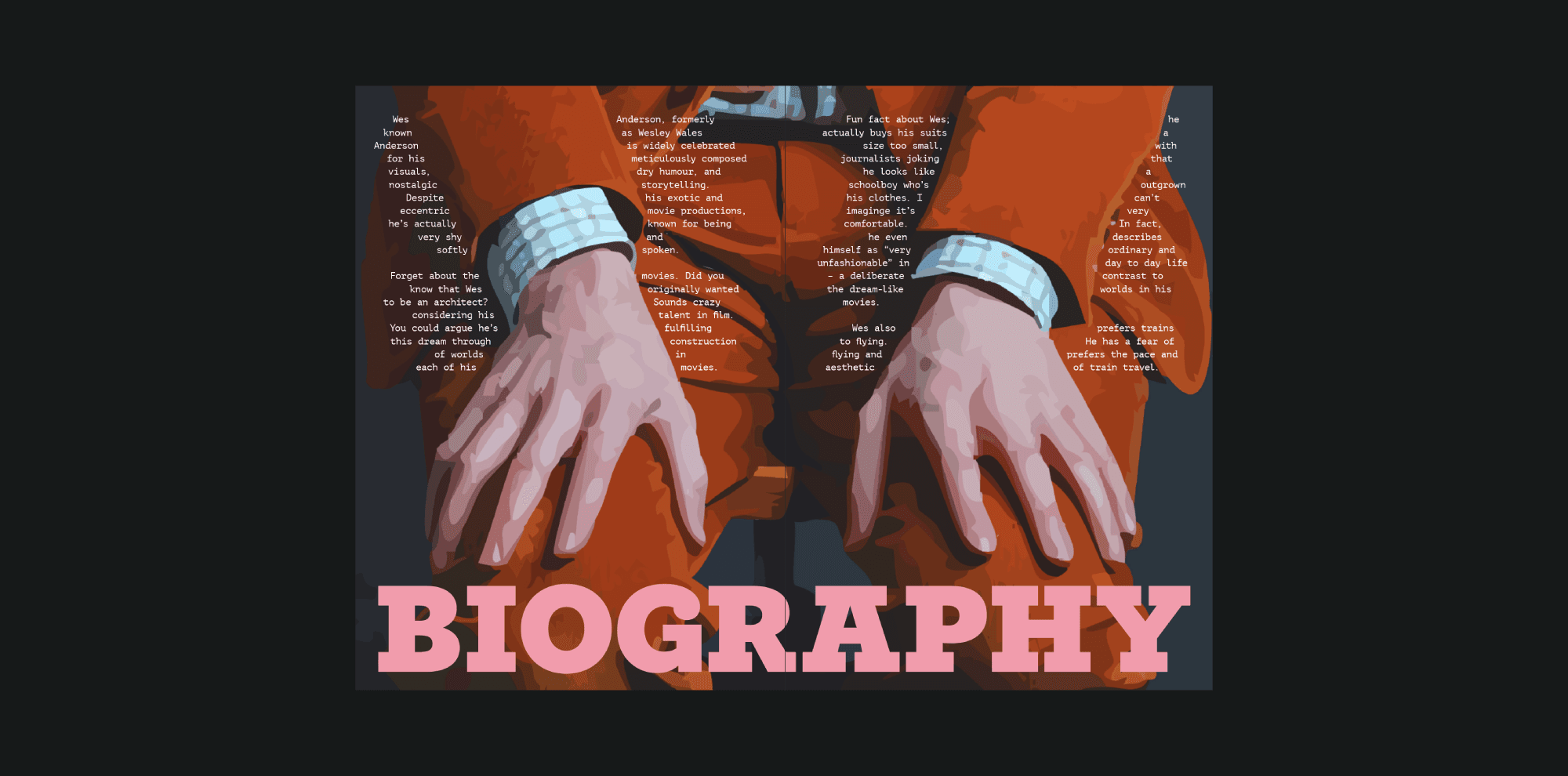
I began by sketching initial layout ideas for the biography page, experimenting with different ways to organise the content. After scanning, printing, and rearranging the compositions, the concepts looked strong in theory but didn’t translate well once applied. One layout in particular unintentionally created the illusion of Anderson having an unusually long face, which made the design feel awkward.
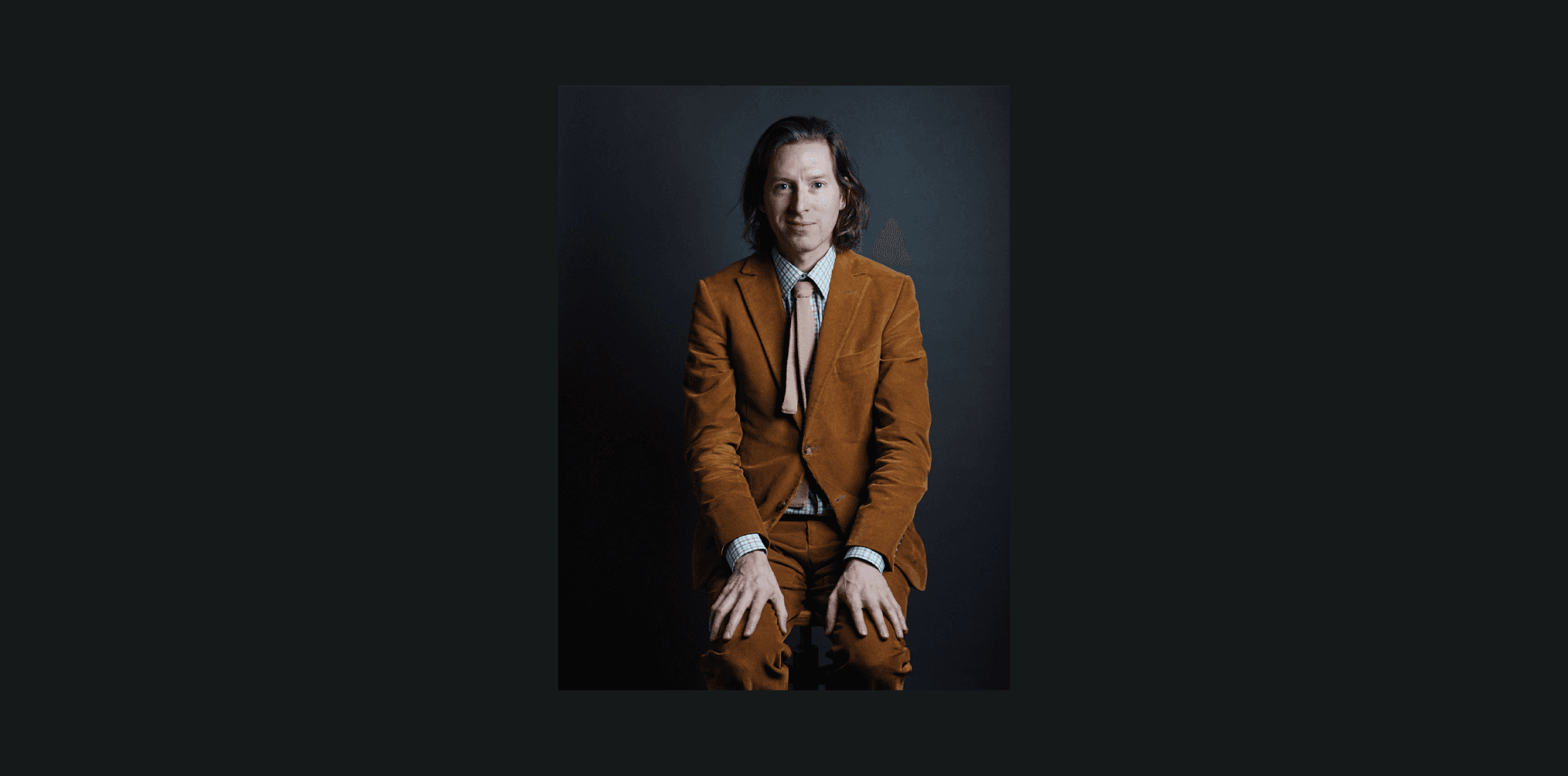
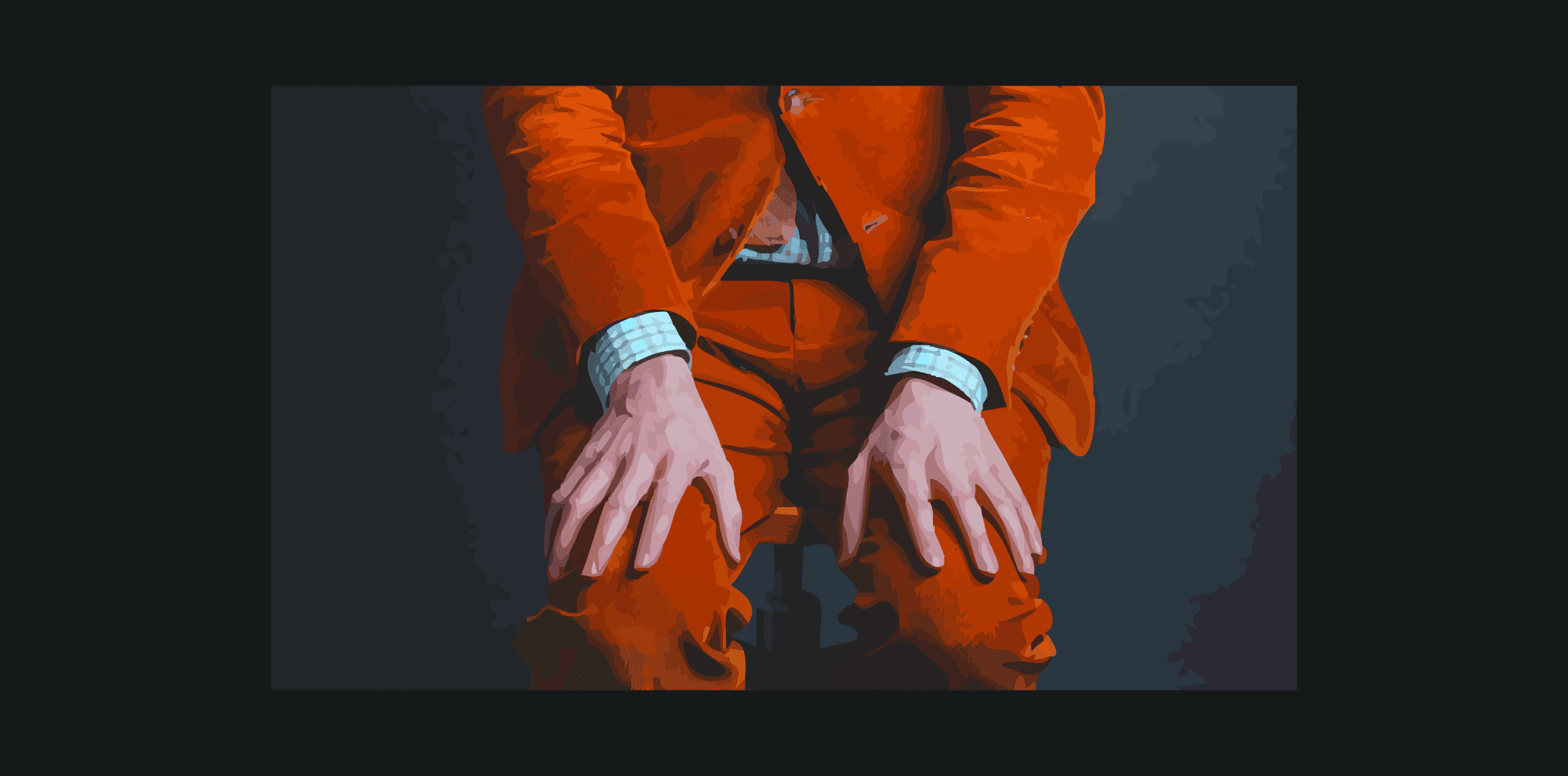
I also wanted to avoid relying on the same portrait repeatedly, especially once I decided not to show his face prominently in the magazine. Instead, I chose an image of his hands resting on his knees as the focal point. This allowed me to wrap the text around his arms, positioning the copy neatly on either side of the page while keeping the visual unobstructed. I applied the same image-trace style as used elsewhere and boosted the saturation for consistency.
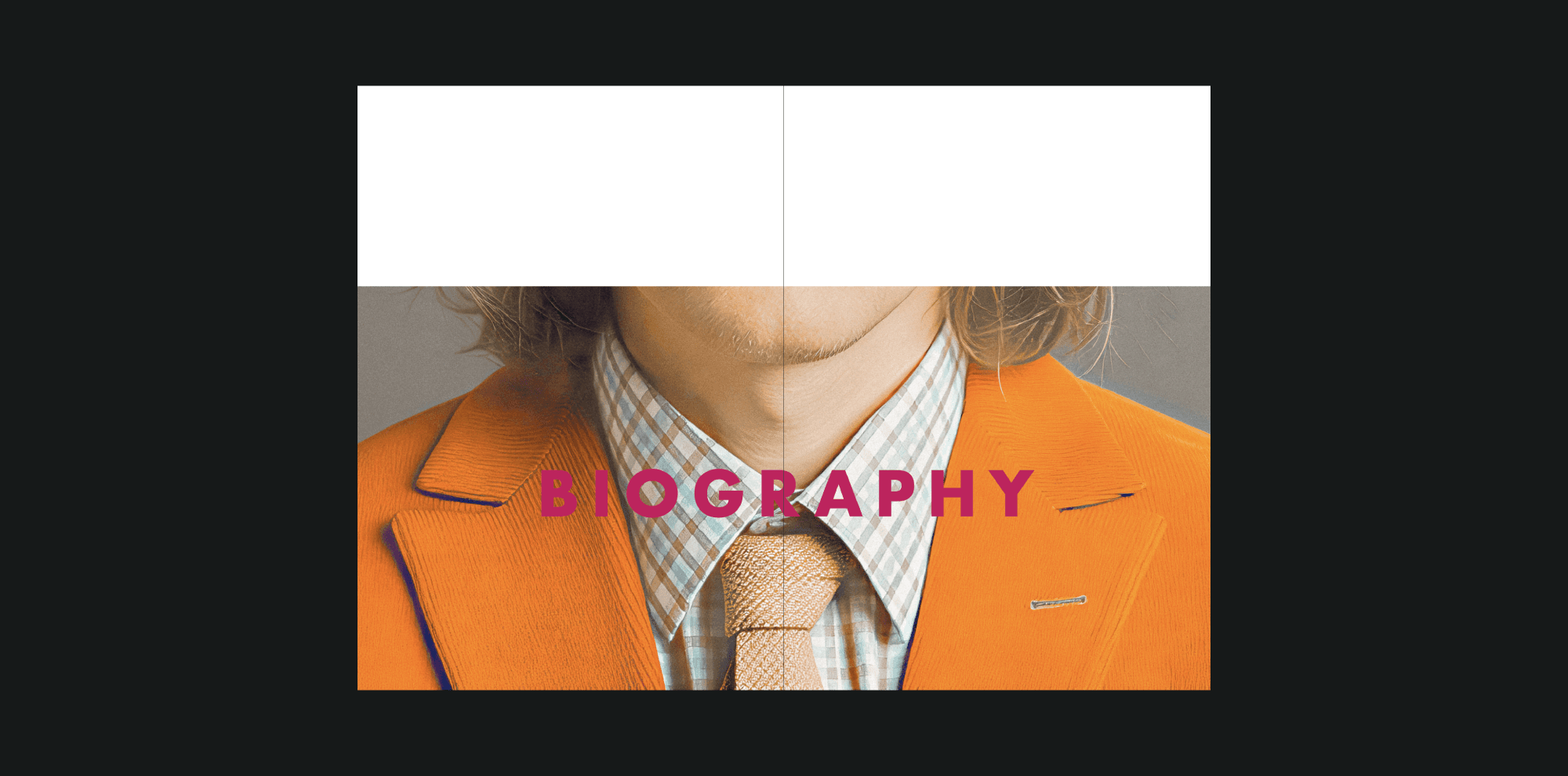
Since the split-type approach no longer worked without adding unnecessary content, I opted instead to place the title Biography in Archer Ultra across the bottom of the spread, set in a pastel pink reminiscent of Anderson’s signature colour palette.
Filmography
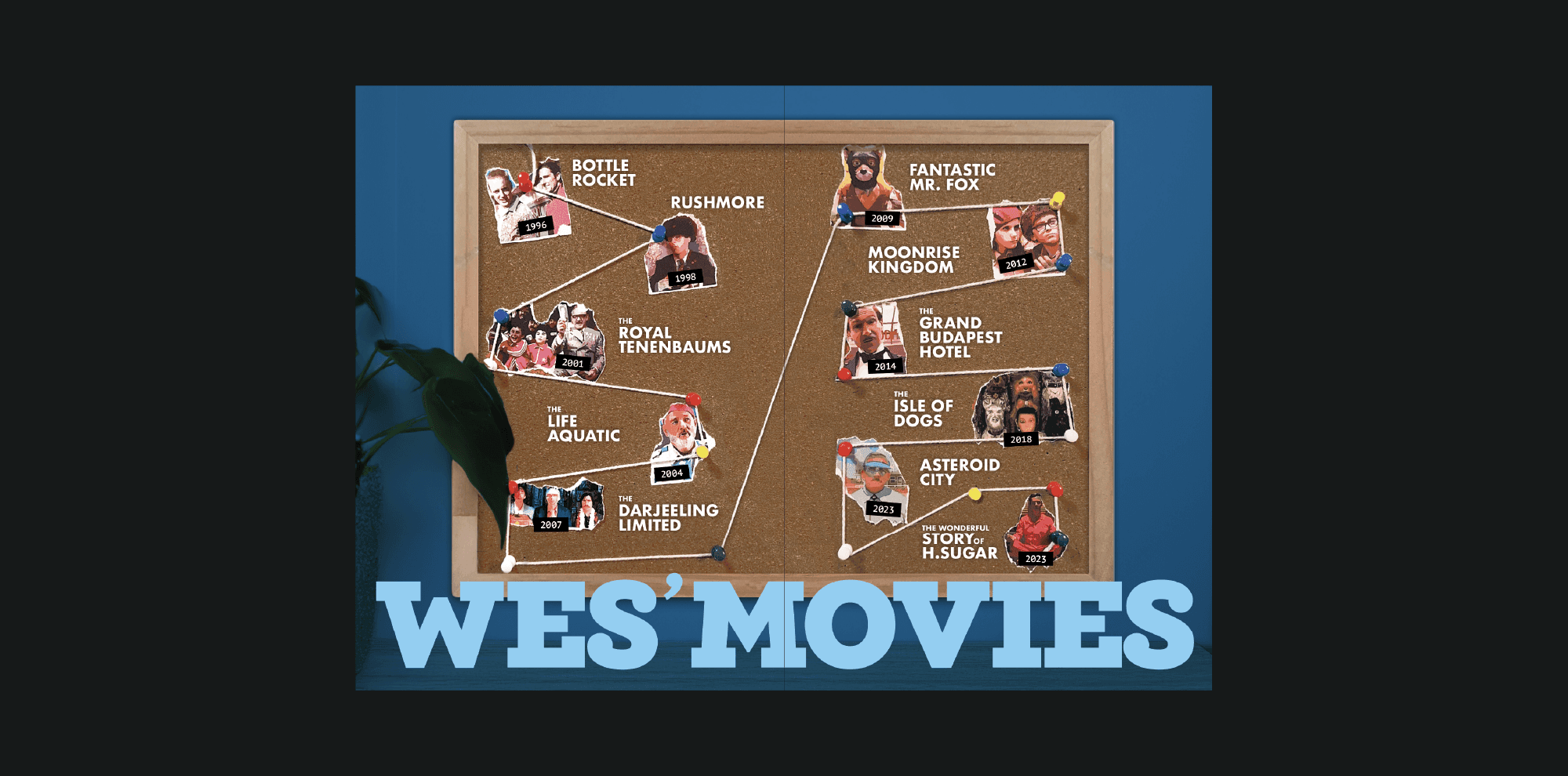
The goal of this page was to present a timeline of Anderson’s films, but I wanted to avoid a predictable geometric line with neatly placed images.
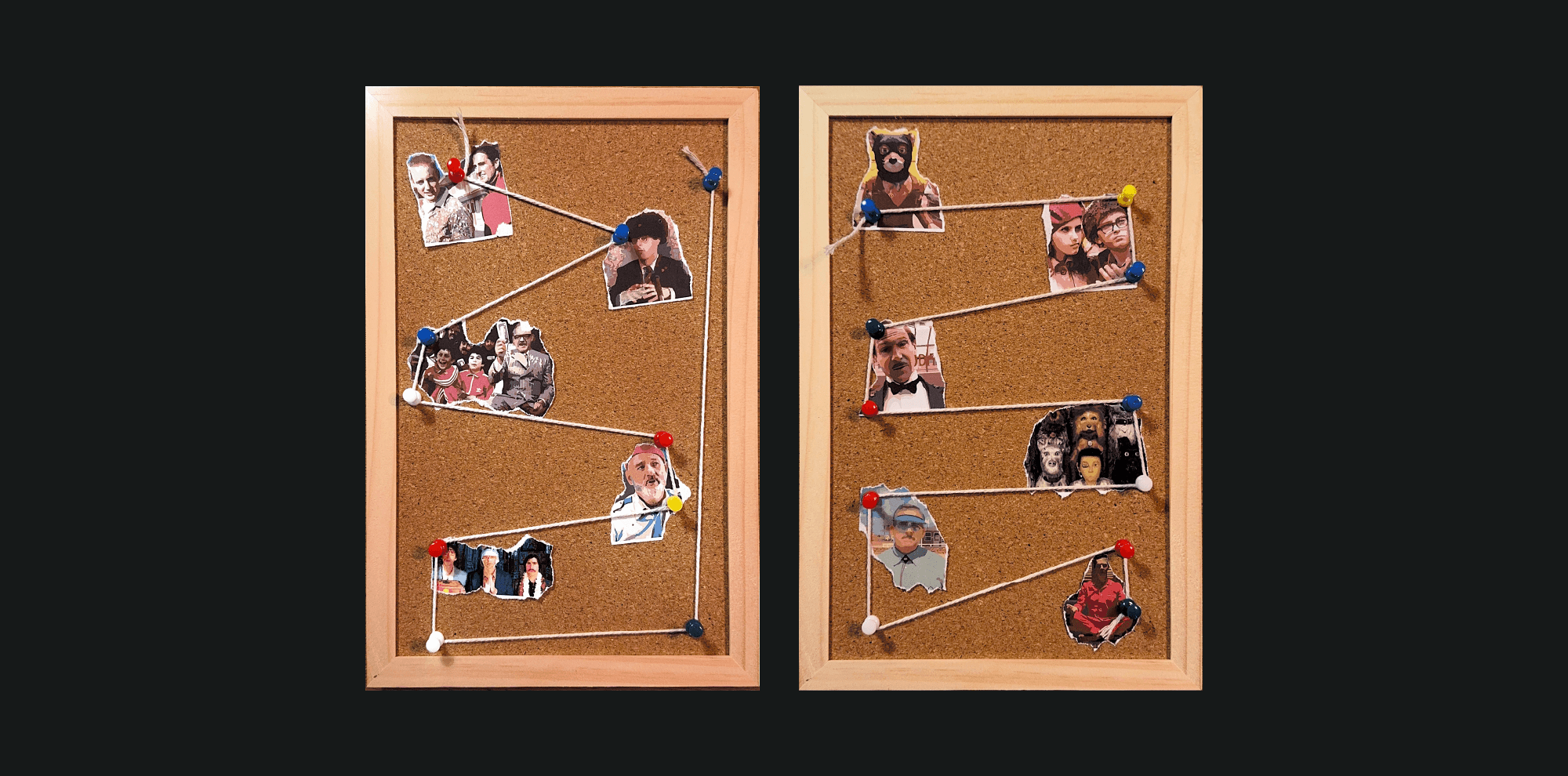
After sketching ideas on paper with Mike, I arrived at a more engaging concept: a physical pinboard displaying torn-out images pinned in place, connected with string to form a visual timeline.
To bring this idea to life, I bought a small A4 pinboard, printed and pinned the images, and threaded string between them to establish the chronology.
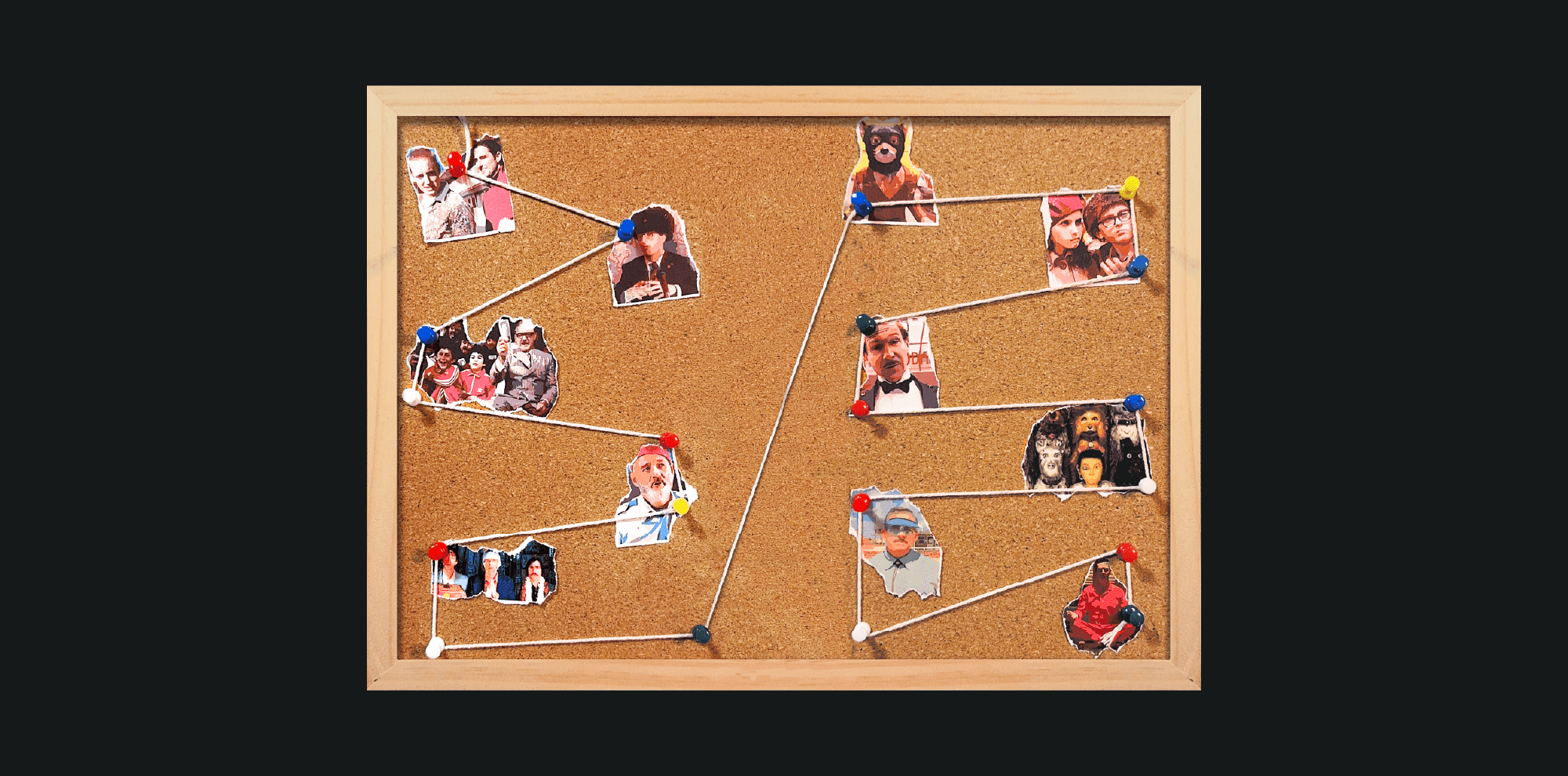
I repeated the process making sure to photograph the board each time to capture everything clearly and later stitched the images together in Photoshop to ensure all the films fit within the spread.
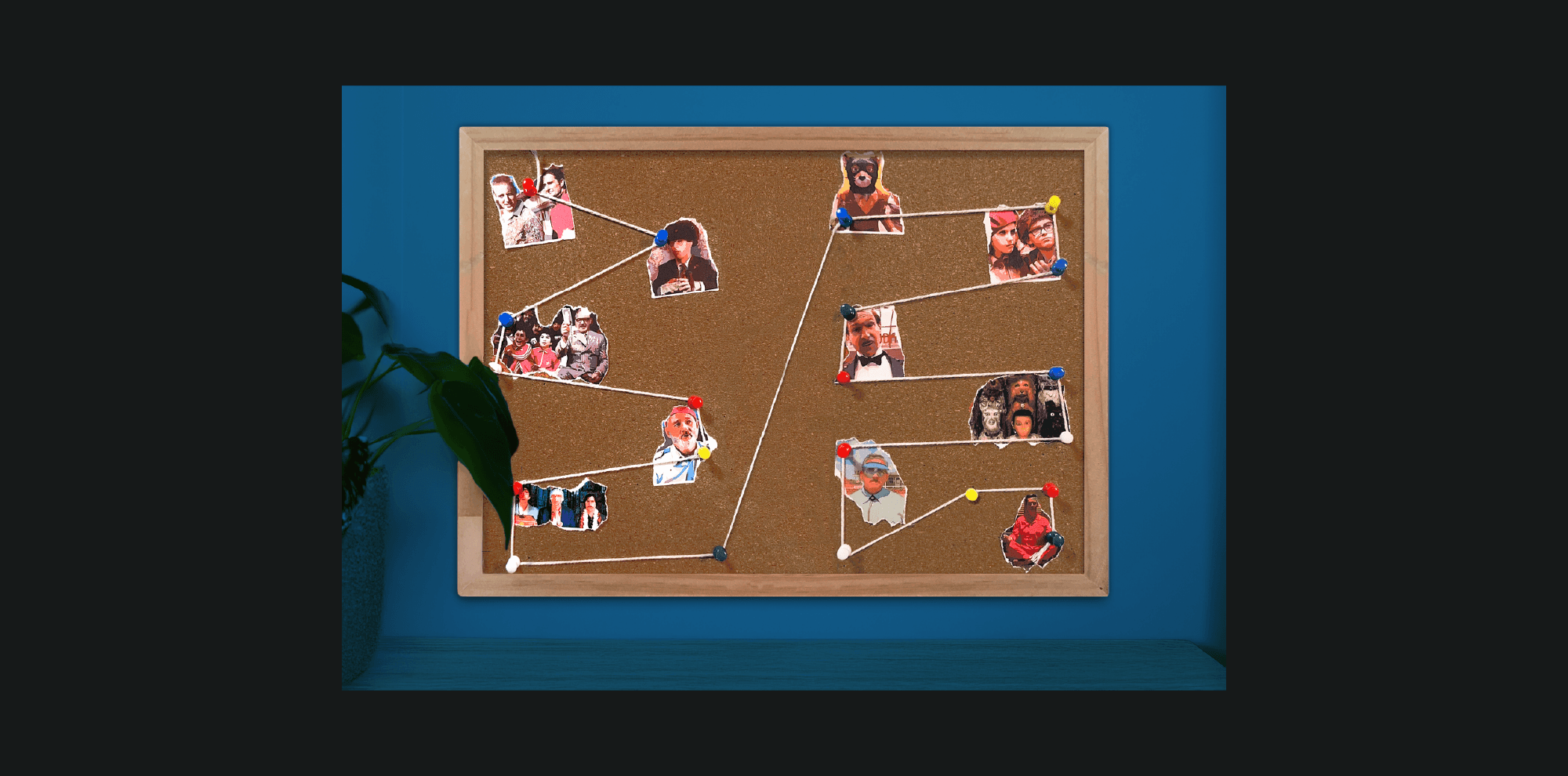
Once I had the pinboards merged into one, I added my typography (film titles, year of creation, brief details of movie). It turned out that the details of each movie ended up taking far too much space and wouldn't realistically work without a much larger pin board. That, or much smaller images which would be no good. After careful consideration of my target market, movie fanatics, I decided to remove the movie details as Anderson's fans would likely already know what these movies are about making it the most logical way to gain back some page real-estate.
Once the composition was finalised, I placed it onto a background with a blue tint and added the title “Wes’ Movies” in the same typographic style used for the biography spread, creating a cohesive visual connection between the pages.
Rear Cover
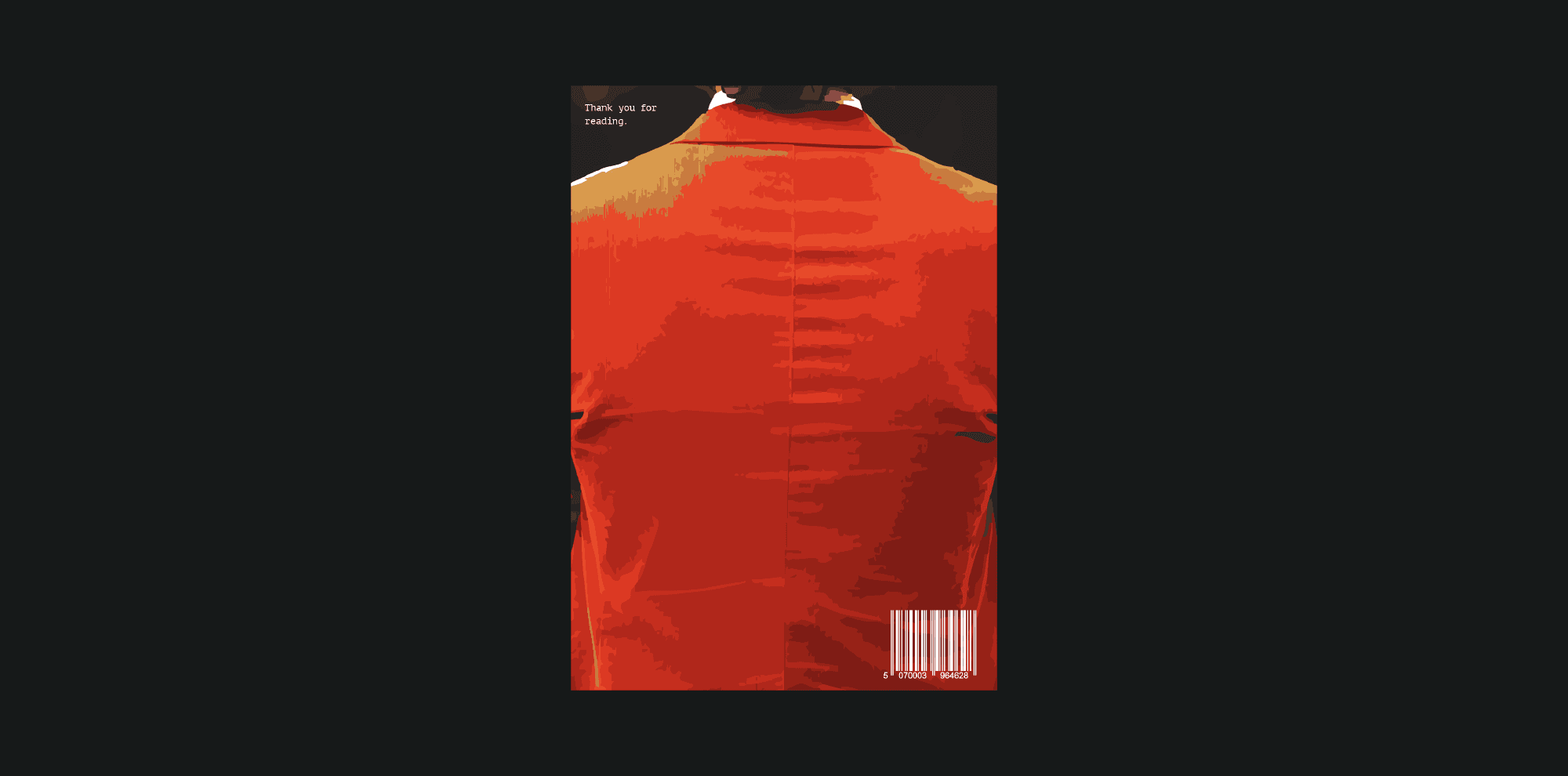
The rear cover was actually quite simple. I noticed in some of Andersons movies, notably "The Wonderful Story of Henry Sugar", they end in the same scenery in which they began, or somewhere very similar.
I used this same 'full circle' story telling method by using the image on the front cover as if it was taken from behind. This works for multiple reasons. The closed magazine would be viewed as a flat piece of print with a 3D level of depth as when turned over, it's though you're literally looking at the back of the magazine as though the cover was a 3D image.
This cover pairing also presents the idea that everything within the magazine is within Wes Anderson, which is technically where it all comes from. Every nuance, every idea, every movie, design choice… it all came from within Andersons mind. I'll admit though, this was a secondary thought after I had designed the rear cover and simply a coincidence.
Final touches include a barcode in the bottom right and a small message that reads "thank you for reading" in the top left.
Final Outcome
Below you can see the final outcome of the magazine as an embedded e-magazine. Alternatively, you can download the magazine as a PDF by clicking the button below.
Task 2
Taking your favourite film produced by your chosen director, produce 2 posters in alternative styles to advertise it. Showing at the Worthing Connaught cinema. The International Swiss graphic style is the compulsory solution and the second is to be in a style of your choice eg collage, photography, illustrator flat illustration.
Poster Research
The task for our poster research was to find a poster from the 1930s, 60s, 90s, and present day. The posters could be chosen from one of four purposes, from which I chose protest/propaganda. Below are my examples and a brief analysis of each.
Poster Research
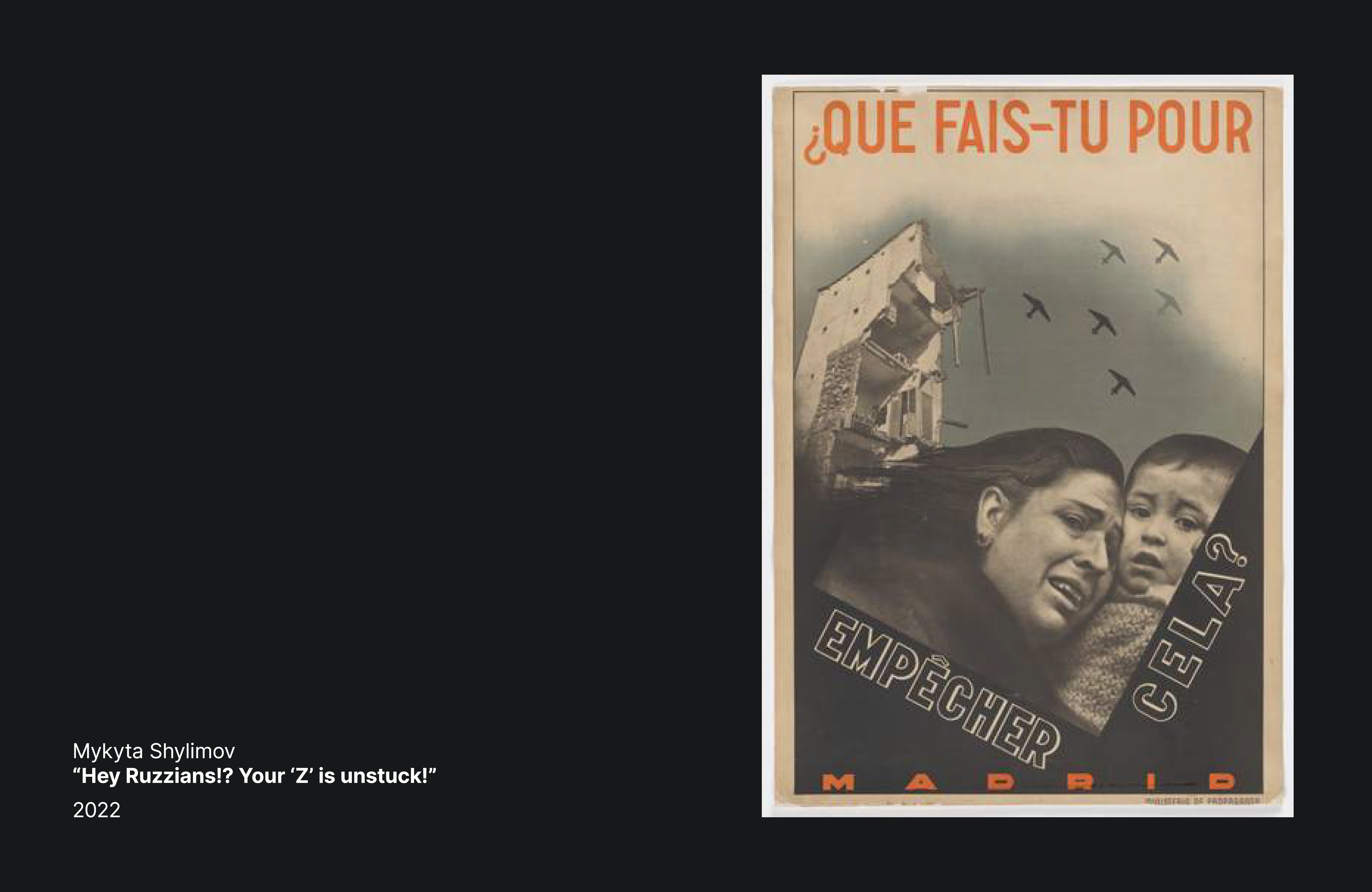
1930s
This poster is taken from the Spanish Civil War, one of the earliest conflicts in which mechanised warfare was unleashed against civilian populations. The distressed mother and child are central to Republican propaganda of the period which frequently depicted women and children as the primary victims of Nationalist air raids. Behind them is a ruined building as a result of ruthless bombing. War planes can also be seen from above, a visual reminder of the constant threat from above. The photomontage and rough textures echo contemporary press photography, giving the message credibility and the angled condensed typography also adds urgency. This poster was part of a broader international campaign that sought to expose atrocities such as the bombing of Guernica and to evoke global sympathy for the Republican cause.
Poster Research
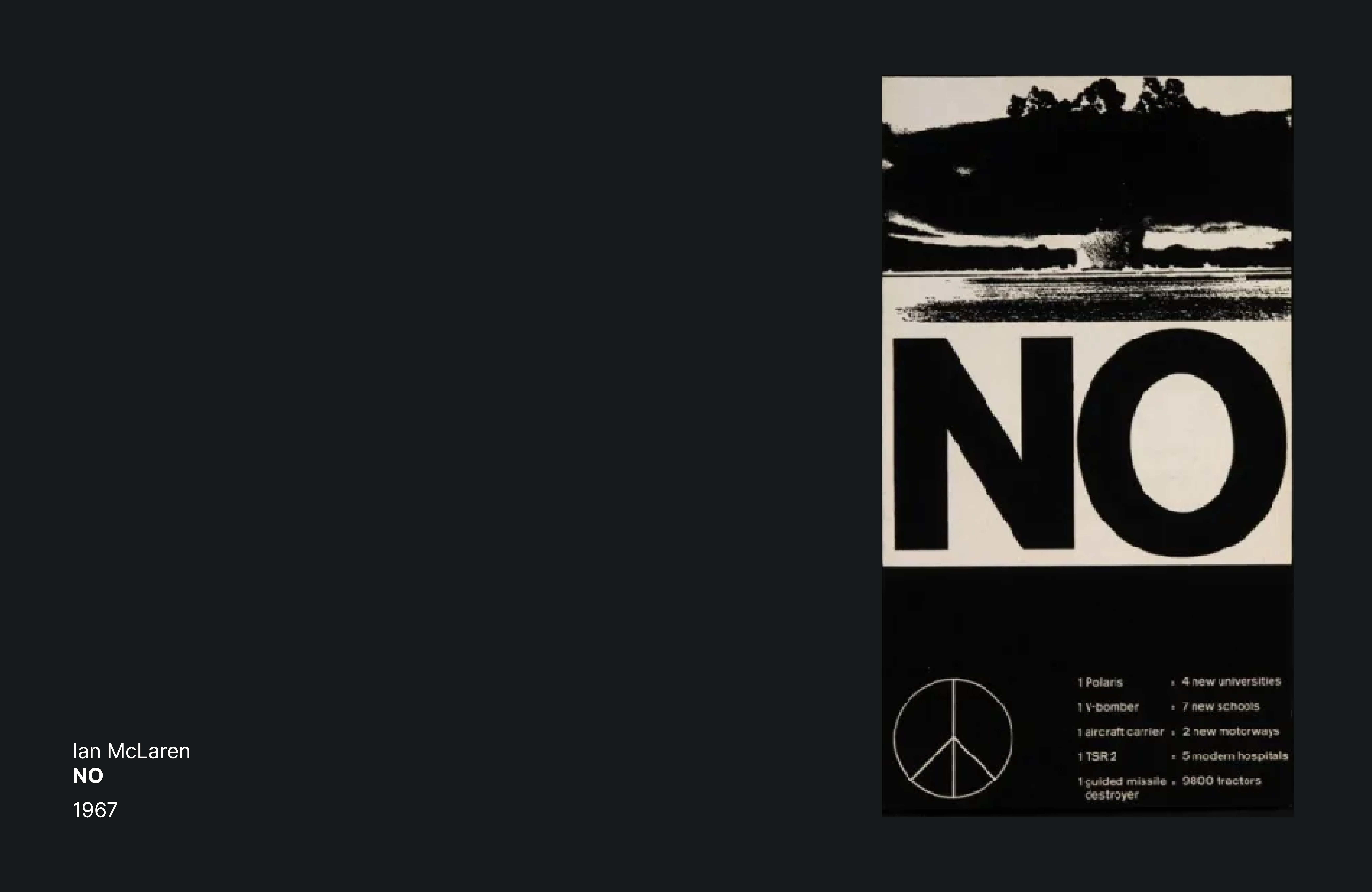
1960s
McLaren’s poster is pure reduction. Everything is stripped to high contrast black and off white, with three stacked zones. At the top, a stark, almost abstracted photograph of a mushroom cloud across the horizon establishes the subject without explanatory text. The middle band is dominated by the word “NO” in large geometric sans serif letters, a blunt typographic element that functions as type and image simultaneously. The lower black block contains a fine-line peace symbol and small, rational text comparing the cost of weapons to social spending. The layout is rigidly vertical and architectural, using scale to utterly refuse the idea of nuclear war whilst giving a supporting argument as to why (how funding can be used for good rather than war).
Poster Research
1990s
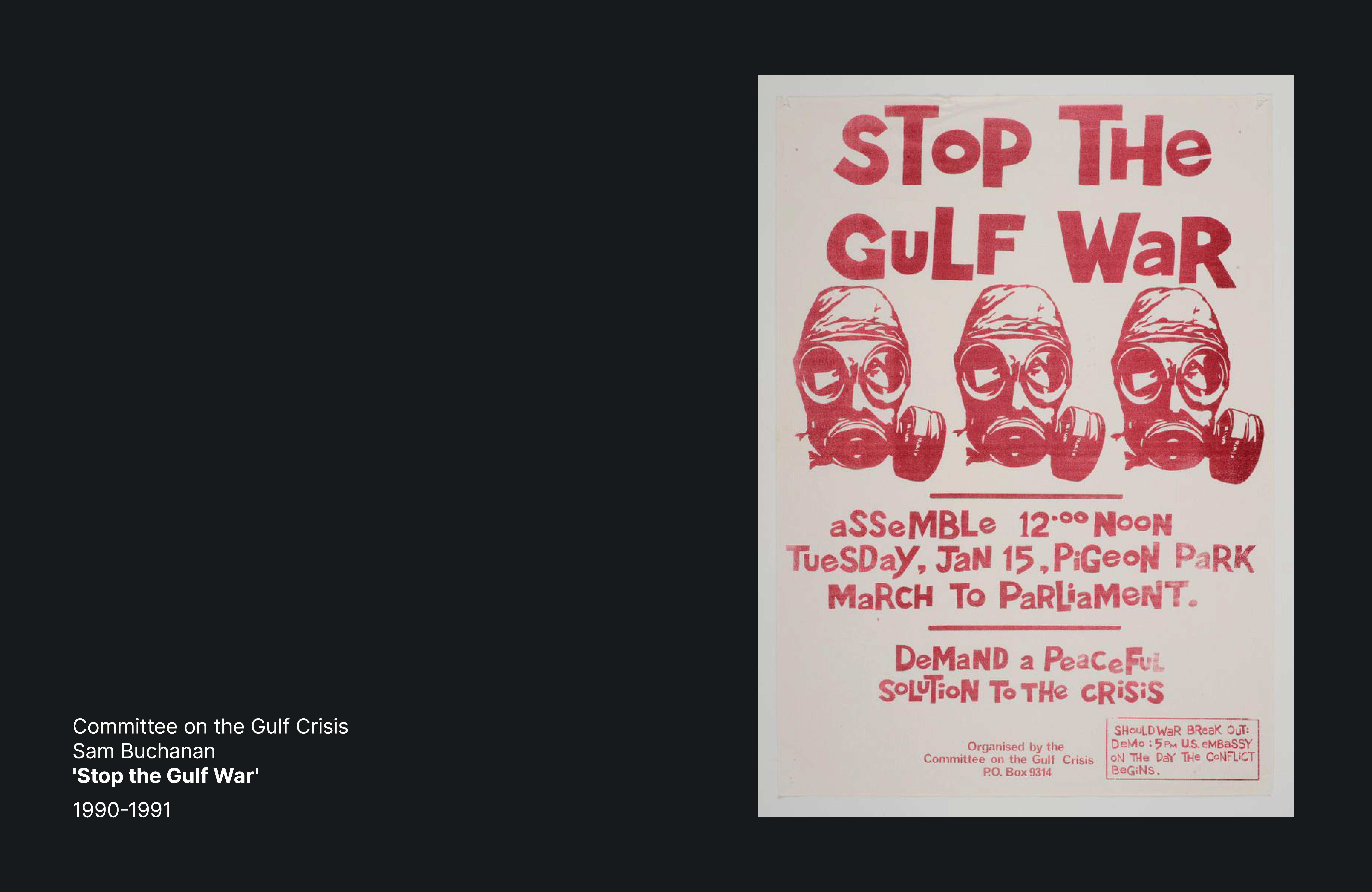
This Gulf War protest poster feels completely different. It's informal, handmade and immediate. The red ink looks like a cheap screen print or stencil, slightly uneven and patchy in places. Three repeated gas mask heads form a crude, almost cartoonish style. The lettering is highly irregular with mixed upper and lower case characters, inconsistent baselines and playful distortions that mimic quick scribbles. There is no strict grid, instead the information is squeezed wherever it fits. The DIY aesthetic communicates grassroots authenticity and makes the poster feel like something produced by activists themselves, not by a design studio, and the message is a practical call to assemble and march.
Poster Research
Present
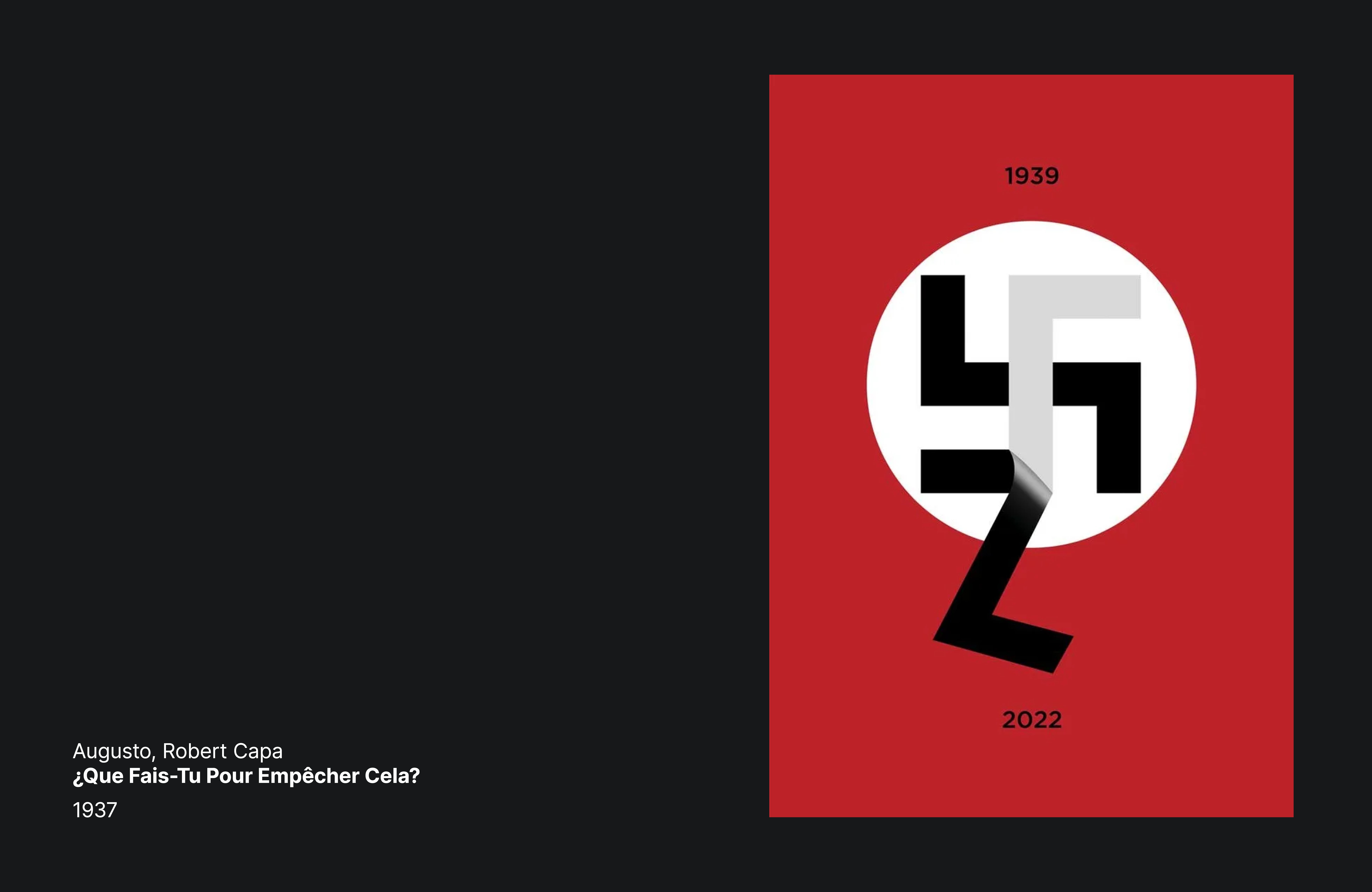
Created by Ukrainian designers who were forced to relocate due to the Russian invasion, this poster operates through immediate symbolism. A flat red field and white circle deliberately symbolise the Nazi flag, but the central black swastika is manipulated so that one arm peels downward into a “Z”. The letter Z has been seen in use by the Russian military for other purposes, but the Russian public have widely appropriated the symbol as a pro-war emblem. The subtle grey underside of the peeled stroke reinforces the idea of exposure or unmasking, visually equating past fascist aggression with present-day Russian militarism. The two dates compresses the comparison into two historical moments, relying on the viewer’s cultural literacy to understand the parallel. Its clean vector geometry clarity are key identifiers of modern design and expresses the need to communicate a global warning with as little language as possible.
Poster Research
Comparison
Across these four posters, the evolution of visual protest language becomes clear. The 1930s Spanish Civil War poster relies on emotional photomontage, confronting viewers with the suffering of civilians, especially women and children, in a new era of mechanised total warfare. Its aim is humanitarian persuasion: to expose atrocities like Guernica and galvanise international support.
By the 1960s, Ian McLaren’s NO adopts a modernist visual language: stark contrast, geometric typography, and a tight grid that shifts protest from emotional appeal to a mixture of visceral refusal and rational argument, reflecting the design culture of the era.
The 1990s Gulf War poster moves in the opposite direction. Raw, hand rendered, and decentralised design communicates the grassroots activism and DIY aesthetic of street protest culture. It prioritises immediacy and participation over formal design.
The present-day Ukrainian poster returns to conceptual clarity but with contemporary digital precision. Created by displaced designers, it draws power from symbolic equivalence by folding a Nazi swastika into the modern Russian “Z” military symbol to warn of recurring authoritarian aggression.
As time progresses, protest imagery shifts from documentary realism to modernist reduction, to DIY activism, and finally to highly distilled symbolic communication. Despite this, the core intent always remains the same: to expose violence, encourage resistance, and reach the conscience of an international audience.
Swiss Style
Swiss Style
Research
Swiss Style, often called the International Typographic Style, emerged in Switzerland during the 1940s and 1950s at a time when Europe was still rebuilding from the upheaval of war. Designers were searching for clarity and order, and for a visual language that could communicate across borders without relying on national motifs or decorative flourishes. In many ways, Swiss Style grew out of a desire for neutrality, a belief that design should be clean, objective, and grounded in logic rather than personal expression. It was not about removing personality entirely, but about clearing away distractions so the content could speak more directly.
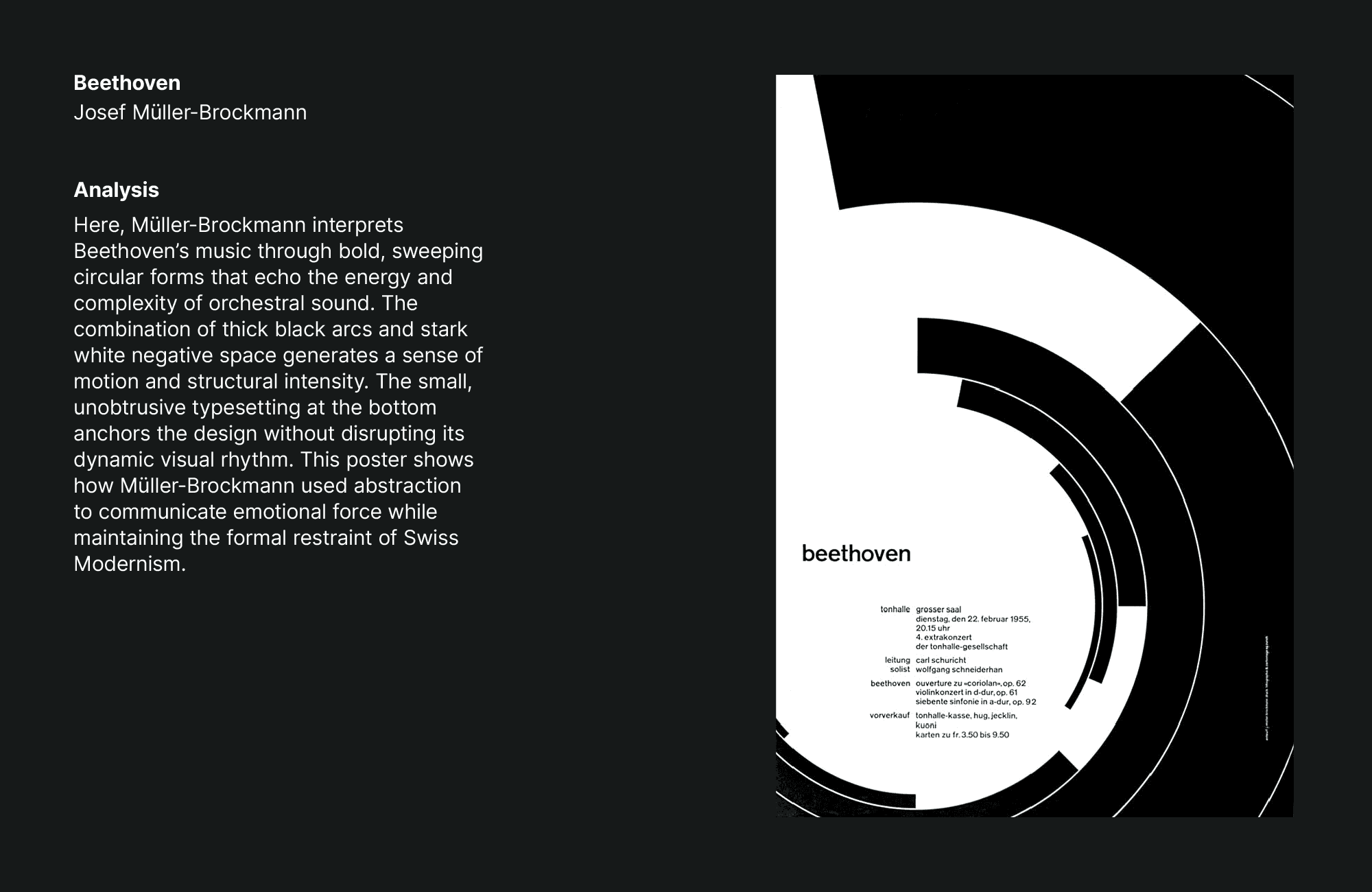
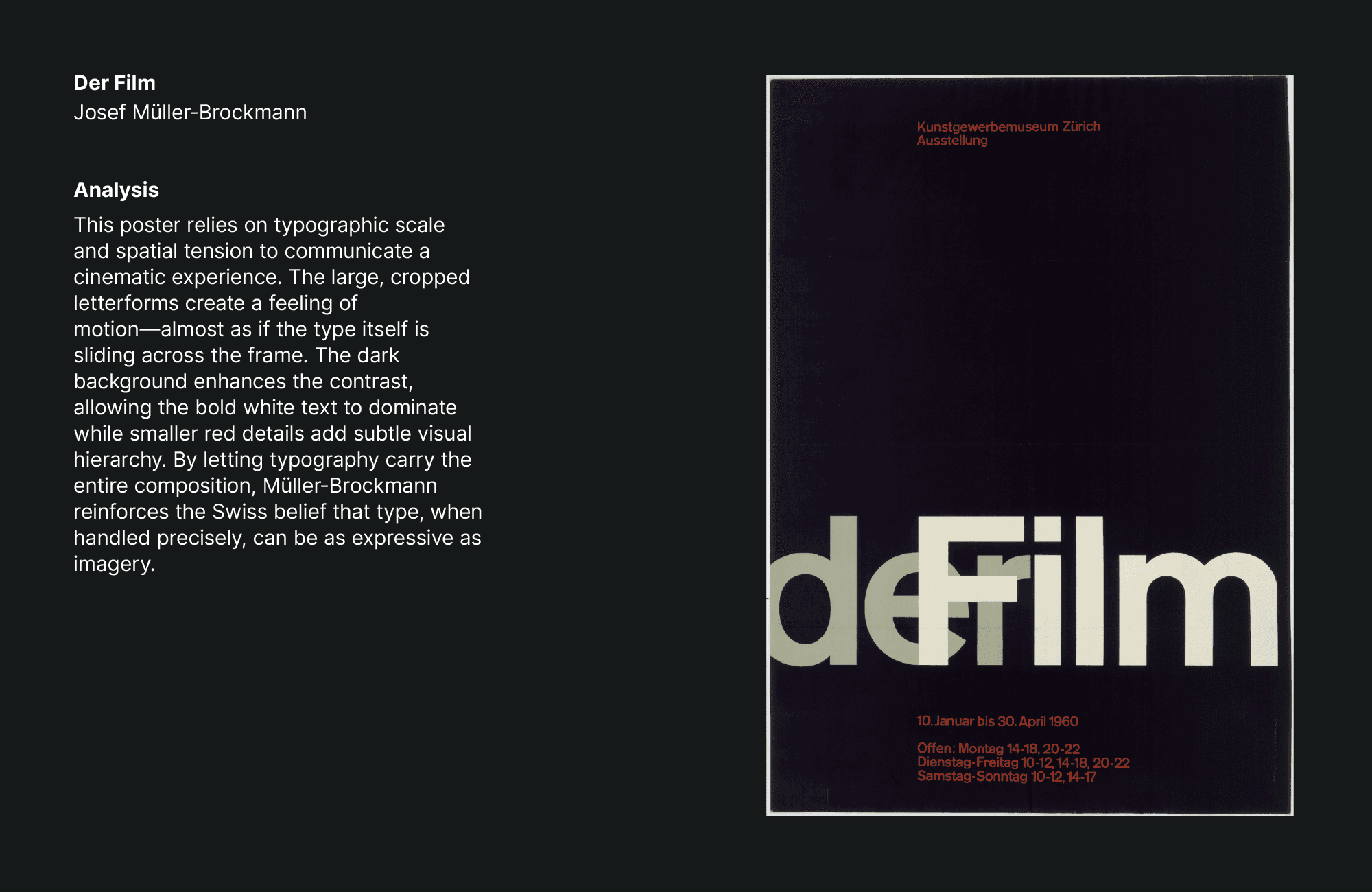
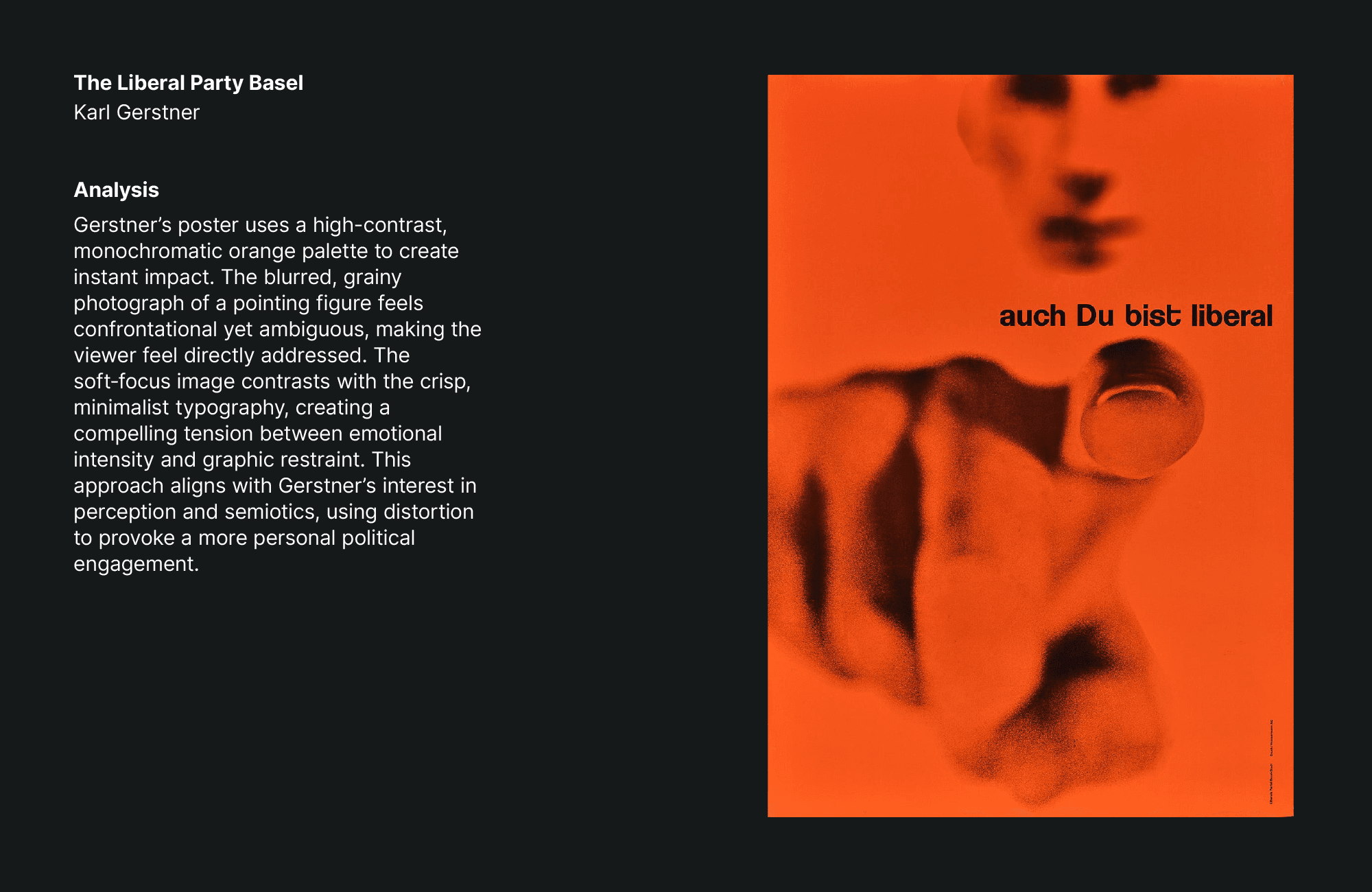
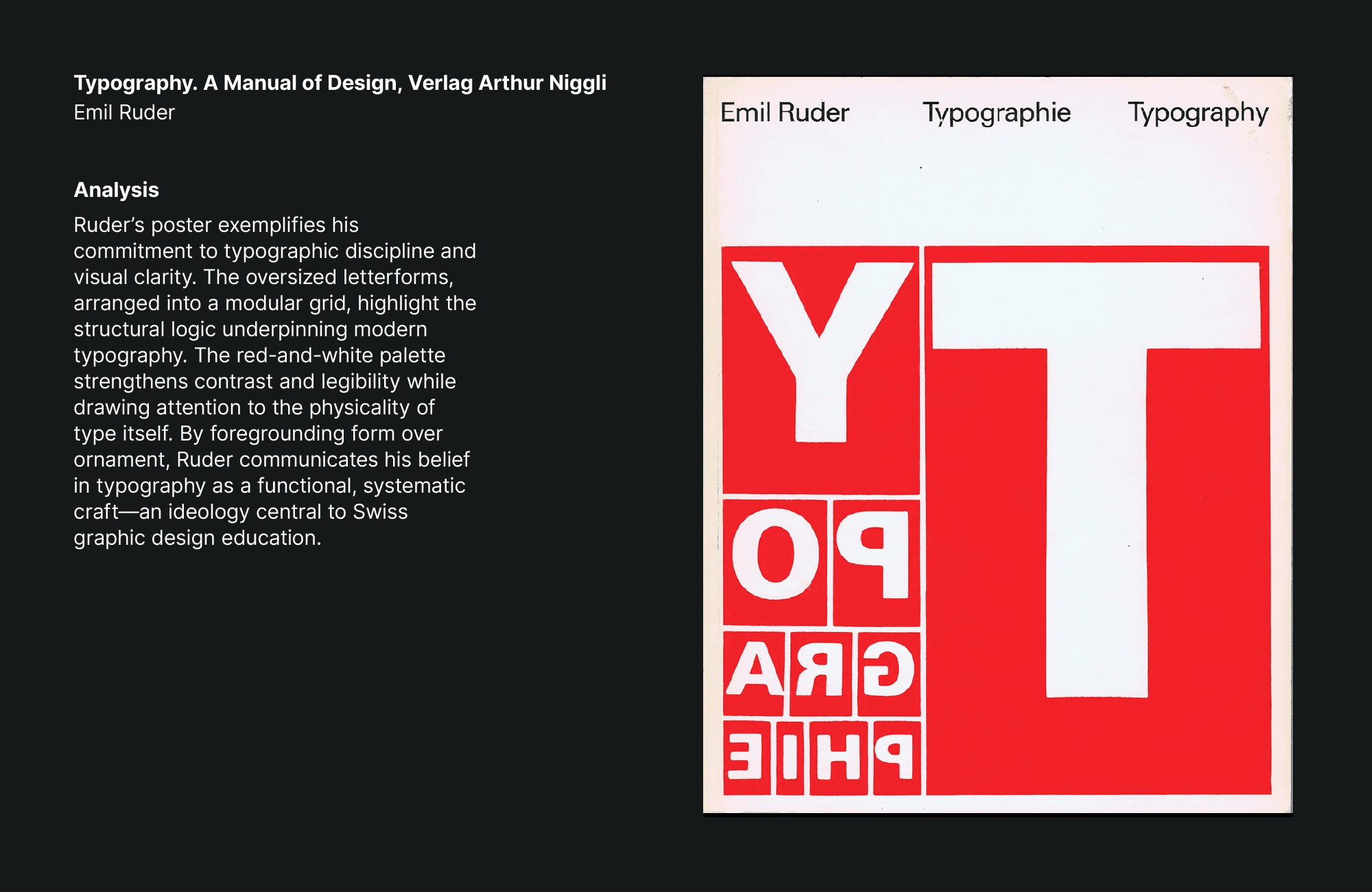
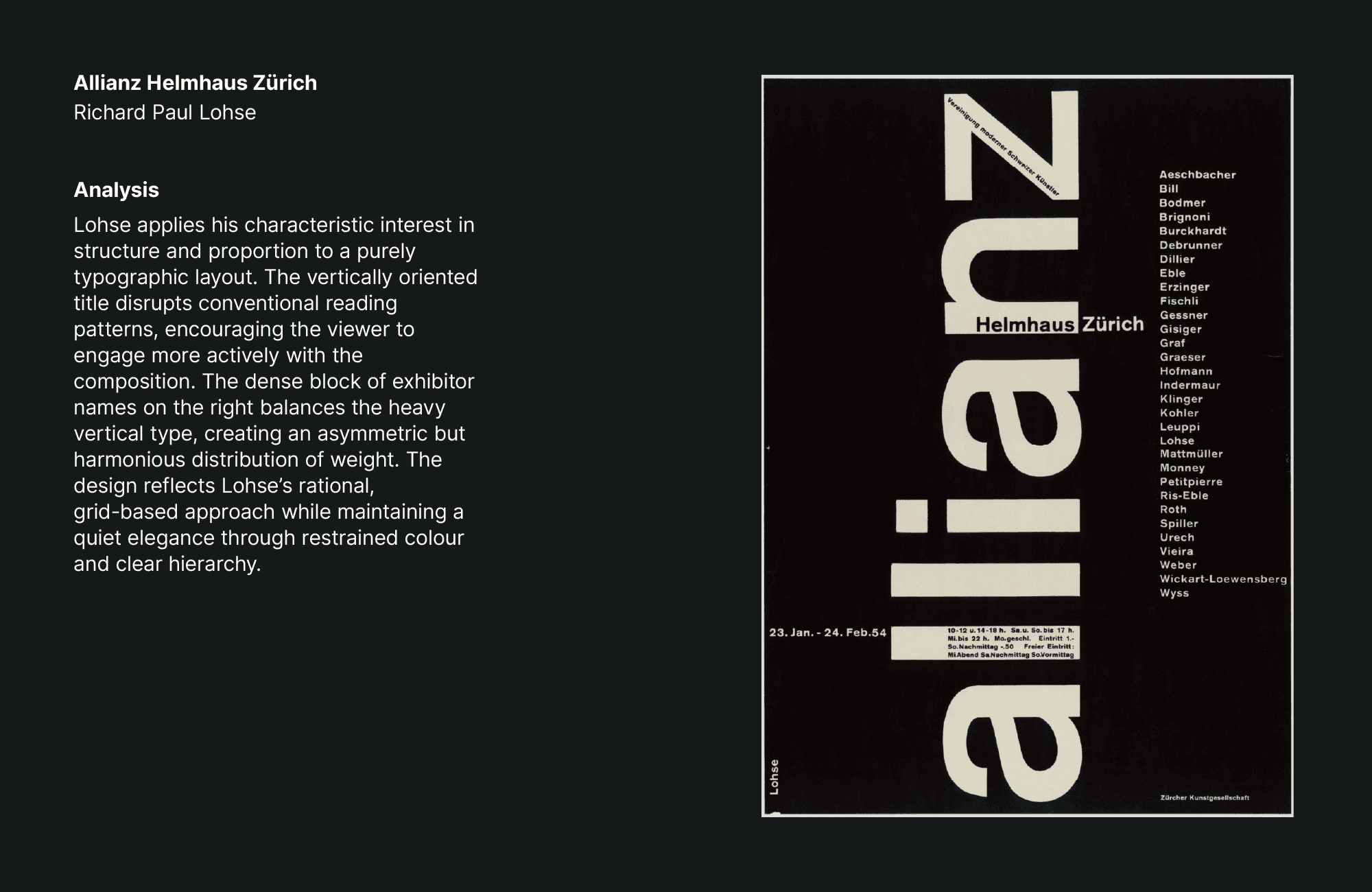
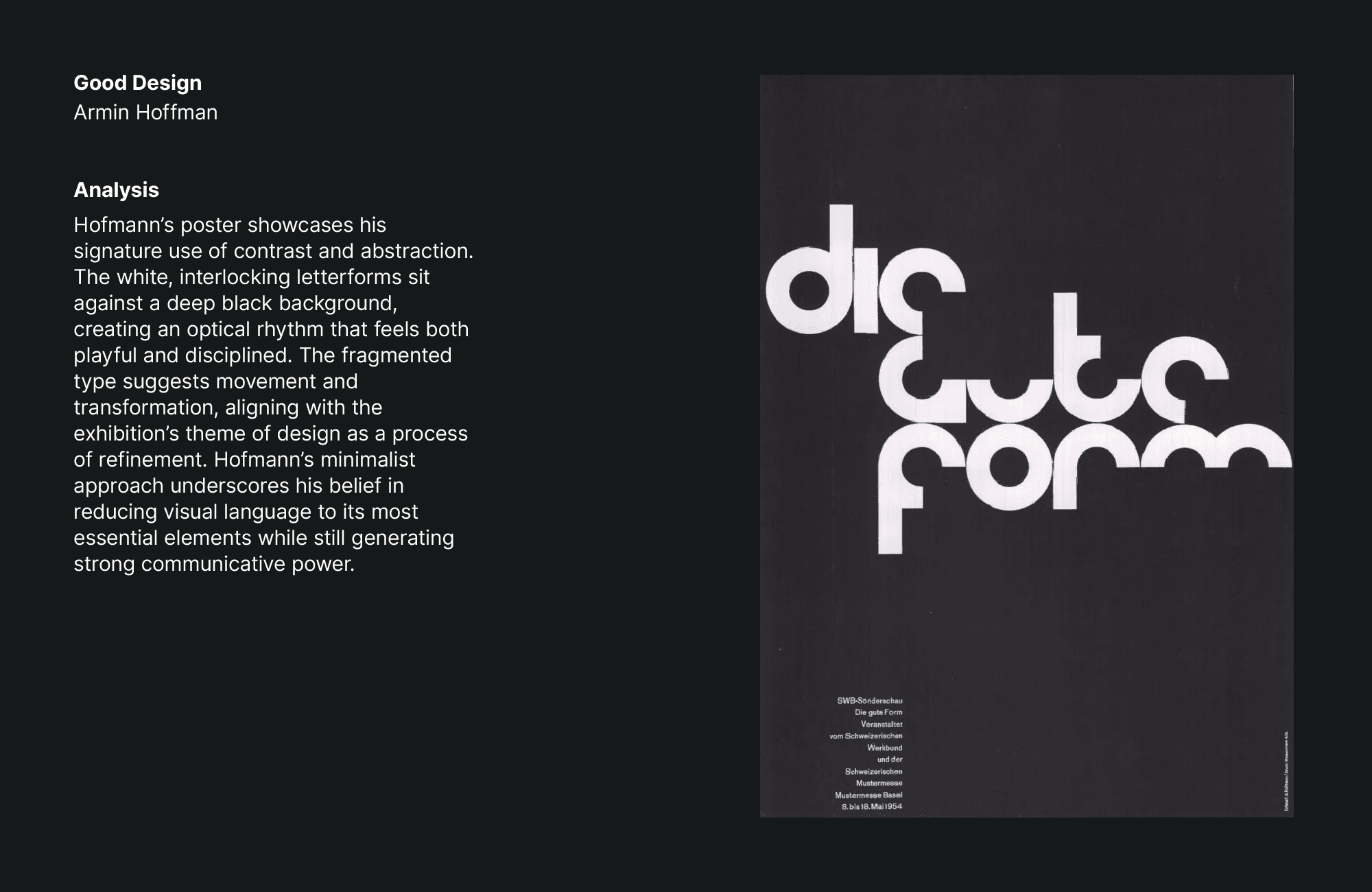
The movement developed around several key schools and teachers. The Zurich School of Arts and Crafts, led by figures like Josef Müller-Brockmann, encouraged the use of grids, sans-serif typefaces, and mathematically precise layouts. In Basel, Armin Hofmann and Emil Ruder promoted a similar approach, arguing that typography should be clear enough to transcend language. These two centres became the intellectual engines of the movement, and their ideas spread through workshops, posters, and design manuals.
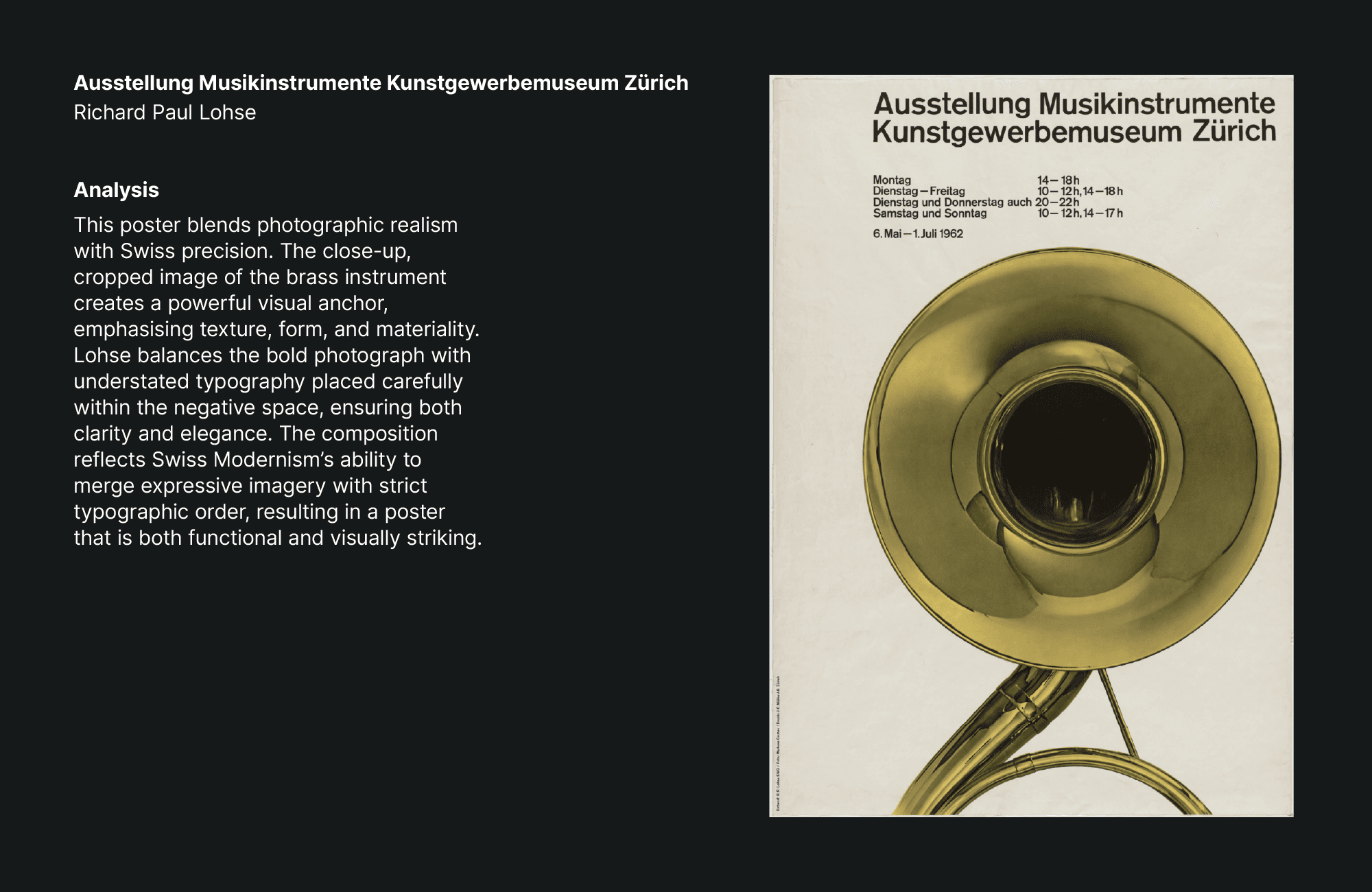
Swiss Style was rooted in practicality. Europe was becoming increasingly international, and designers needed visual systems that could function across posters, signage, packaging, and corporate communication. To achieve this, they relied on a handful of core principles: asymmetric layouts anchored by modular grids, photography used as a factual element rather than decoration, and a preference for sans-serif typefaces like Helvetica, which later became synonymous with the style. White space was treated as an essential structural component that created calm and order. Colour was often used sparingly, usually in bold, limited palettes that reinforced hierarchy and clarity.
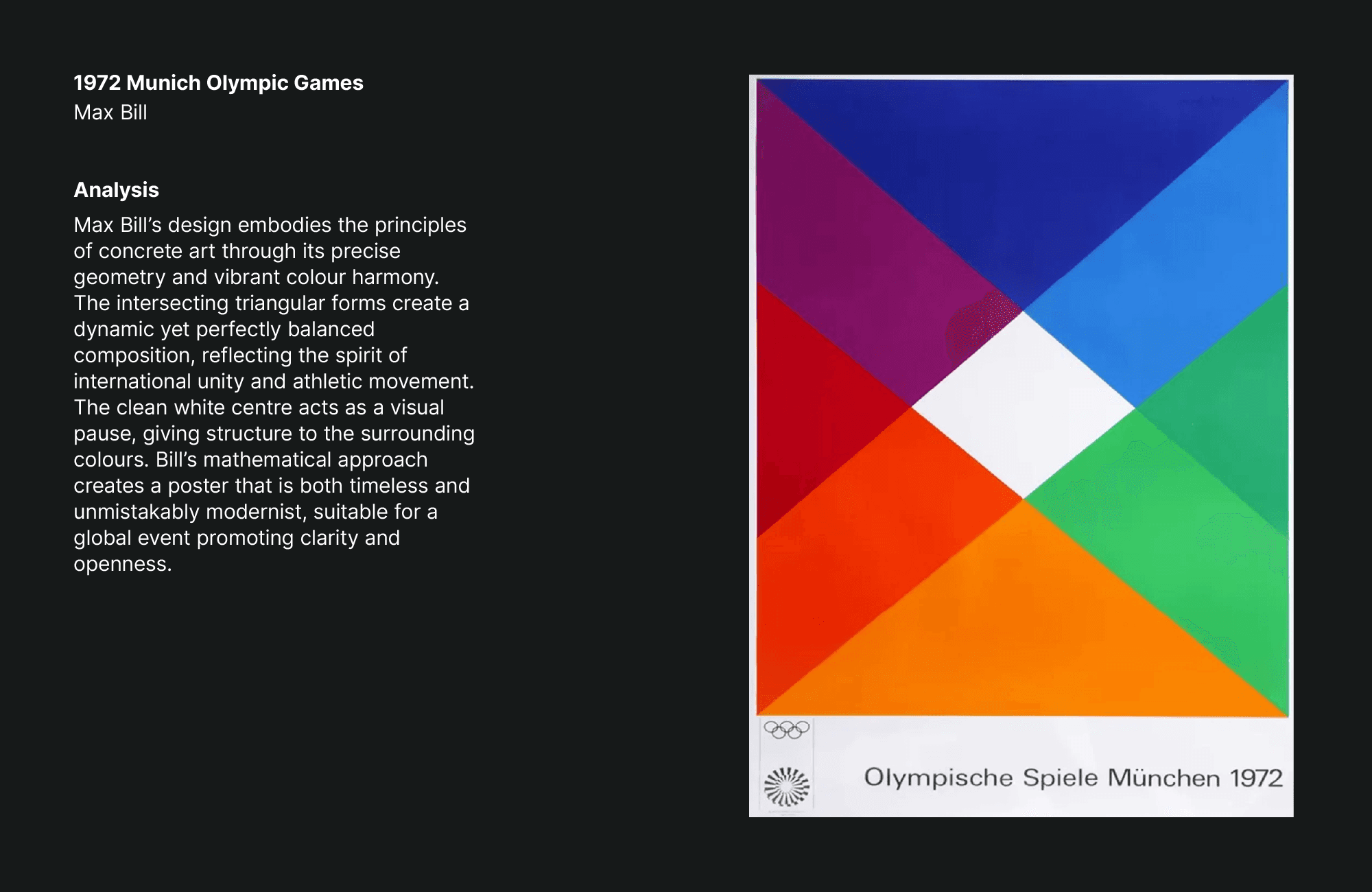
Influential designers such as Müller-Brockmann, Hofmann, Ruder, Max Bill, and later Wim Crouwel all helped shape the movement, each adding their own emphasis. Some pushed for pure geometric order, others focused on typography or on the creation of coherent corporate identity systems. What united them was the belief that design should be honest and functional, and that effective communication depends on clarity rather than ornament.
Over the decades, Swiss Style spread far beyond Switzerland. In the 1960s it helped shape corporate branding in the United States, influenced international signage systems, and eventually became a foundation for modern digital interface design. Its influence is still visible today, in minimalist magazine layouts, in tech branding, and in the clean, structured design of contemporary websites. Although it is sometimes seen as strict or formal, at its core Swiss Style is about respect for the viewer, communicating with clarity, structure, and a quiet confidence that good design does not need to raise its voice to be understood.
The thing I find truly fascinating is that despite the movements core fundamentals being formed around the removal of style and introduction of order and clarity, Swiss Style has become one of the most influential and widespread styles of all time. It has quite literally become it's own style, one that has stood the test of time all the way from its roots until the present day.
However, myself and many other believe there is a fine line. A common criticism is the wave of “Helveticisation”, especially in mid-century America, where countless brands adopted near-identical Helvetica wordmarks. What was meant to create clarity instead led to visual sameness, making many identities feel interchangeable.
Swiss Style is also sometimes viewed as too cold or impersonal. Its commitment to neutrality and objectivity can strip away cultural nuance or emotional warmth, which doesn’t suit every message or audience.
The movement’s strict reliance on grids can also feel rigid and limiting. While the grid is a powerful tool, an overemphasis on precision can discourage experimentation and make design feel formulaic rather than expressive (something I have admittedly struggled with in my own work due to a love for Swiss design).
Swiss Style
Examples
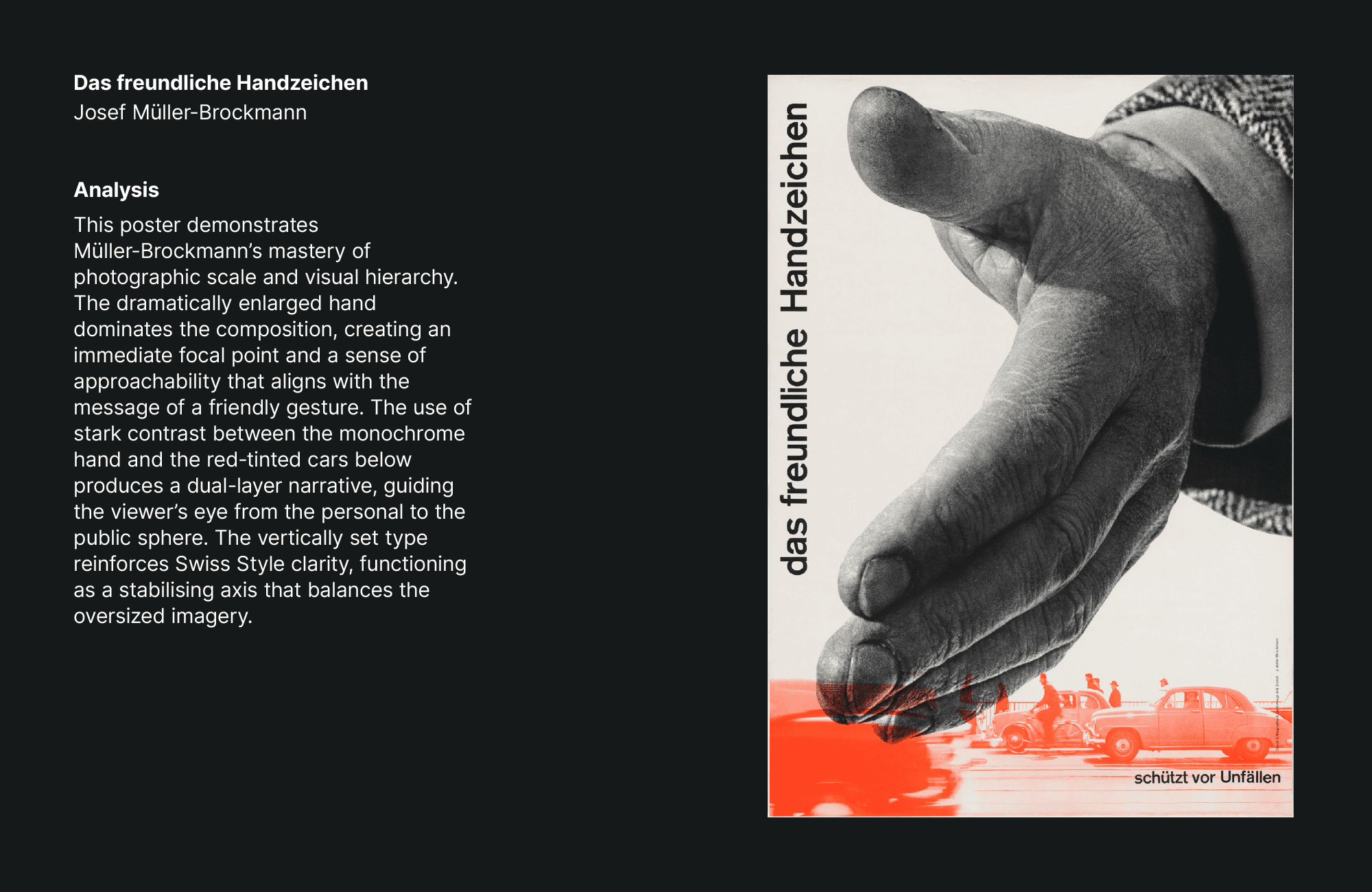
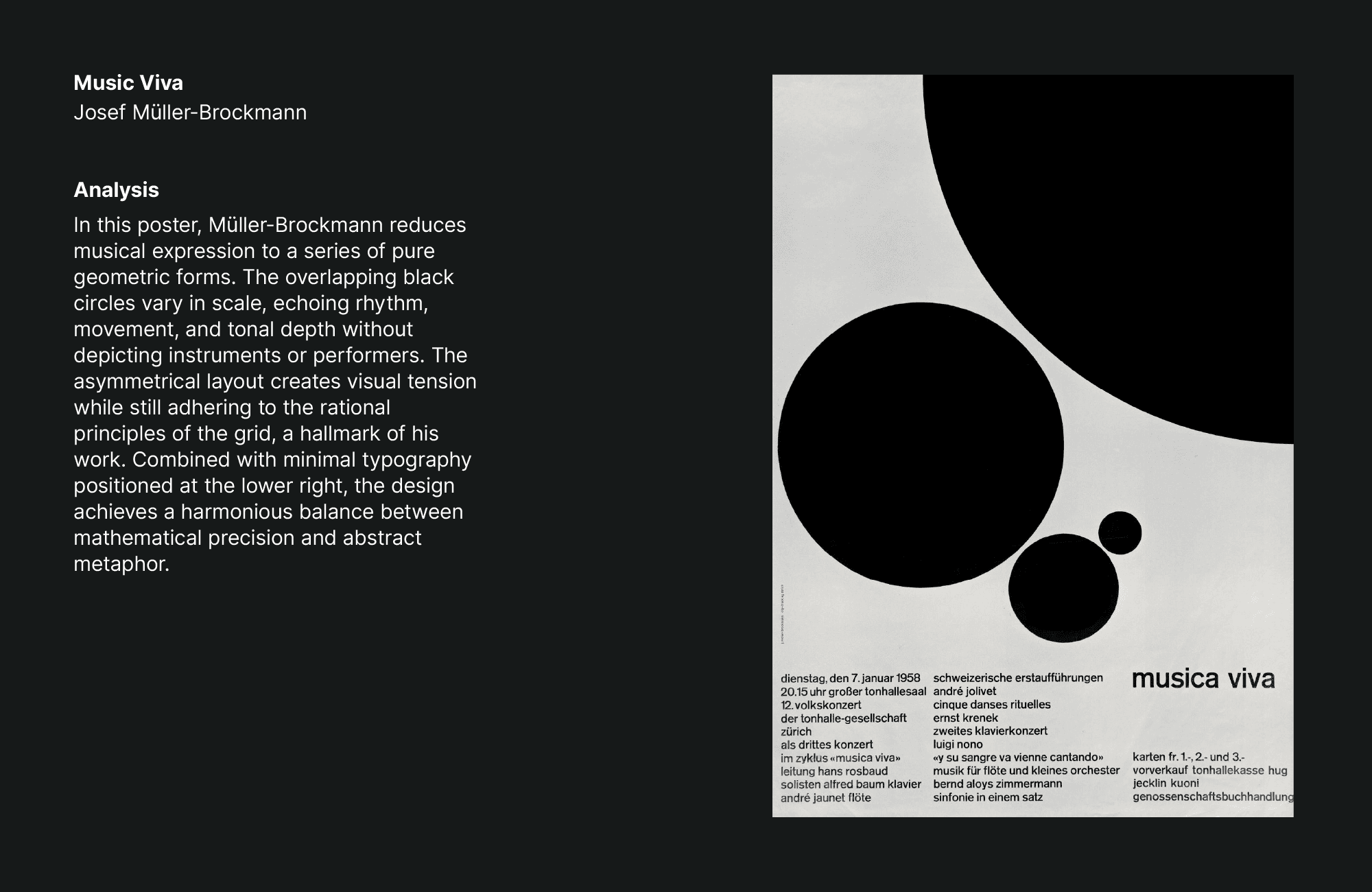
Swipe through my top ten Swiss style posters from designers such as Josef Müller-Brockmann, Max Bill, Richard Paul Lohse, Armin Hoffman, Karl Gerstner, and Emil Ruder.
Poster Design
Now it's time to move on to the design of my own posters. Having analysed Swiss Style posters and compared posters from a variety of eras, I should be well equipped to create my own two posters for a specific film directed by Wes Anderson. One in Swiss Style, and another that encapsulates Andersons own style (similarly to the magazine). Fantastic Mr. Fox is my film of choice.
Poster Design
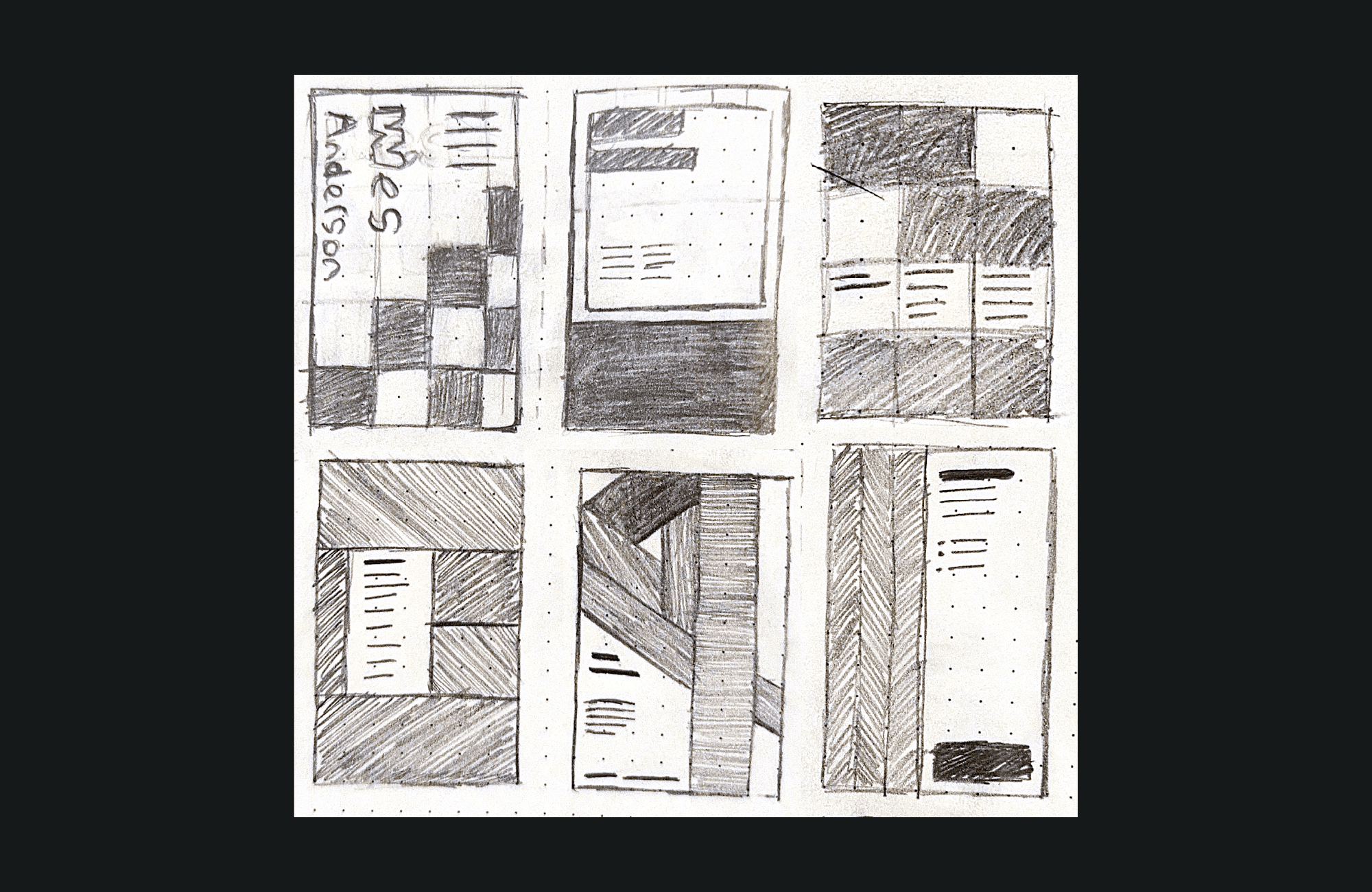
Sketches 1
Straight away, I began sketching various ideas on how I could create a visually balanced layout that could allow me to add some form of symmetry without breaking too many rules of Swiss design. A big factor of course is asymmetry and flush left, ragged right text. Two things that push me further away from Wes Andersons style.
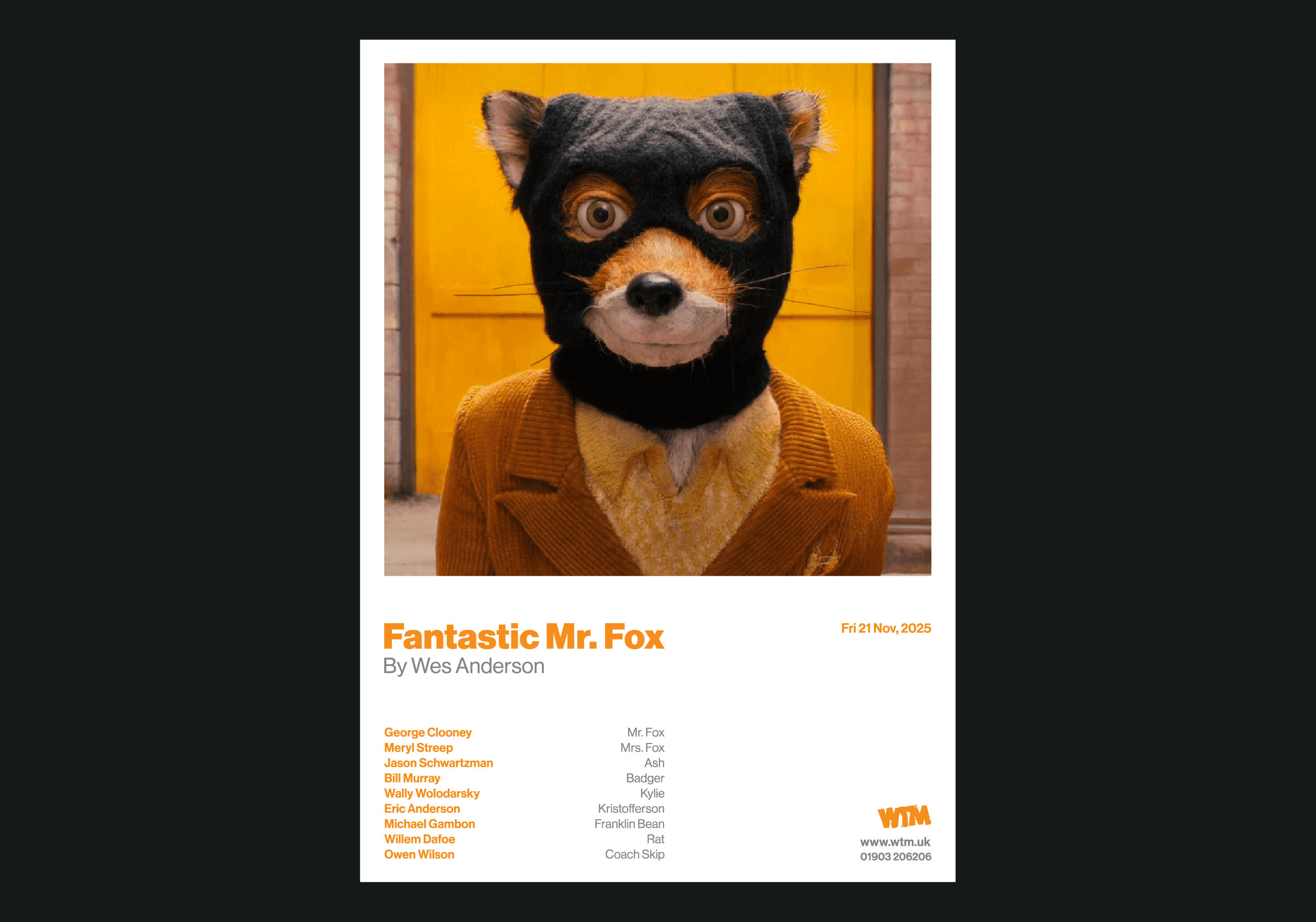
The question was, how could I make any of these layouts feel like Wes' work whilst using Swiss Style? I really liked the top right sketch, it divides the page into thirds and distributes them at a ratio of 2:1. Similar format to a polaroid. With polaroids in mind, when it came to designing I ended up using the top two thirds for imagery and the rest for my text.
Poster Design
Illustrator 1
Me being far too eager to design a Swiss poster made a fundamental error. I didn't fully read the brief. The poster has to be for one movie directed by Wes. I made a poster, realised this, and salvaged what I could to make something that fit the brief.
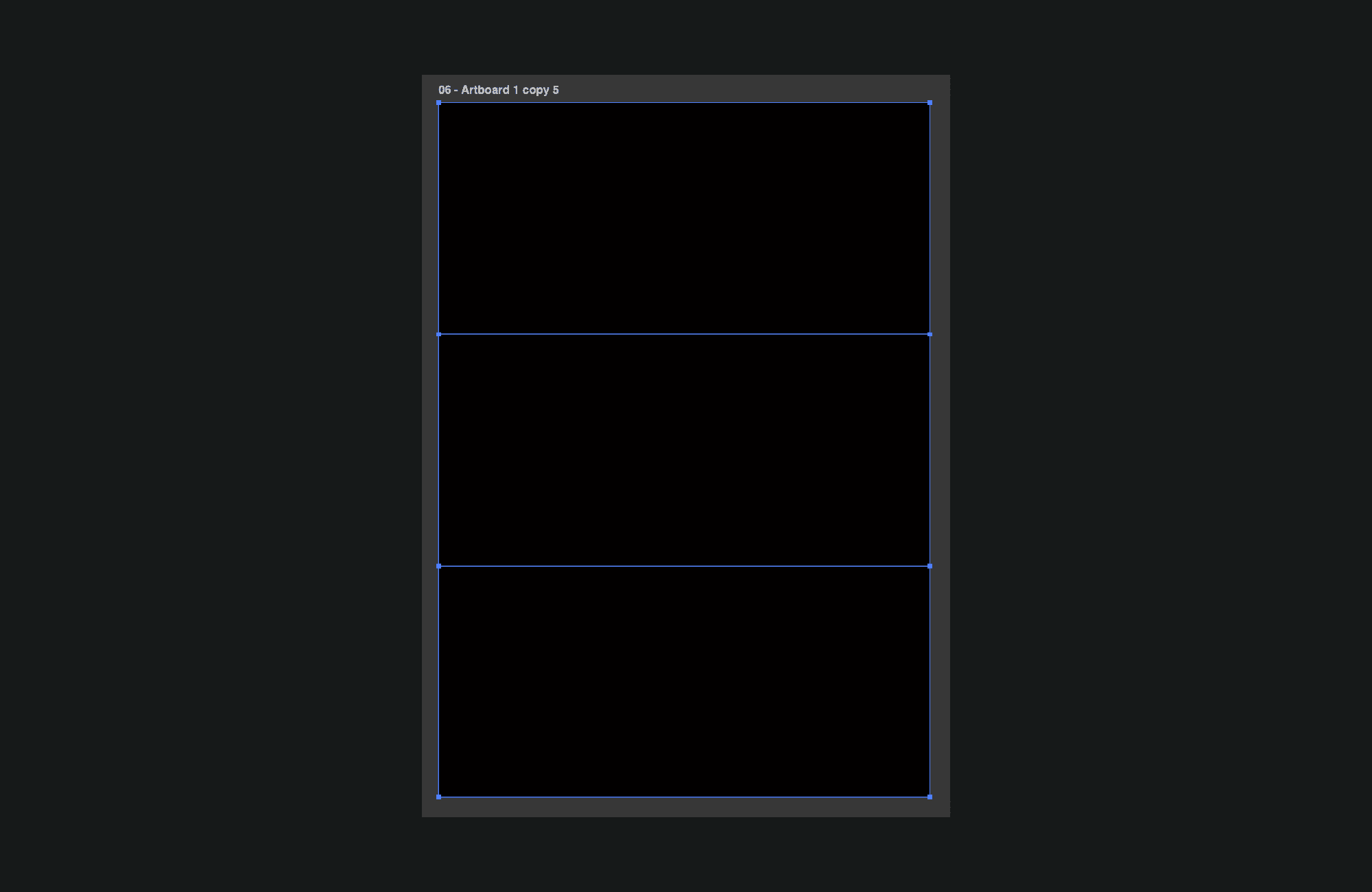
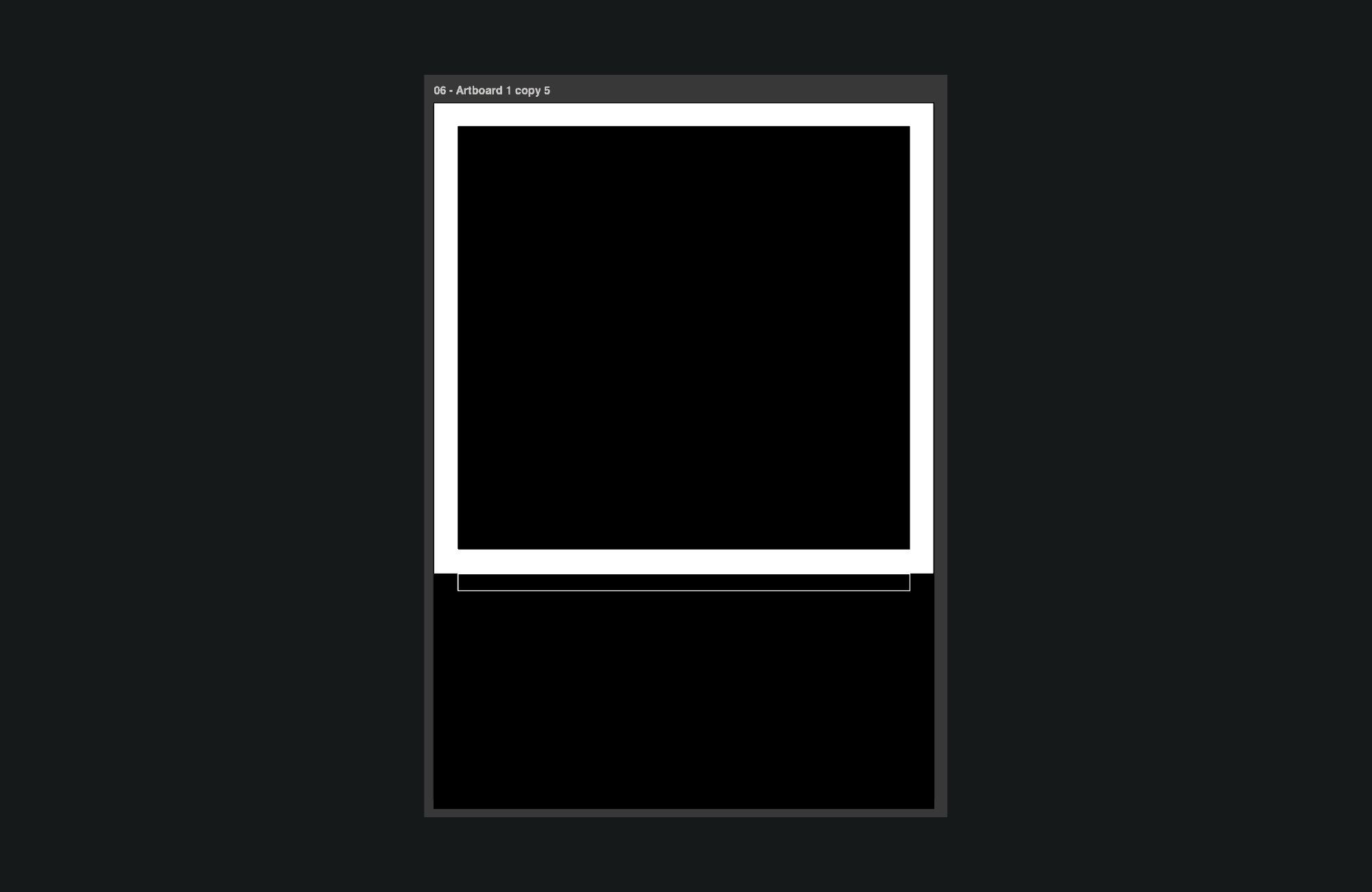
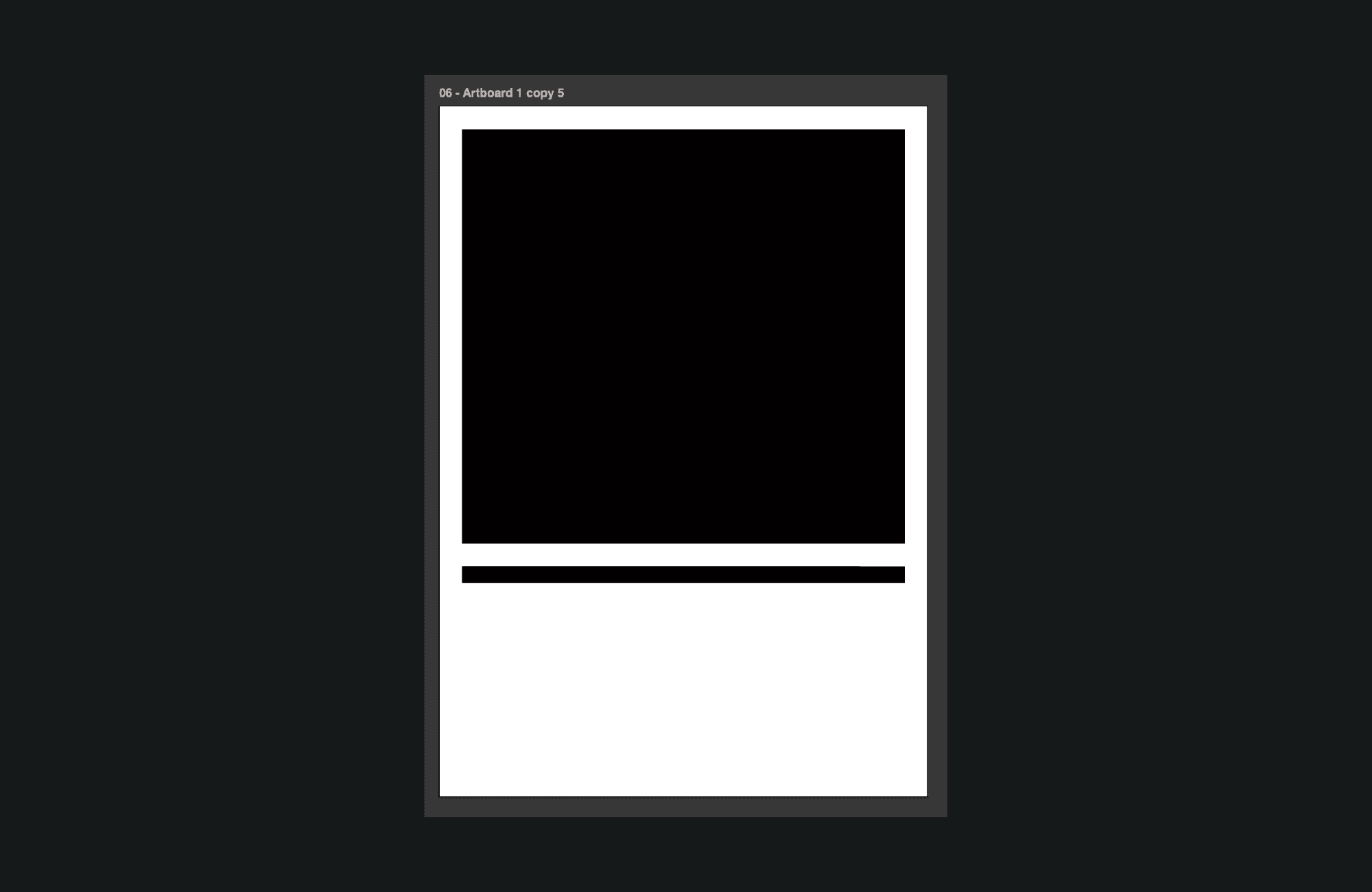
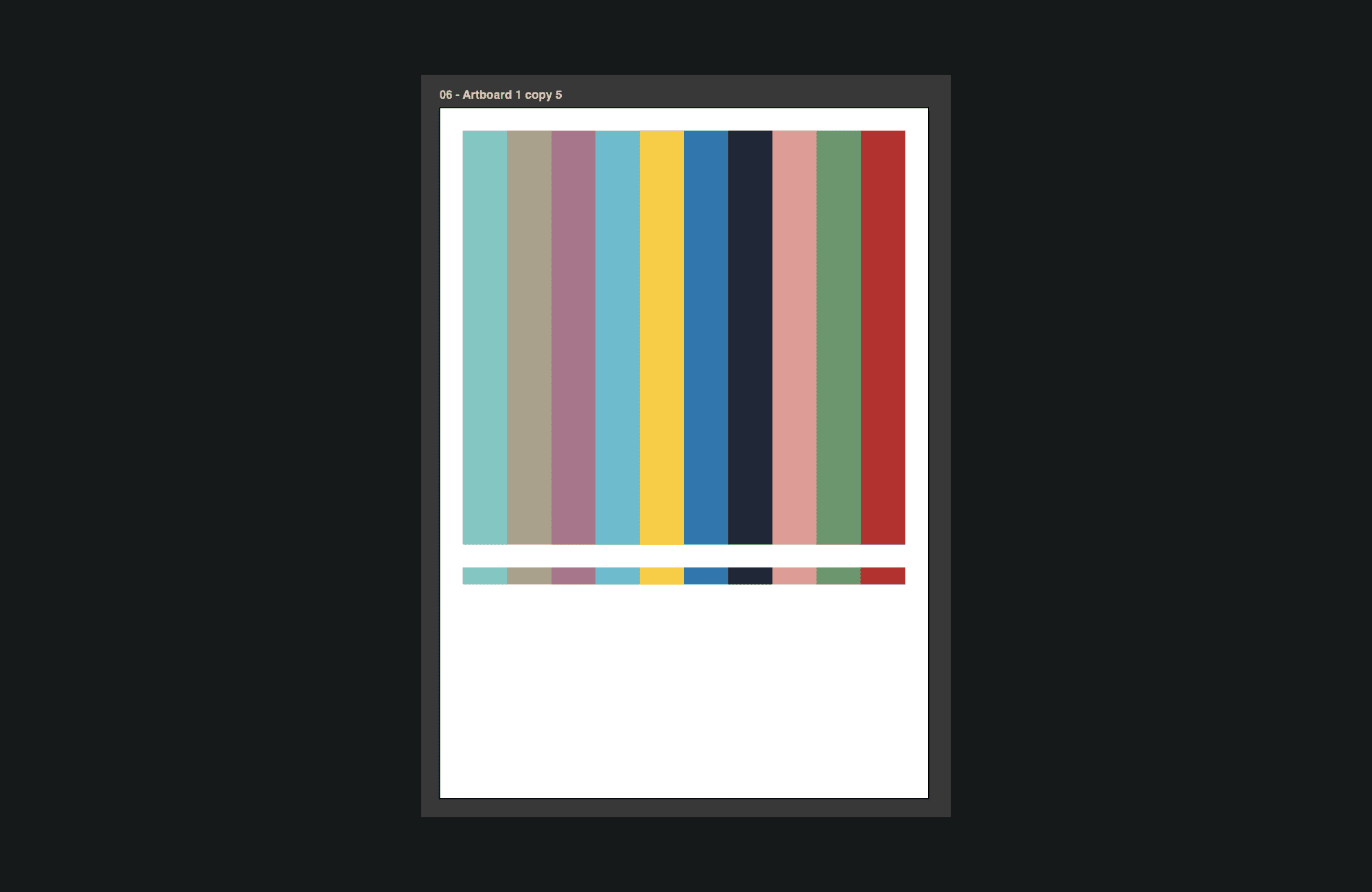
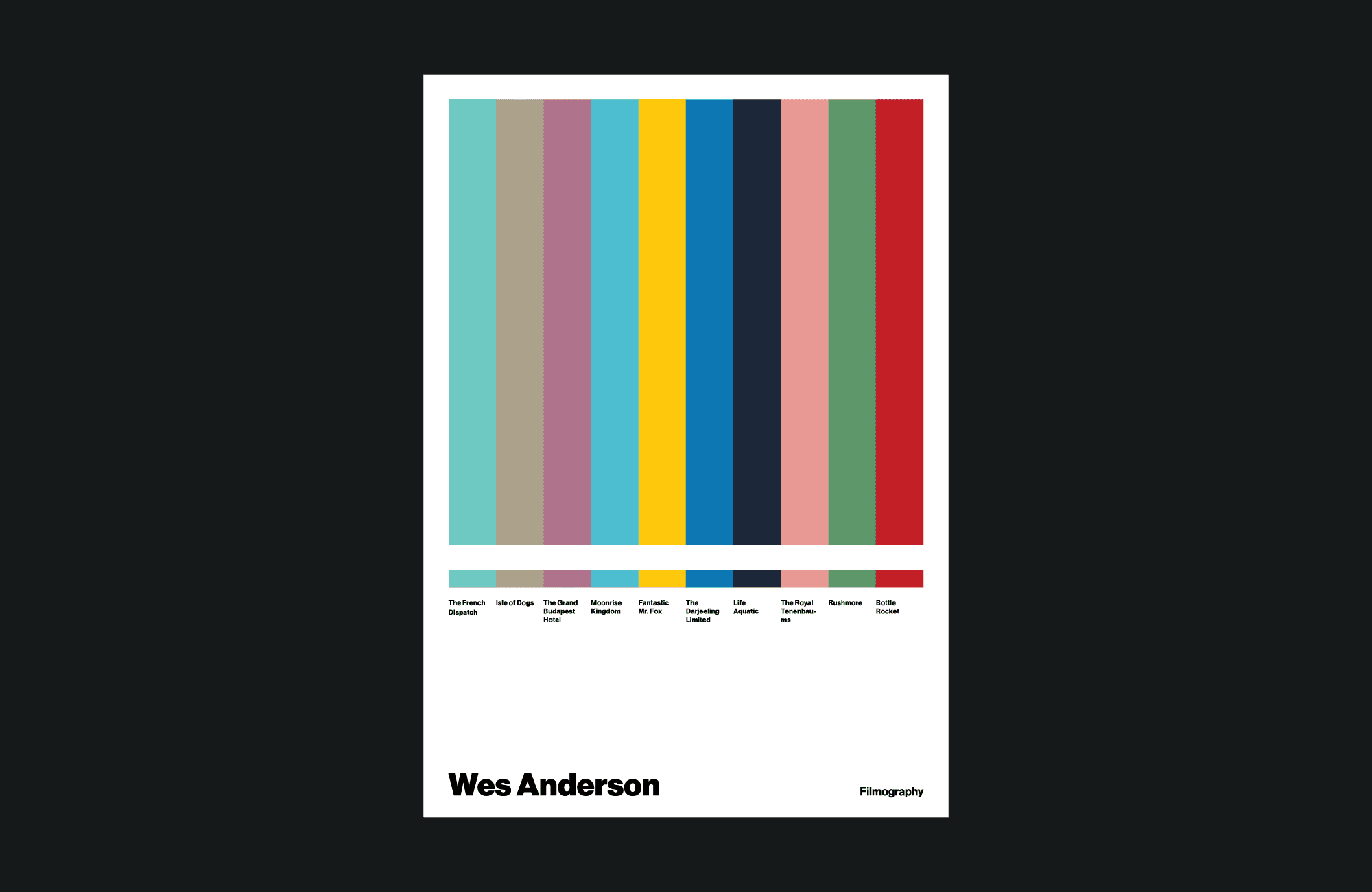
As mentioned before, I divided the page into thirds to begin. Then, I merged the top two and gave it an offset of -10mm. This created a nice frame for imagery in the top two thirds of the page. I divided this into 10 columns (a column per movie). I gave each column a prominent colour from one of Anderson's movies.
This created a very interesting visual focus that was a little strange, almost like an old-school TV that had lost signal. I then repeated these columns, made them 10mm tall and placed them 10mm below the original columns. This meant they aligned perfectly with the top line of the bottom third of the page.
Then, using Helvetica, I added my typography. I added the name of every movie, left aligned with their respective column. In the bottom left of the page, I added the title "Wes Anderson" and the subtitle "Filmography" in the bottom right. The type hierarchy was established by taking my body text size and multiplying it by the golden ratio (1.618) four times to give me various text sizes. The smallest for body, next size up for subtitle, skip the next, and then the largest size for the heading to make sure it's significantly bigger than the subtitle.
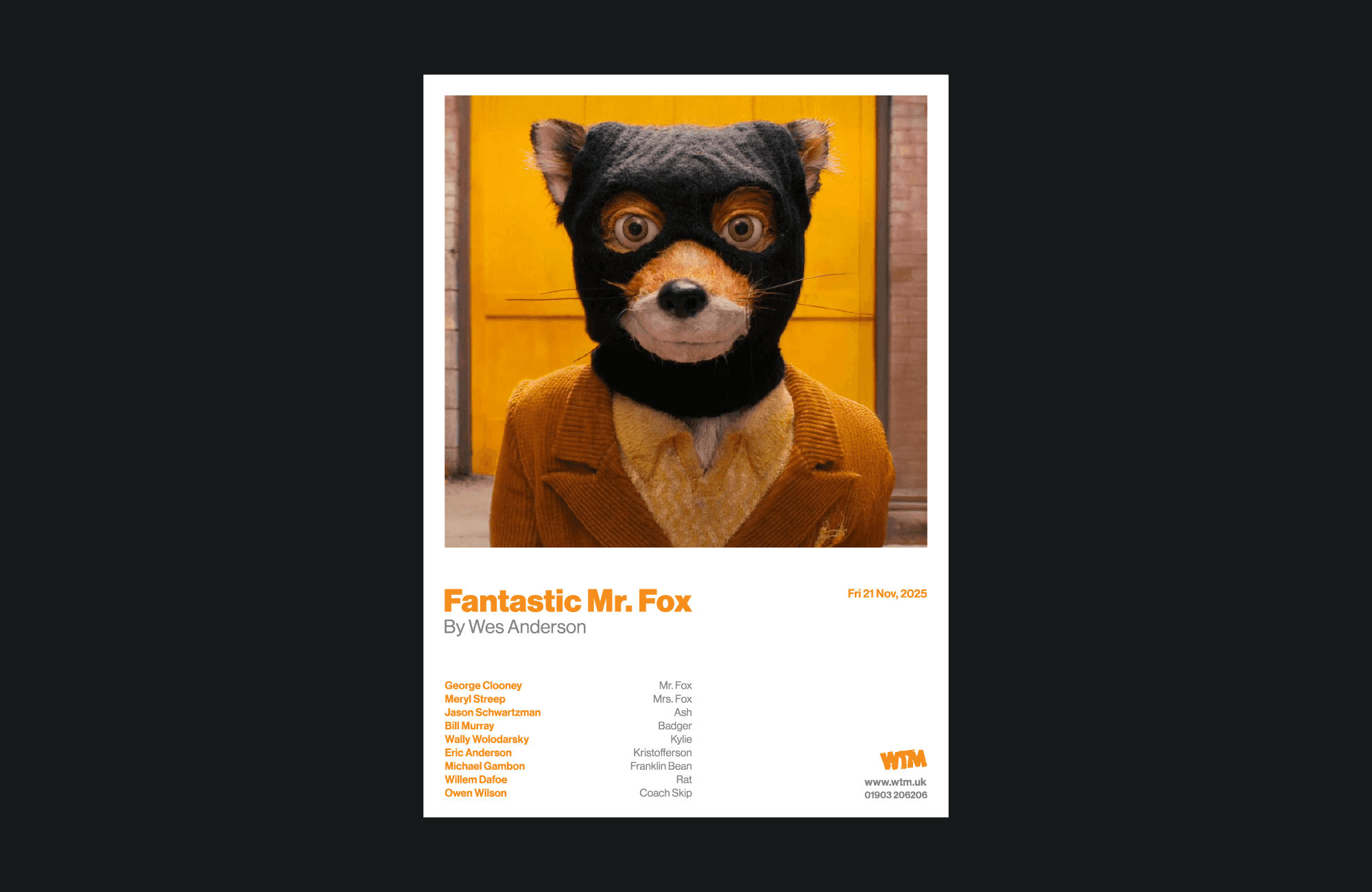
And then, as mentioned before, I realised my mistake. My first action was merging the original colour columns into one quadrilateral and placing an image of Fantastic Mr. Fox inside. This uses the same frontal portraiture used in Andersons movies.
I removed the 10mm tall columns entirely. Then, I added the movie title, "By Wes Anderson", cast and the characters they played, the Worthing Theatre and Museums logo + contact details, and date. I used the same type hierarchy as this was already effective, but I utilised Helvetica Medium, Bold, and Regular this time.
For colours, I used a limited palette of just white, orange, and grey. The orange is sampled from Mr Fox's clothing and the grey was a substitute for the black of his mask as this would have been too much contrast next to the orange.
The result is a poster that draws you in through the immediate eye contact with Mr Fox and politely communicates the information of the movie without being too abrupt.
Poster Design
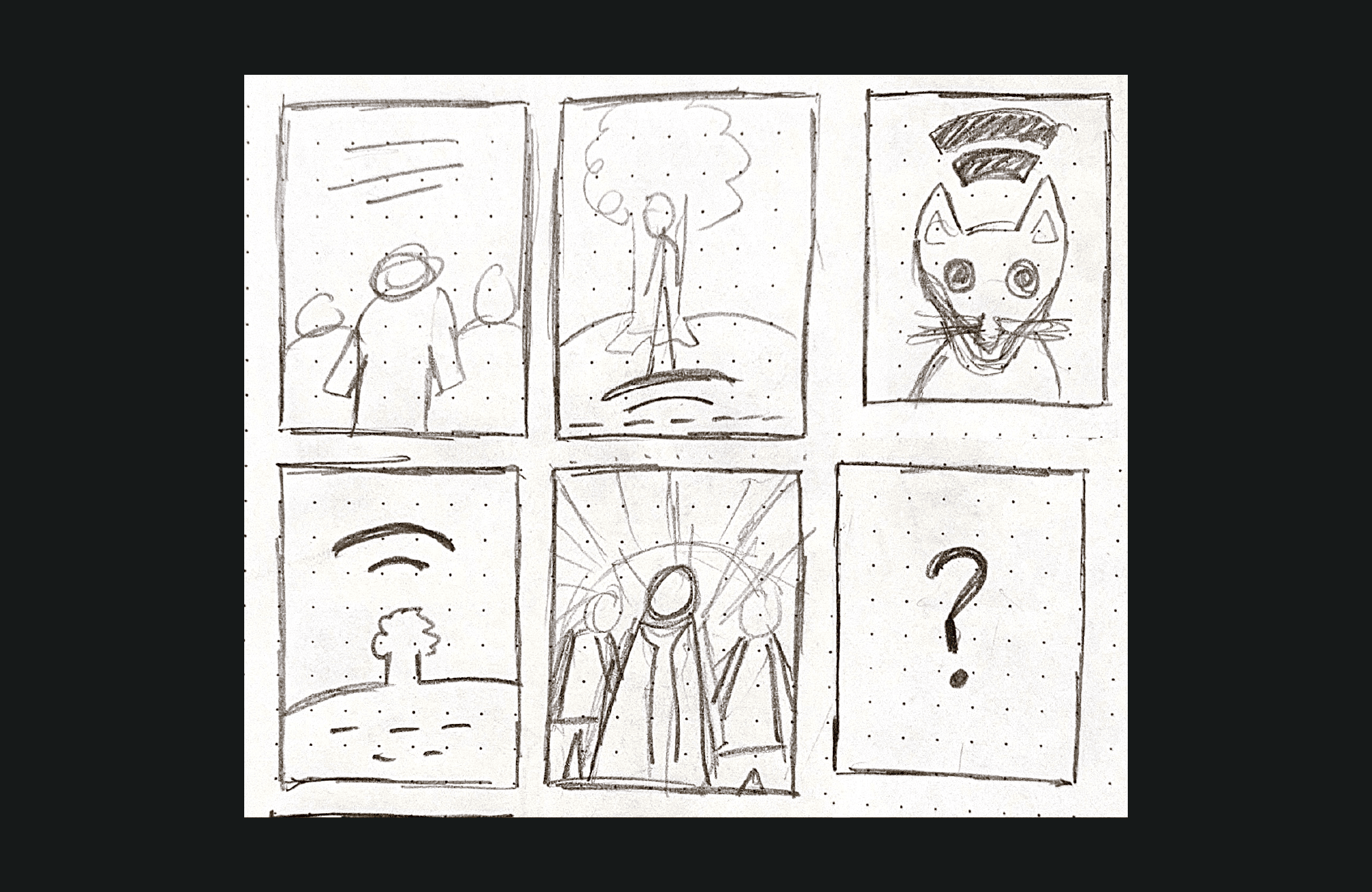
Sketches 2
For my second poster I wanted to create a poster that gives a glimpse into the story of the film using a key scene, but the issue was that lots of these has already been done. I wanted to try something different. I began sketching and didn't come up with many revolutionary ideas, however when searching for the right image I came across something perfect.
Poster Design
Illustrator 2
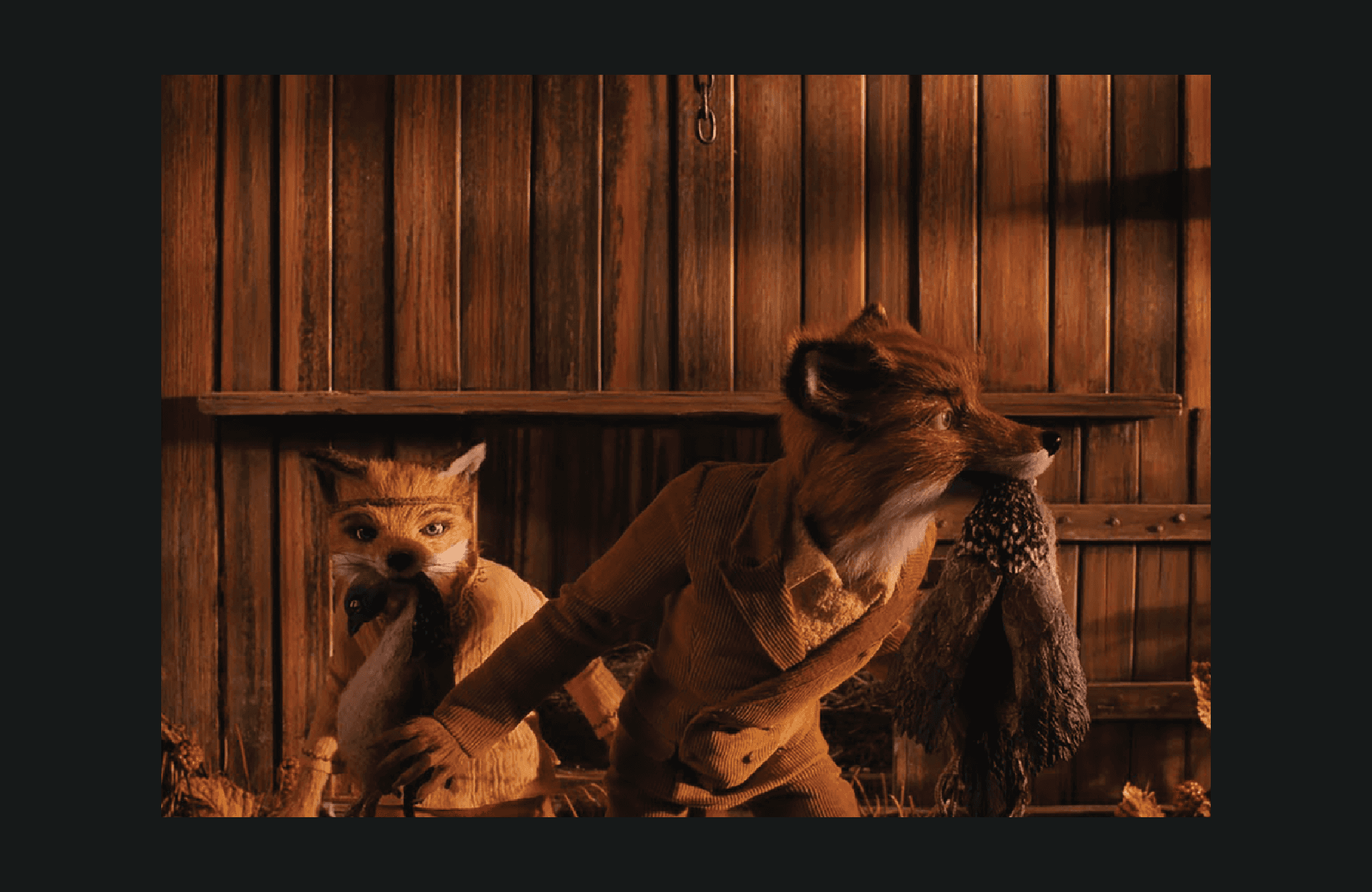
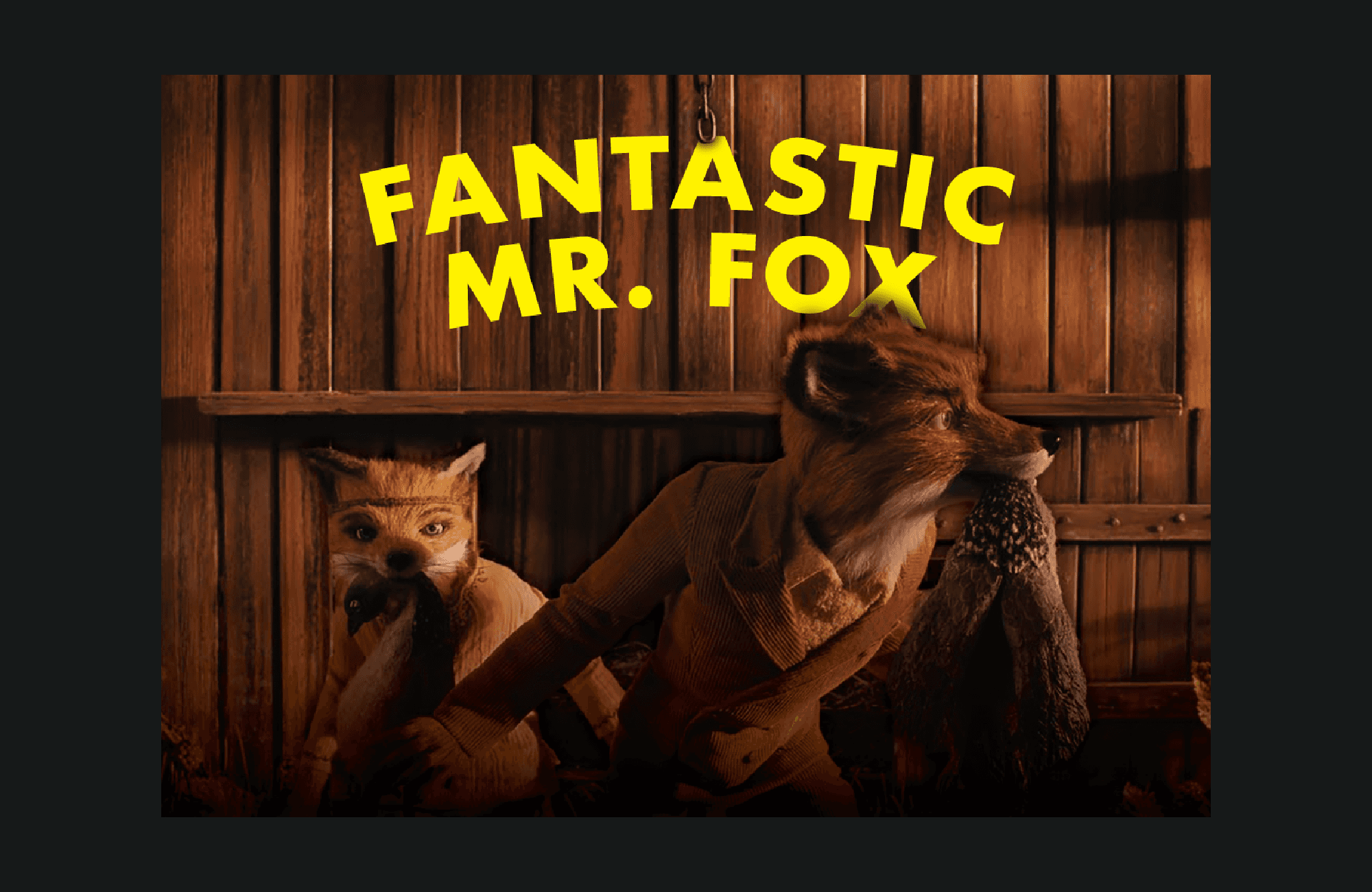
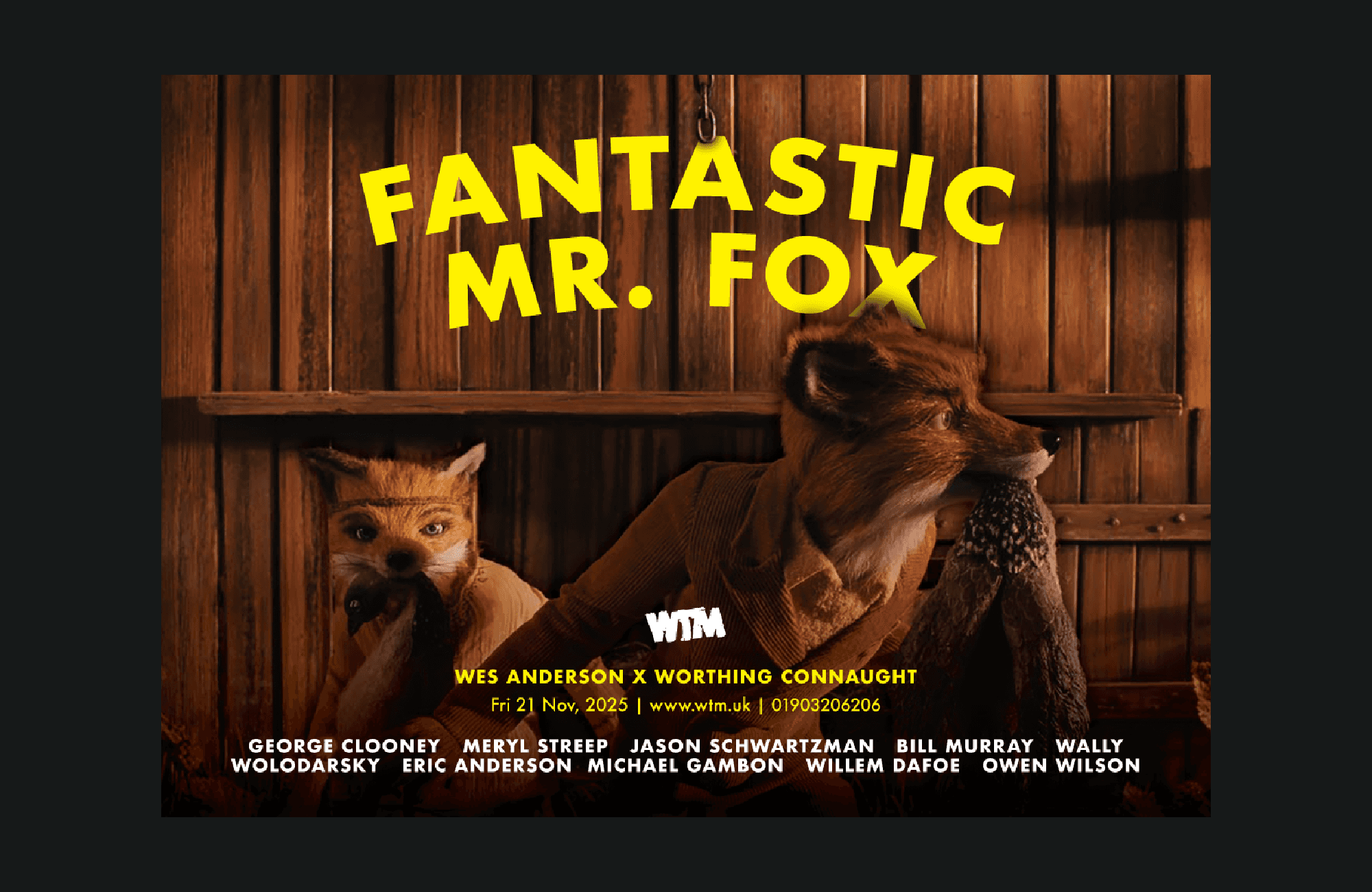
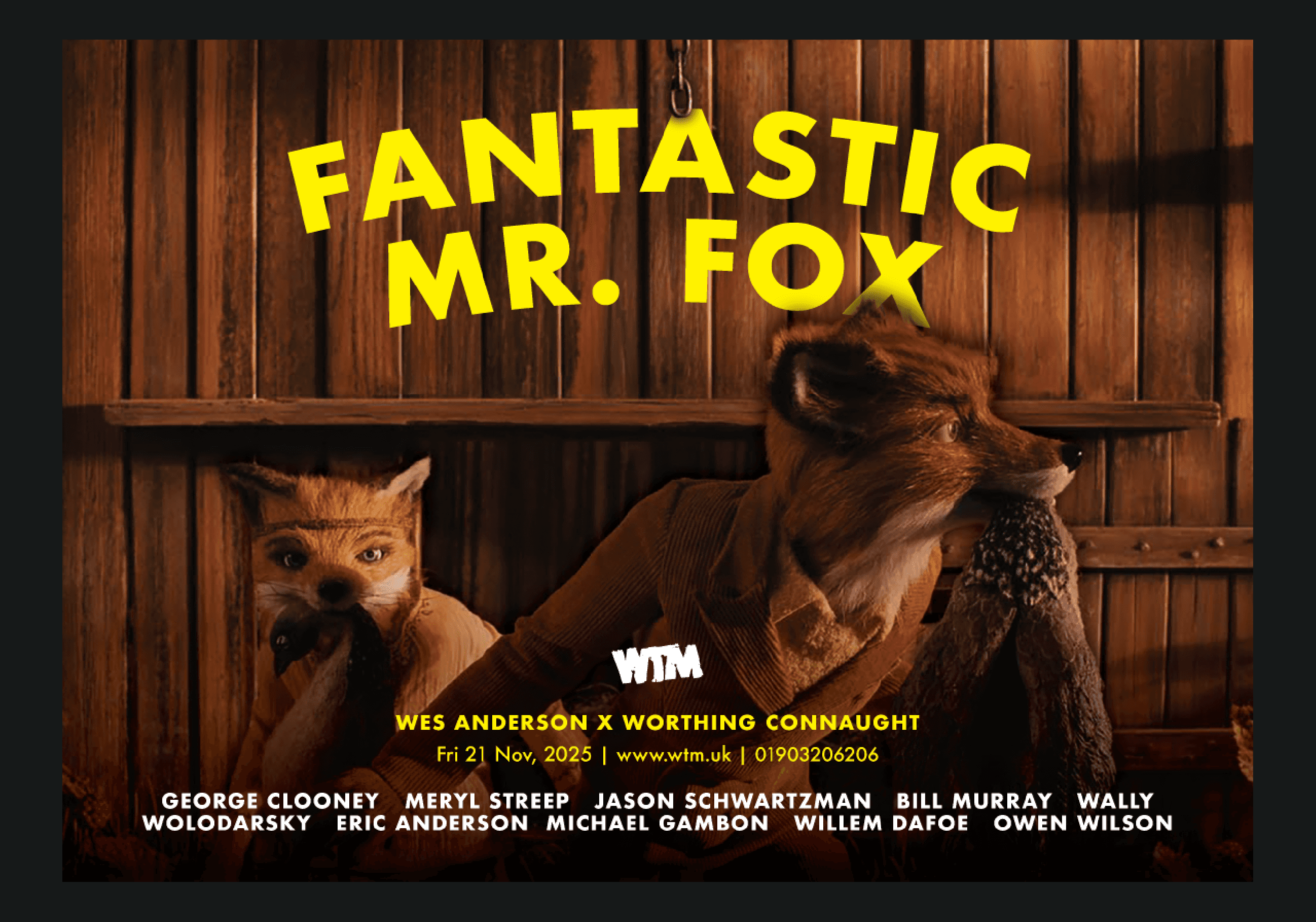
This scene of the foxes stealing the turkeys from the farmers felt like a great image to base my poster on. I also thought I'd give myself the challenge of creating a landscape poster. I tend to stay away from landscape posters as it's hard to make them look good and they often disappoint. This image however felt right for the occasion.
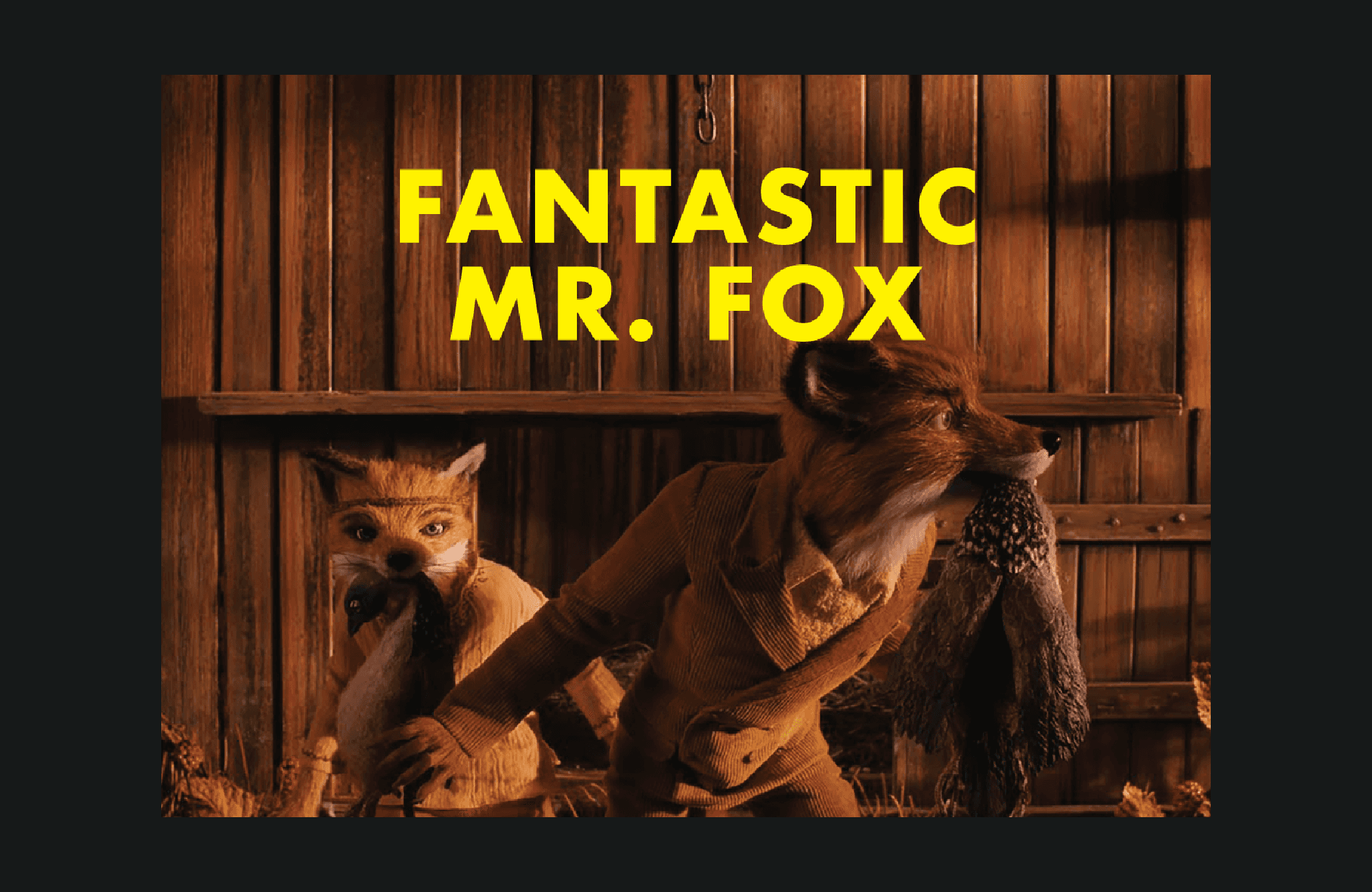
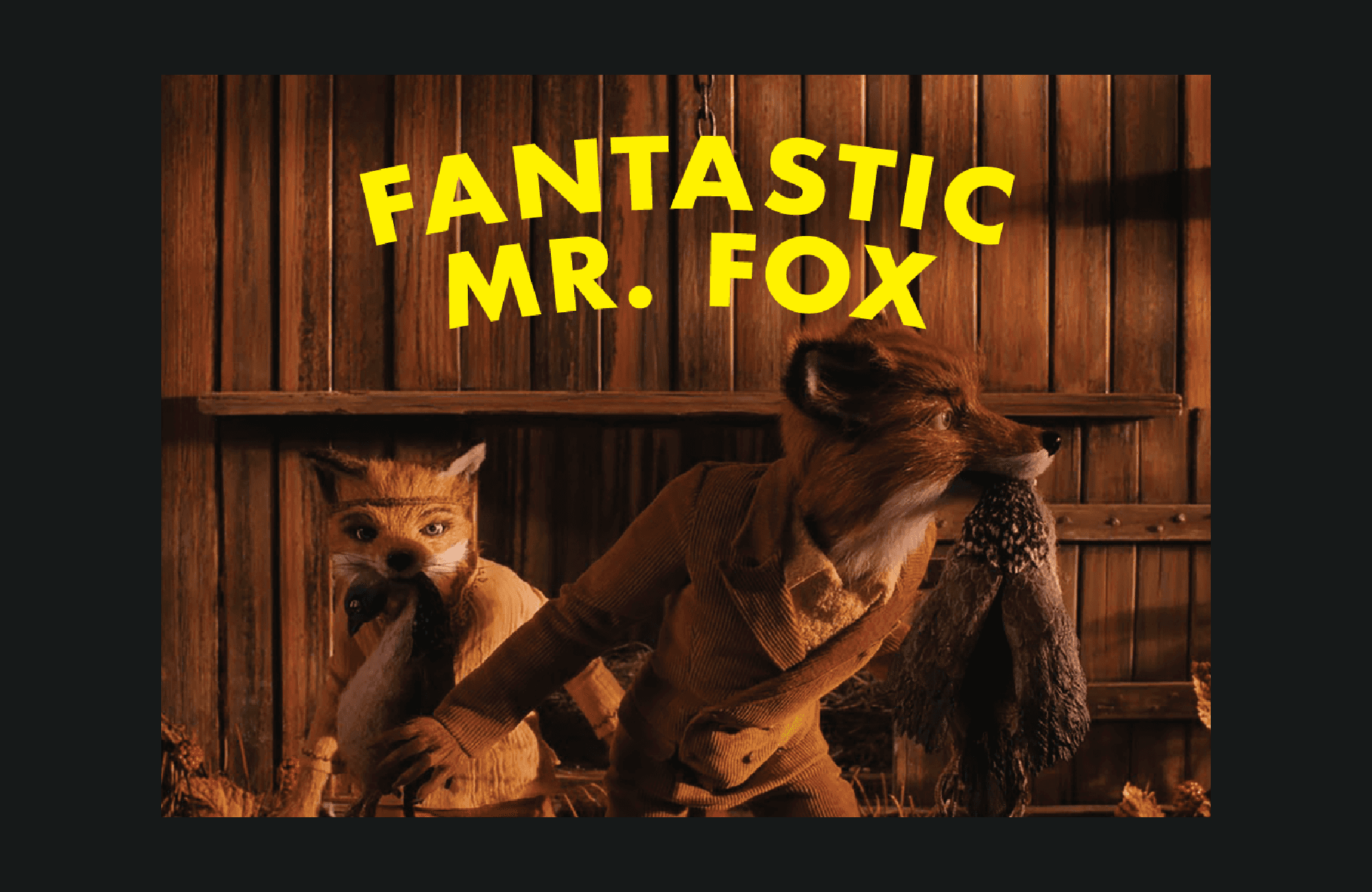
I began by framing the image on an A3 page so that the characters sat in in the lower middle of the frame. This left room for the heading in the top middle portion of the page. Using Futura bold in a saturated yellow, I added the movie title and applied an arc warp (commonly seen on Fantastic Mr. Fox promotional material).
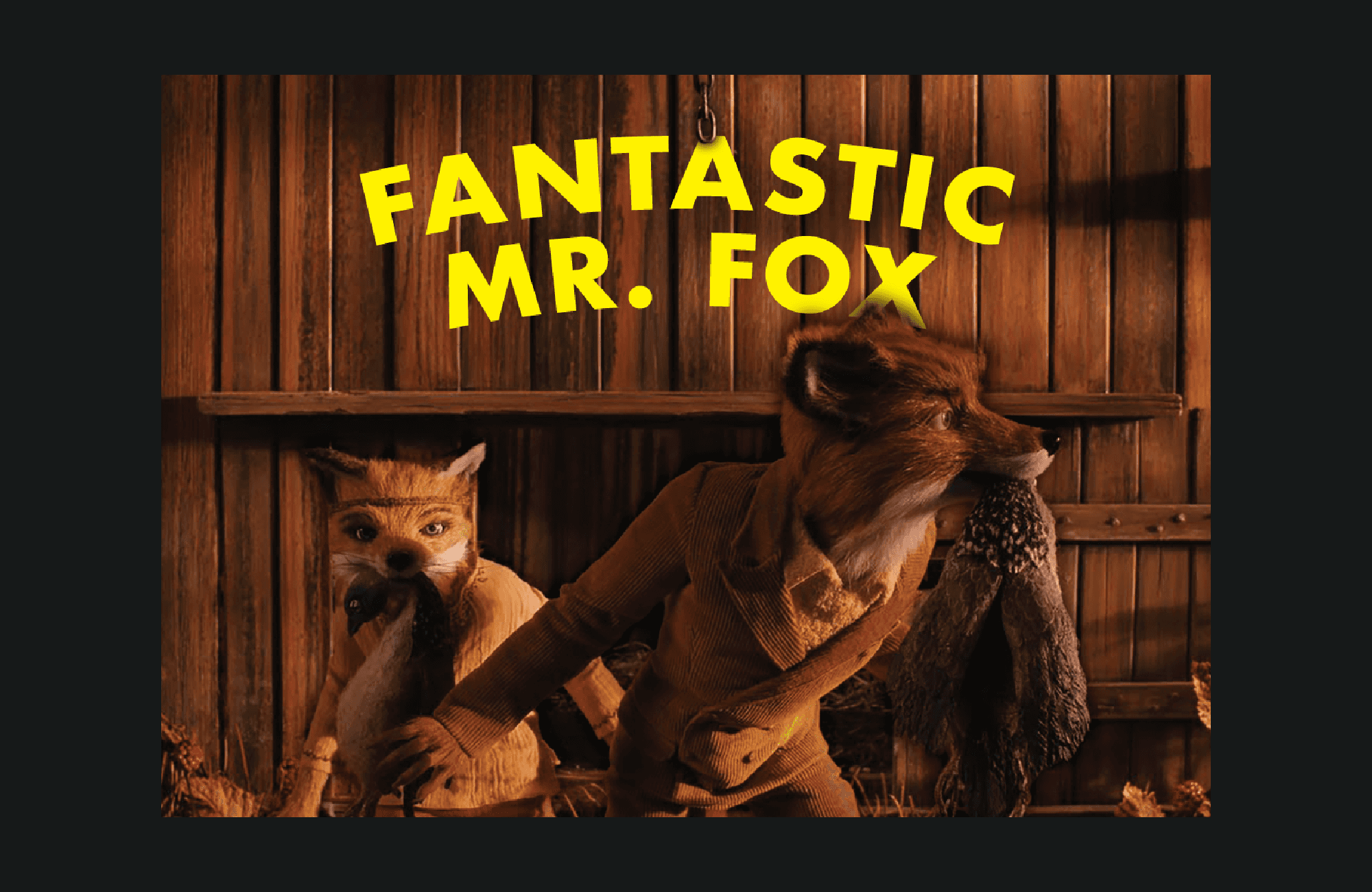
Then, using photoshop, I separated the image into three layers. Subject, background, and the small chain at the top of the image. This meant I could sandwich the type in between the layers to give the poster depth. I applied slight drop shadows to the elements in the foreground to make the text appear as though it's deep in the image.
I then added a simple black (100% opacity) to white (0% opacity) gradient to create a space for the supporting information that would provide enough contrast to avoid being lost in the background.
From there, I added my supporting info using Futura bold and medium. The WTM logo leads the information, followed by "Wes Adnerson x Worthing Connaught". The date and contact details were set in Futura medium to make sure they stood out from the bold block-cap lettering as this is vital information. Finally, the cast has been placed at the bottom and filled in white to ensure the yellow is used sparingly. This gives the yellow elements a higher level of importance.
Poster Design
Outcomes
Below you can see both poster outcomes. One in Swiss style, and the other in the style of Wes Andersons movies.
Project Overview
That's a wrap! Shaky start, but I think we got there in the end.
Wrapping Up
Evaluation
The unit as a whole was okay. Unfortunately, I got off to a shaky start as I struggled to get back into the swing of the academic workflow after returning from summer break. The brief itself was engaging, but due to creative block I struggled to make a start until later in the unit. Despite these setbacks, I was able to get back on track and complete my work and produce all deliverables as outlined in the brief.
Once I managed to find my rhythm, I began making steady progress on the project and enjoyed creating the magazine as well as the posters. I chose Wes Anderson to force myself to create varied colour palettes and unconventional layouts as typically, my work isn’t very experimental. Throughout my magazine, I made a strong effort to venture out of my comfort zone and I’m quite happy with the outcome. The magazine has strong cohesion across each page without feeling repetitive and actively communicates Wes Andersons signature style.
Whilst I have been experimental, I think that I could have found more suitable colour palettes for the biography and filmography spreads. They communicate the fact that Anderson has a unique style, but they don’t quite capture the nostalgic, relatable feeling that you feel when watching one of his movies.
In terms of the poster designs, I’m pleased with the outcomes. The Swiss Style poster uses an effective colour palette, and the imagery communicates the mischievous, comedic, but also serious themes featured in his productions and the second poster is an effective poster, despite landscape posters often being unflattering. However, the typography within the second poster is a little too safe and could be experimented with further.
Overall, the project was successful in the end but had I been committed from the beginning, I could have experimented further and potentially better captured the essence of Wes Andersons creative style.
The end!
Apologies for all that reading, I hope it didn't take up too much of your week. That's the entirety of the project from start to finish, I hope you enjoyed it.